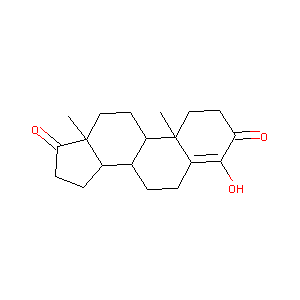
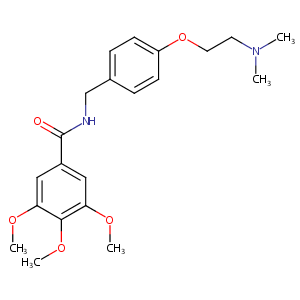
General Information of Drug Combination (ID: DCM0S7G)

Drug Combination Name
FORMESTANE Trimethobenzamide
Indication
Disease Entry Status REF
Chronic myelogenous leukemia Investigative [1]
Component Drugs FORMESTANE   DMWIDJK Trimethobenzamide   DMPP4DT
Small molecular drug Small molecular drug
2D MOL 2D MOL
3D MOL 3D MOL
High-throughput Screening Result Testing Cell Line: KBM-7
Zero Interaction Potency (ZIP) Score: 11.32
Bliss Independence Score: 11.32
Loewe Additivity Score: 23.76
LHighest Single Agent (HSA) Score: 23.76

Molecular Interaction Atlas of This Drug Combination

Molecular Interaction Atlas (MIA)
Indication(s) of FORMESTANE
Disease Entry ICD 11 Status REF
Breast cancer 2C60-2C65 Withdrawn from market [2]
FORMESTANE Interacts with 1 DTT Molecule(s)
DTT Name DTT ID UniProt ID Mode of Action REF
Aromatase (CYP19A1) TTSZLWK CP19A_HUMAN Inhibitor [4]
------------------------------------------------------------------------------------
FORMESTANE Interacts with 2 DOT Molecule(s)
DOT Name DOT ID UniProt ID Mode of Action REF
Adenylate kinase isoenzyme 1 (AK1) OT614AR3 KAD1_HUMAN Increases ADR [5]
17-beta-hydroxysteroid dehydrogenase type 1 (HSD17B1) OT6EBDHM DHB1_HUMAN Decreases Activity [6]
------------------------------------------------------------------------------------
Indication(s) of Trimethobenzamide
Disease Entry ICD 11 Status REF
Nausea MD90 Approved [3]
Nausea and vomiting MD90 Approved [2]
Vomiting MD90 Approved [3]

References

1 CheMBL Affinity Phenotypic Cellular Interaction Assay ID: CHEMBL1125966
2 Drugs@FDA. U.S. Food and Drug Administration. U.S. Department of Health & Human Services. 2015
3 Trimethobenzamide FDA Label
4 The taiwaniaquinoids: a review. J Nat Prod. 2010 Feb 26;73(2):284-98.
5 ADReCS-Target: target profiles for aiding drug safety research and application. Nucleic Acids Res. 2018 Jan 4;46(D1):D911-D917. doi: 10.1093/nar/gkx899.
6 Mammalian lignans and genistein decrease the activities of aromatase and 17beta-hydroxysteroid dehydrogenase in MCF-7 cells. J Steroid Biochem Mol Biol. 2005 Apr;94(5):461-7.