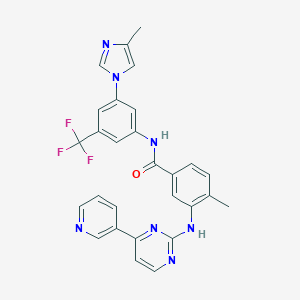
General Information of Drug Combination (ID: DCM2FO4)

Drug Combination Name
Lenalidomide Nilotinib
Indication
Disease Entry Status REF
Carcinoma Investigative [1]
Component Drugs Lenalidomide   DM6Q7U4 Nilotinib   DM7HXWT
Small molecular drug Small molecular drug
2D MOL 2D MOL
3D MOL 3D MOL
High-throughput Screening Result Testing Cell Line: RXF 393
Zero Interaction Potency (ZIP) Score: 0.43
Bliss Independence Score: 3.42
Loewe Additivity Score: 1.07
LHighest Single Agent (HSA) Score: 0.56

Molecular Interaction Atlas of This Drug Combination

Molecular Interaction Atlas (MIA)
Indication(s) of Lenalidomide
Disease Entry ICD 11 Status REF
Adult T-cell leukemia/lymphoma N.A. Approved [2]
Advanced cancer 2A00-2F9Z Approved [2]
Complex regional pain syndrome type 1 N.A. Approved [2]
Hepatosplenic T-cell lymphoma N.A. Approved [2]
Large granular lymphocytic leukemia 2A90.1 Approved [2]
Leukemia N.A. Approved [2]
MALT lymphoma N.A. Approved [2]
Multiple myeloma 2A83 Approved [3]
Nodal marginal zone lymphoma 2A85.0 Approved [2]
Pain MG30-MG3Z Approved [2]
Plasma cell myeloma 2A83.1 Approved [2]
Primary cutaneous peripheral T-cell lymphoma not otherwise specified N.A. Approved [2]
Prolymphocytic leukaemia 2A82.1 Approved [2]
Recurrent adult burkitt lymphoma 2A85.6 Approved [2]
Small intestine lymphoma N.A. Approved [2]
Splenic marginal zone lymphoma N.A. Approved [2]
Testicular lymphoma N.A. Approved [2]
Urinary bladder neoplasm N.A. Approved [2]
Waldenstrom macroglobulinemia 2A85.4 Approved [2]
Coronavirus Disease 2019 (COVID-19) 1D6Y Phase 3 [4]
Colon cancer 2B90.Z Investigative [2]
Lenalidomide Interacts with 1 DTT Molecule(s)
DTT Name DTT ID UniProt ID Mode of Action REF
Tumor necrosis factor (TNF) TTF8CQI TNFA_HUMAN Inhibitor [6]
------------------------------------------------------------------------------------
Lenalidomide Interacts with 1 DTP Molecule(s)
DTP Name DTP ID UniProt ID Mode of Action REF
P-glycoprotein 1 (ABCB1) DTUGYRD MDR1_HUMAN Substrate [7]
------------------------------------------------------------------------------------
Lenalidomide Interacts with 5 DOT Molecule(s)
DOT Name DOT ID UniProt ID Mode of Action REF
Tumor necrosis factor receptor superfamily member 1A (TNFRSF1A) OT2D9DOV TNR1A_HUMAN Decreases Expression [8]
Tumor necrosis factor receptor superfamily member 1B (TNFRSF1B) OTDS2EAR TNR1B_HUMAN Decreases Expression [8]
Interleukin-6 receptor subunit beta (IL6ST) OT1N9C70 IL6RB_HUMAN Decreases Expression [8]
DNA damage-binding protein 1 (DDB1) OTTR2L3Z DDB1_HUMAN Affects Binding [9]
Sal-like protein 4 (SALL4) OTC08PR5 SALL4_HUMAN Affects Binding [10]
------------------------------------------------------------------------------------
Indication(s) of Nilotinib
Disease Entry ICD 11 Status REF
Chronic myelogenous leukaemia 2A20.0 Approved [5]
Nilotinib Interacts with 1 DTT Molecule(s)
DTT Name DTT ID UniProt ID Mode of Action REF
Fusion protein Bcr-Abl (Bcr-Abl) TTS7G69 BCR_HUMAN-ABL1_HUMAN Modulator [14]
------------------------------------------------------------------------------------
Nilotinib Interacts with 5 DTP Molecule(s)
DTP Name DTP ID UniProt ID Mode of Action REF
Multidrug resistance-associated protein 2 (ABCC2) DTFI42L MRP2_HUMAN Substrate [15]
P-glycoprotein 1 (ABCB1) DTUGYRD MDR1_HUMAN Substrate [16]
Breast cancer resistance protein (ABCG2) DTI7UX6 ABCG2_HUMAN Substrate [15]
Organic anion transporting polypeptide 1B1 (SLCO1B1) DT3D8F0 SO1B1_HUMAN Substrate [17]
Organic anion transporting polypeptide 1B3 (SLCO1B3) DT9C1TS SO1B3_HUMAN Substrate [17]
------------------------------------------------------------------------------------
Nilotinib Interacts with 2 DME Molecule(s)
DME Name DME ID UniProt ID Mode of Action REF
Cytochrome P450 3A4 (CYP3A4) DE4LYSA CP3A4_HUMAN Metabolism [18]
Cytochrome P450 2C8 (CYP2C8) DES5XRU CP2C8_HUMAN Metabolism [19]
------------------------------------------------------------------------------------
Nilotinib Interacts with 21 DOT Molecule(s)
DOT Name DOT ID UniProt ID Mode of Action REF
Broad substrate specificity ATP-binding cassette transporter ABCG2 (ABCG2) OTW8V2V1 ABCG2_HUMAN Affects Response To Substance [20]
ATP-dependent translocase ABCB1 (ABCB1) OTEJROBO MDR1_HUMAN Affects Response To Substance [21]
Acetyl-CoA carboxylase 1 (ACACA) OT5CQPZY ACACA_HUMAN Increases Phosphorylation [22]
Protein c-Fos (FOS) OTJBUVWS FOS_HUMAN Increases Expression [13]
Transcription factor Jun (JUN) OTCYBO6X JUN_HUMAN Increases Expression [13]
Homeobox protein Hox-B7 (HOXB7) OTC7WYU8 HXB7_HUMAN Increases Expression [12]
Poly polymerase 1 (PARP1) OT310QSG PARP1_HUMAN Increases Cleavage [23]
Transcription factor JunB (JUNB) OTG2JXV5 JUNB_HUMAN Increases Expression [13]
Homeobox protein Hox-B9 (HOXB9) OTMVHQOU HXB9_HUMAN Increases Expression [12]
Cyclic AMP-dependent transcription factor ATF-6 alpha (ATF6) OTAFHAVI ATF6A_HUMAN Decreases Expression [13]
Paired box protein Pax-3 (PAX3) OTN5PJZV PAX3_HUMAN Decreases Expression [12]
Paired box protein Pax-6 (PAX6) OTOC9876 PAX6_HUMAN Increases Expression [12]
DNA damage-inducible transcript 3 protein (DDIT3) OTI8YKKE DDIT3_HUMAN Increases Expression [13]
Crk-like protein (CRKL) OTOYSD1R CRKL_HUMAN Decreases Phosphorylation [13]
Homeobox protein MOX-1 (MEOX1) OTJEMT2D MEOX1_HUMAN Decreases Expression [12]
Mesoderm posterior protein 2 (MESP2) OT7H4LYA MESP2_HUMAN Decreases Expression [12]
Transcription factor 15 (TCF15) OTA6UCWC TCF15_HUMAN Decreases Expression [12]
Oligodendrocyte transcription factor 3 (OLIG3) OTU8XLAF OLIG3_HUMAN Increases Expression [12]
ER degradation-enhancing alpha-mannosidase-like protein 1 (EDEM1) OTWHN69S EDEM1_HUMAN Increases Expression [13]
Eyes absent homolog 1 (EYA1) OTHU807A EYA1_HUMAN Decreases Expression [12]
Neurogenin-2 (NEUROG2) OTAEMIGT NGN2_HUMAN Increases Expression [12]
------------------------------------------------------------------------------------
⏷ Show the Full List of 21 DOT(s)

Test Results of This Drug Combination in Other Disease Systems

Indication DrugCom ID Cell Line Status REF
Colon adenocarcinoma DCSSX18 COLO 205 Investigative [1]
Amelanotic melanoma DCGJOU7 MDA-MB-435 Investigative [24]
Melanoma DCAWVV0 MALME-3M Investigative [24]
------------------------------------------------------------------------------------

References

1 CheMBL Affinity Phenotypic Cellular Interaction Assay ID: CHEMBL1126165
2 Lenalidomide FDA Label
3 URL: http://www.guidetopharmacology.org Nucleic Acids Res. 2015 Oct 12. pii: gkv1037. The IUPHAR/BPS Guide to PHARMACOLOGY in 2016: towards curated quantitative interactions between 1300 protein targets and 6000 ligands. (Ligand id: 7331).
4 Low-dose Lenalidomide for Non-severe COVID-19 Treatment Trial (GETAFE)
5 URL: http://www.guidetopharmacology.org Nucleic Acids Res. 2015 Oct 12. pii: gkv1037. The IUPHAR/BPS Guide to PHARMACOLOGY in 2016: towards curated quantitative interactions between 1300 protein targets and 6000 ligands. (Ligand id: 5697).
6 Thalidomide and thalidomide analogues for maintenance of remission in Crohn's disease. Cochrane Database Syst Rev. 2009 Apr 15;(2):CD007351.
7 DrugBank 5.0: a major update to the DrugBank database for 2018. Nucleic Acids Res. 2018 Jan 4;46(D1):D1074-D1082. (ID: DB00480)
8 Circulating endothelial progenitor cells in multiple myeloma: implications and significance. Blood. 2005 Apr 15;105(8):3286-94. doi: 10.1182/blood-2004-06-2101. Epub 2004 Dec 23.
9 Structure of the human Cereblon-DDB1-lenalidomide complex reveals basis for responsiveness to thalidomide analogs. Nat Struct Mol Biol. 2014 Sep;21(9):803-9. doi: 10.1038/nsmb.2874. Epub 2014 Aug 10.
10 Thalidomide promotes degradation of SALL4, a transcription factor implicated in Duane Radial Ray syndrome. Elife. 2018 Aug 1;7:e38430. doi: 10.7554/eLife.38430.
11 Assessment of the inhibition potential of Licochalcone A against human UDP-glucuronosyltransferases. Food Chem Toxicol. 2016 Apr;90:112-22.
12 Exposure-based assessment of chemical teratogenicity using morphogenetic aggregates of human embryonic stem cells. Reprod Toxicol. 2020 Jan;91:74-91. doi: 10.1016/j.reprotox.2019.10.004. Epub 2019 Nov 8.
13 Endoplasmic reticulum stress-mediated apoptosis in imatinib-resistant leukemic K562-r cells triggered by AMN107 combined with arsenic trioxide. Exp Biol Med (Maywood). 2013 Aug 1;238(8):932-42. doi: 10.1177/1535370213492689. Epub 2013 Jul 24.
14 2007 FDA drug approvals: a year of flux. Nat Rev Drug Discov. 2008 Feb;7(2):107-9.
15 Interaction of nilotinib, dasatinib and bosutinib with ABCB1 and ABCG2: implications for altered anti-cancer effects and pharmacological properties. Br J Pharmacol. 2009 Oct;158(4):1153-64.
16 KEGG: new perspectives on genomes, pathways, diseases and drugs. Nucleic Acids Res. 2017 Jan 4;45(D1):D353-D361. (dg:DG01665)
17 Contribution of OATP1B1 and OATP1B3 to the disposition of sorafenib and sorafenib-glucuronide. Clin Cancer Res. 2013 Mar 15;19(6):1458-66.
18 Drug interactions with the tyrosine kinase inhibitors imatinib, dasatinib, and nilotinib. Blood. 2011 Feb 24;117(8):e75-87.
19 Role of cytochrome P450 2C8 in drug metabolism and interactions. Pharmacol Rev. 2016 Jan;68(1):168-241.
20 Resistance to daunorubicin, imatinib, or nilotinib depends on expression levels of ABCB1 and ABCG2 in human leukemia cells. Chem Biol Interact. 2014 Aug 5;219:203-10. doi: 10.1016/j.cbi.2014.06.009. Epub 2014 Jun 19.
21 Reversal of ABCB1 mediated efflux by imatinib and nilotinib in cells expressing various transporter levels. Chem Biol Interact. 2017 Aug 1;273:171-179. doi: 10.1016/j.cbi.2017.06.012. Epub 2017 Jun 13.
22 Multi-parameter in vitro toxicity testing of crizotinib, sunitinib, erlotinib, and nilotinib in human cardiomyocytes. Toxicol Appl Pharmacol. 2013 Oct 1;272(1):245-55.
23 Nilotinib reduced the viability of human ovarian cancer cells via mitochondria-dependent apoptosis, independent of JNK activation. Toxicol In Vitro. 2016 Mar;31:1-11. doi: 10.1016/j.tiv.2015.11.002. Epub 2015 Nov 6.
24 CheMBL Affinity Phenotypic Cellular Interaction Assay ID: CHEMBL1125976