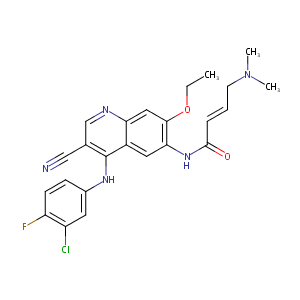
General Information of Drug Combination (ID: DCR2NYO)

Drug Combination Name
Pelitinib Pralatrexate
Indication
Disease Entry Status REF
Ewing sarcoma Investigative [1]
Component Drugs Pelitinib   DMIW453 Pralatrexate   DMAO80I
Small molecular drug Small molecular drug
2D MOL 2D MOL
3D MOL 3D MOL
High-throughput Screening Result Testing Cell Line: TC-71
Zero Interaction Potency (ZIP) Score: 20.61
Bliss Independence Score: 19.945
Loewe Additivity Score: 5.523
LHighest Single Agent (HSA) Score: 8.91

Molecular Interaction Atlas of This Drug Combination

Molecular Interaction Atlas (MIA)
Indication(s) of Pelitinib
Disease Entry ICD 11 Status REF
Lymphoma 2A80-2A86 Phase 2 [2]
Pelitinib Interacts with 1 DTT Molecule(s)
DTT Name DTT ID UniProt ID Mode of Action REF
Epidermal growth factor receptor (EGFR) TTGKNB4 EGFR_HUMAN Modulator [5]
------------------------------------------------------------------------------------
Pelitinib Interacts with 7 DOT Molecule(s)
DOT Name DOT ID UniProt ID Mode of Action REF
Baculoviral IAP repeat-containing protein 5 (BIRC5) OTILXZYL BIRC5_HUMAN Decreases Expression [6]
B-cell lymphoma/leukemia 10 (BCL10) OT47MCLI BCL10_HUMAN Decreases Expression [6]
Cyclic AMP-dependent transcription factor ATF-1 (ATF1) OT251CI0 ATF1_HUMAN Decreases Expression [6]
B-cell lymphoma 3 protein (BCL3) OT1M5B95 BCL3_HUMAN Decreases Expression [6]
Bcl-2-like protein 1 (BCL2L1) OTRC5K9O B2CL1_HUMAN Decreases Expression [6]
Baculoviral IAP repeat-containing protein 1 (NAIP) OTLA925F BIRC1_HUMAN Decreases Expression [6]
Baculoviral IAP repeat-containing protein 2 (BIRC2) OTFXFREP BIRC2_HUMAN Decreases Expression [6]
------------------------------------------------------------------------------------
⏷ Show the Full List of 7 DOT(s)
Indication(s) of Pralatrexate
Disease Entry ICD 11 Status REF
Breast cancer 2C60-2C65 Approved [3]
Peripheral T-cell lymphoma 2A90.C Approved [3]
Primary cutaneous peripheral T-cell lymphoma not otherwise specified N.A. Approved [4]
Pralatrexate Interacts with 1 DTT Molecule(s)
DTT Name DTT ID UniProt ID Mode of Action REF
Polypeptide deformylase (PDF) TT9SL3Q DEFM_HUMAN Inhibitor [7]
------------------------------------------------------------------------------------
Pralatrexate Interacts with 2 DTP Molecule(s)
DTP Name DTP ID UniProt ID Mode of Action REF
Folate transporter 1 (SLC19A1) DTOSN46 S19A1_HUMAN Substrate [8]
Proton-coupled folate transporter (SLC46A1) DTDJEMI PCFT_HUMAN Substrate [8]
------------------------------------------------------------------------------------
Pralatrexate Interacts with 1 DME Molecule(s)
DME Name DME ID UniProt ID Mode of Action REF
Folylpolyglutamate synthase (FPGS) DECWT2V FOLC_HUMAN Metabolism [9]
------------------------------------------------------------------------------------

References

1 CheMBL Affinity Phenotypic Cellular Interaction Assay ID: CHEMBL1125966
2 URL: http://www.guidetopharmacology.org Nucleic Acids Res. 2015 Oct 12. pii: gkv1037. The IUPHAR/BPS Guide to PHARMACOLOGY in 2016: towards curated quantitative interactions between 1300 protein targets and 6000 ligands. (Ligand id: 7644).
3 URL: http://www.guidetopharmacology.org Nucleic Acids Res. 2015 Oct 12. pii: gkv1037. The IUPHAR/BPS Guide to PHARMACOLOGY in 2016: towards curated quantitative interactions between 1300 protein targets and 6000 ligands. (Ligand id: 6840).
4 Pralatrexate FDA Label
5 EGFR tyrosine kinase inhibitor pelitinib regulates radiation-induced p65-dependent telomerase activation in squamous cell carcinoma.Radiat Res.2013 Mar;179(3):304-12.
6 Irreversible EGFR inhibitor EKB-569 targets low-LET -radiation-triggered rel orchestration and potentiates cell death in squamous cell carcinoma. PLoS One. 2011;6(12):e29705. doi: 10.1371/journal.pone.0029705. Epub 2011 Dec 29.
7 Hughes B: 2009 FDA drug approvals. Nat Rev Drug Discov. 2010 Feb;9(2):89-92.
8 Antifolates in cancer therapy: structure, activity and mechanisms of drug resistance. Drug Resist Updat. 2012 Aug;15(4):183-210.
9 Pralatrexate : evaluation of clinical efficacy and toxicity in T-cell lymphoma. Expert Opin Pharmacother. 2013 Mar;14(4):515-23.