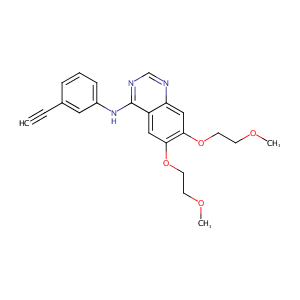
General Information of Drug Combination (ID: DCS7SV7)

Drug Combination Name
Erlotinib SNX-2112
Indication
Disease Entry Status REF
Adenocarcinoma Investigative [1]
Component Drugs Erlotinib   DMCMBHA SNX-2112   DMB5A80
Small molecular drug Small molecular drug
2D MOL 2D MOL
3D MOL 3D MOL
High-throughput Screening Result Testing Cell Line: SW-620
Zero Interaction Potency (ZIP) Score: 8.61
Bliss Independence Score: 5.35
Loewe Additivity Score: 10.57
LHighest Single Agent (HSA) Score: 5.93

Molecular Interaction Atlas of This Drug Combination

Molecular Interaction Atlas (MIA)
Indication(s) of Erlotinib
Disease Entry ICD 11 Status REF
Adrenal gland neoplasm N.A. Approved [2]
Adult hepatocellular carcinoma N.A. Approved [2]
Brain cancer 2A00 Approved [2]
Esophageal disorder N.A. Approved [2]
Lung cancer 2C25.0 Approved [2]
Non-small-cell lung cancer 2C25.Y Approved [3]
Pancreatic adenocarcinoma N.A. Approved [2]
Psoriasis EA90 Approved [2]
Salivary gland squamous cell carcinoma N.A. Approved [2]
Pancreatic cancer 2C10 Phase 3 [3]
Colon cancer 2B90.Z Phase 2 [3]
Ependymoma 2A00.0Y Investigative [2]
Neoplastic meningitis N.A. Investigative [2]
Neuroblastoma 2D11.2 Investigative [2]
Erlotinib Interacts with 1 DTT Molecule(s)
DTT Name DTT ID UniProt ID Mode of Action REF
Epidermal growth factor receptor (EGFR) TTGKNB4 EGFR_HUMAN Inhibitor [5]
------------------------------------------------------------------------------------
Erlotinib Interacts with 2 DTP Molecule(s)
DTP Name DTP ID UniProt ID Mode of Action REF
P-glycoprotein 1 (ABCB1) DTUGYRD MDR1_HUMAN Substrate [6]
Breast cancer resistance protein (ABCG2) DTI7UX6 ABCG2_HUMAN Substrate [7]
------------------------------------------------------------------------------------
Erlotinib Interacts with 4 DME Molecule(s)
DME Name DME ID UniProt ID Mode of Action REF
Cytochrome P450 3A4 (CYP3A4) DE4LYSA CP3A4_HUMAN Metabolism [8]
Cytochrome P450 1A2 (CYP1A2) DEJGDUW CP1A2_HUMAN Metabolism [9]
Cytochrome P450 2D6 (CYP2D6) DECB0K3 CP2D6_HUMAN Metabolism [9]
Cytochrome P450 3A5 (CYP3A5) DEIBDNY CP3A5_HUMAN Metabolism [9]
------------------------------------------------------------------------------------
Indication(s) of SNX-2112
Disease Entry ICD 11 Status REF
Discovery agent N.A. Investigative [4]
SNX-2112 Interacts with 1 DTT Molecule(s)
DTT Name DTT ID UniProt ID Mode of Action REF
Heat shock protein 90 alpha (HSP90A) TT78R5H HS90A_HUMAN Inhibitor [4]
------------------------------------------------------------------------------------
SNX-2112 Interacts with 6 DOT Molecule(s)
DOT Name DOT ID UniProt ID Mode of Action REF
Inhibitor of nuclear factor kappa-B kinase subunit alpha (CHUK) OTLF4ZB1 IKKA_HUMAN Decreases Expression [10]
Poly polymerase 1 (PARP1) OT310QSG PARP1_HUMAN Increases Cleavage [10]
Cytochrome c (CYCS) OTBFALJD CYC_HUMAN Affects Localization [10]
Transcription factor p65 (RELA) OTUJP9CN TF65_HUMAN Decreases Expression [10]
Bcl-2-like protein 1 (BCL2L1) OTRC5K9O B2CL1_HUMAN Decreases Expression [10]
Heat shock protein 75 kDa, mitochondrial (TRAP1) OTNG0L8J TRAP1_HUMAN Decreases Expression [10]
------------------------------------------------------------------------------------
⏷ Show the Full List of 6 DOT(s)

Test Results of This Drug Combination in Other Disease Systems

Indication DrugCom ID Cell Line Status REF
Adenocarcinoma DC9NRVW CAOV3 Investigative [1]
Adenocarcinoma DC2FZQJ OVCAR3 Investigative [1]
Adenocarcinoma DCACMZ9 A427 Investigative [1]
Adenocarcinoma DCRK3B9 NCIH1650 Investigative [1]
Adenocarcinoma DCAAGHB NCIH2122 Investigative [1]
Adenocarcinoma DCEFHCQ NCIH520 Investigative [1]
Adenocarcinoma DCC3SVB DLD1 Investigative [1]
Adenocarcinoma DCXE2VY HT29 Investigative [1]
Amelanotic melanoma DC7V5NC A2058 Investigative [1]
Germ cell tumour DC8O74J PA1 Investigative [1]
Large cell lung carcinoma DCBLMFQ NCI-H460 Investigative [1]
Malignant melanoma DCODAF2 A375 Investigative [1]
Malignant melanoma DCABR7B HT144 Investigative [1]
Malignant melanoma DCE0P5I SKMEL30 Investigative [1]
Malignant melanoma DCPWHBW UACC62 Investigative [1]
Mesothelioma DC96HYR MSTO Investigative [1]
Non small cell carcinoma DCR1YDL SKMES1 Investigative [1]
Ovarian endometrioid adenocarcinoma DC5U26J A2780 Investigative [1]
Ovarian serous cystadenocarcinoma DCOQ9YP SK-OV-3 Investigative [1]
Prostate carcinoma DCLQPRW VCAP Investigative [1]
Breast carcinoma DCARUUS KPL1 Investigative [11]
Breast carcinoma DCF47VW OCUBM Investigative [11]
Carcinoma DC1AHT3 OV90 Investigative [11]
Carcinoma DCQNIBK EFM192B Investigative [11]
Carcinoma DCWSOXW MDAMB436 Investigative [11]
Invasive ductal carcinoma DCWN5F0 T-47D Investigative [11]
------------------------------------------------------------------------------------
⏷ Show the Full List of 26 DrugCom(s)

References

1 CheMBL Affinity Phenotypic Cellular Interaction Assay ID: CHEMBL1125966
2 Erlotinib FDA Label
3 URL: http://www.guidetopharmacology.org Nucleic Acids Res. 2015 Oct 12. pii: gkv1037. The IUPHAR/BPS Guide to PHARMACOLOGY in 2016: towards curated quantitative interactions between 1300 protein targets and 6000 ligands. (Ligand id: 4920).
4 Heat shock protein 90: inhibitors in clinical trials. J Med Chem. 2010 Jan 14;53(1):3-17.
5 Quantitative prediction of fold resistance for inhibitors of EGFR. Biochemistry. 2009 Sep 8;48(35):8435-48.
6 Effect of the ATP-binding cassette drug transporters ABCB1, ABCG2, and ABCC2 on erlotinib hydrochloride (Tarceva) disposition in in vitro and in vivo pharmacokinetic studies employing Bcrp1-/-/Mdr1a/1b-/- (triple-knockout) and wild-type mice. Mol Cancer Ther. 2008 Aug;7(8):2280-7.
7 Functions of the breast cancer resistance protein (BCRP/ABCG2) in chemotherapy. Adv Drug Deliv Rev. 2009 Jan 31;61(1):26-33.
8 In vitro assessment of time-dependent inhibitory effects on CYP2C8 and CYP3A activity by fourteen protein kinase inhibitors. Drug Metab Dispos. 2014 Jul;42(7):1202-9.
9 Clinical pharmacokinetics of tyrosine kinase inhibitors. Cancer Treat Rev. 2009 Dec;35(8):692-706.
10 The Hsp90 inhibitor SNX-2112, induces apoptosis in multidrug resistant K562/ADR cells through suppression of Akt/NF-B and disruption of mitochondria-dependent pathways. Chem Biol Interact. 2013 Sep 5;205(1):1-10. doi: 10.1016/j.cbi.2013.06.007. Epub 2013 Jun 15.
11 CheMBL Affinity Phenotypic Cellular Interaction Assay ID: CHEMBL1126165