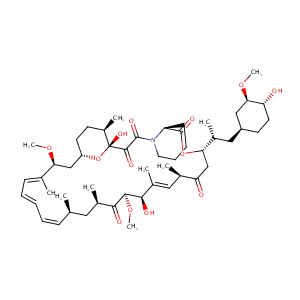
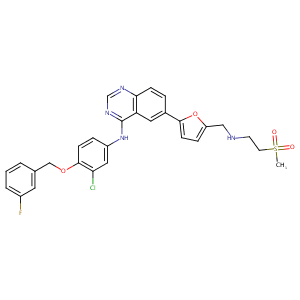
General Information of Drug Combination (ID: DCS8OSN)

Drug Combination Name
Sirolimus Lapatinib
Indication
Disease Entry Status REF
Cutaneous melanoma Investigative [1]
Component Drugs Sirolimus   DMGW1ID Lapatinib   DM3BH1Y
Small molecular drug Small molecular drug
2D MOL 2D MOL
3D MOL 3D MOL
High-throughput Screening Result Testing Cell Line: SK-MEL-28
Zero Interaction Potency (ZIP) Score: 4.86
Bliss Independence Score: 6.97
Loewe Additivity Score: 4.41
LHighest Single Agent (HSA) Score: 3.79

Molecular Interaction Atlas of This Drug Combination

Molecular Interaction Atlas (MIA)
Indication(s) of Sirolimus
Disease Entry ICD 11 Status REF
Advanced cancer 2A00-2F9Z Approved [2]
Brainstem neoplasm N.A. Approved [2]
Graft-versus-host disease 4B24 Approved [2]
Intracranial meningioma N.A. Approved [2]
Lung cancer 2C25.0 Approved [2]
Lung lymphangioleiomyomatosis N.A. Approved [2]
Lymphangioleiomyomatosis CB07 Approved [3]
Mucosal melanoma N.A. Approved [2]
Multiple myeloma 2A83 Approved [4]
Multiple sclerosis 8A40 Approved [2]
Non-small-cell lung cancer 2C25.Y Approved [2]
Organ transplant rejection NE84 Approved [5]
Plasma cell myeloma 2A83.1 Approved [2]
Prostate cancer 2C82.0 Approved [2]
Salivary gland squamous cell carcinoma N.A. Approved [2]
Uveitis 9A96.Z Phase 3 [6]
Coronavirus Disease 2019 (COVID-19) 1D6Y Phase 2 [7]
Dutch elm disease 8D64 Phase 1/2 [5]
Castration-resistant prostate carcinoma N.A. Investigative [2]
Neuroblastoma 2D11.2 Investigative [2]
Pancreatic acinar cell carcinoma N.A. Investigative [2]
Polycystic kidney disease GB8Y Investigative [2]
Rheumatoid arthritis FA20 Investigative [2]
Sirolimus Interacts with 3 DTT Molecule(s)
DTT Name DTT ID UniProt ID Mode of Action REF
Serine/threonine-protein kinase mTOR (mTOR) TTCJG29 MTOR_HUMAN Inhibitor [10]
PI3K/AKT/mTOR pathway (PAm pathway) TTGQUFK NOUNIPROTAC Inhibitor [11]
HUMAN mammalian target of rapamycin (mTOR) TT7HQAF MTOR_HUMAN Inhibitor [12]
------------------------------------------------------------------------------------
Sirolimus Interacts with 2 DTP Molecule(s)
DTP Name DTP ID UniProt ID Mode of Action REF
P-glycoprotein 1 (ABCB1) DTUGYRD MDR1_HUMAN Substrate [13]
Organic anion transporting polypeptide 1B1 (SLCO1B1) DT3D8F0 SO1B1_HUMAN Substrate [14]
------------------------------------------------------------------------------------
Sirolimus Interacts with 3 DME Molecule(s)
DME Name DME ID UniProt ID Mode of Action REF
Cytochrome P450 3A4 (CYP3A4) DE4LYSA CP3A4_HUMAN Metabolism [15]
Cytochrome P450 3A5 (CYP3A5) DEIBDNY CP3A5_HUMAN Metabolism [16]
Cytochrome P450 3A7 (CYP3A7) DERD86B CP3A7_HUMAN Metabolism [16]
------------------------------------------------------------------------------------
Sirolimus Interacts with 1 DOT Molecule(s)
DOT Name DOT ID UniProt ID Mode of Action REF
Calcineurin subunit B type 1 (PPP3R1) OTGQNFJQ CANB1_HUMAN Increases ADR [17]
------------------------------------------------------------------------------------
Indication(s) of Lapatinib
Disease Entry ICD 11 Status REF
Breast cancer 2C60-2C65 Approved [8]
Gastroesophageal junction adenocarcinoma 2B71 Approved [9]
Melanoma 2C30 Approved [9]
Lapatinib Interacts with 3 DTT Molecule(s)
DTT Name DTT ID UniProt ID Mode of Action REF
Erbb2 tyrosine kinase receptor (HER2) TT6EO5L ERBB2_HUMAN Inhibitor [19]
Epidermal growth factor receptor (EGFR) TTGKNB4 EGFR_HUMAN Inhibitor [19]
Eukaryotic elongation factor 2 kinase (eEF-2K) TT1QFLA EF2K_HUMAN Inhibitor [20]
------------------------------------------------------------------------------------
Lapatinib Interacts with 2 DTP Molecule(s)
DTP Name DTP ID UniProt ID Mode of Action REF
P-glycoprotein 1 (ABCB1) DTUGYRD MDR1_HUMAN Substrate [21]
Breast cancer resistance protein (ABCG2) DTI7UX6 ABCG2_HUMAN Substrate [22]
------------------------------------------------------------------------------------
Lapatinib Interacts with 4 DME Molecule(s)
DME Name DME ID UniProt ID Mode of Action REF
Cytochrome P450 3A4 (CYP3A4) DE4LYSA CP3A4_HUMAN Metabolism [23]
Cytochrome P450 3A5 (CYP3A5) DEIBDNY CP3A5_HUMAN Metabolism [24]
Cytochrome P450 2C8 (CYP2C8) DES5XRU CP2C8_HUMAN Metabolism [23]
Mephenytoin 4-hydroxylase (CYP2C19) DEGTFWK CP2CJ_HUMAN Metabolism [24]
------------------------------------------------------------------------------------
Lapatinib Interacts with 15 DOT Molecule(s)
DOT Name DOT ID UniProt ID Mode of Action REF
Bile salt export pump (ABCB11) OTRU7THO ABCBB_HUMAN Decreases Activity [25]
Superoxide dismutase , mitochondrial (SOD2) OTIWXGZ9 SODM_HUMAN Increases Expression [26]
Baculoviral IAP repeat-containing protein 5 (BIRC5) OTILXZYL BIRC5_HUMAN Decreases Expression [27]
Poly polymerase 1 (PARP1) OT310QSG PARP1_HUMAN Increases Cleavage [28]
Histone H2AX (H2AX) OT18UX57 H2AX_HUMAN Increases Expression [29]
Phosphatidylcholine translocator ABCB4 (ABCB4) OTE6PY83 MDR3_HUMAN Decreases Activity [30]
Receptor tyrosine-protein kinase erbB-3 (ERBB3) OTRSST0A ERBB3_HUMAN Decreases Activity [31]
Mitogen-activated protein kinase 3 (MAPK3) OTCYKGKO MK03_HUMAN Decreases Activity [28]
Mitogen-activated protein kinase 1 (MAPK1) OTH85PI5 MK01_HUMAN Decreases Activity [28]
Cyclin-dependent kinase inhibitor 1B (CDKN1B) OTNY5LLZ CDN1B_HUMAN Increases Expression [32]
HLA class II histocompatibility antigen, DQ alpha 1 chain (HLA-DQA1) OTC6GISG DQA1_HUMAN Increases ADR [33]
Zinc finger protein SNAI1 (SNAI1) OTDPYAMC SNAI1_HUMAN Decreases Response To Substance [34]
Transforming growth factor beta-1 proprotein (TGFB1) OTV5XHVH TGFB1_HUMAN Decreases Response To Substance [34]
Tenascin-X (TNXB) OTVBWAV5 TENX_HUMAN Increases ADR [33]
HLA class II histocompatibility antigen, DQ beta 1 chain (HLA-DQB1) OTVVI3UI DQB1_HUMAN Increases ADR [33]
------------------------------------------------------------------------------------
⏷ Show the Full List of 15 DOT(s)

Test Results of This Drug Combination in Other Disease Systems

Indication DrugCom ID Cell Line Status REF
Anaplastic large cell lymphoma DCCMSKL SR Investigative [35]
Astrocytoma DCX6X2A SNB-19 Investigative [35]
Chronic myelogenous leukemia DC81Q64 K-562 Investigative [35]
Clear cell renal cell carcinoma DC8DFRJ A498 Investigative [35]
Clear cell renal cell carcinoma DCKVHNO 786-0 Investigative [35]
Clear cell renal cell carcinoma DCC5VXQ CAKI-1 Investigative [35]
Papillary renal cell carcinoma DCHH364 ACHN Investigative [35]
Plasma cell myeloma DCXOLH6 RPMI-8226 Investigative [35]
Renal cell carcinoma DC9AMY8 UO-31 Investigative [35]
Breast adenocarcinoma DCUR8MW MDA-MB-468 Investigative [36]
Colon adenocarcinoma DCMO56E COLO 205 Investigative [36]
Colon carcinoma DCDD7CT KM12 Investigative [36]
Invasive ductal carcinoma DCWZ6D1 HS 578T Investigative [36]
Invasive ductal carcinoma DC0KKYA BT-549 Investigative [36]
Adenocarcinoma DCU1ARS DU-145 Investigative [1]
Adenocarcinoma DCVR78D OVCAR3 Investigative [1]
Adenocarcinoma DCQPO9W NCIH23 Investigative [1]
Adenocarcinoma DC2T1AX A549 Investigative [1]
Adenocarcinoma DC8LNN6 SW-620 Investigative [1]
Adenocarcinoma DCS4QIF HCC-2998 Investigative [1]
Adenocarcinoma DCVYQDD HCT-15 Investigative [1]
Adenocarcinoma DC3ONFW HCT116 Investigative [1]
Lung adenocarcinoma DCA0IKM MDA-MB-231 Investigative [1]
Lung adenocarcinoma DCLV9UI EKVX Investigative [1]
Mixed endometrioid and clear cell carcinoma DC32URJ IGROV1 Investigative [1]
Prostate carcinoma DCPHZ5A PC-3 Investigative [1]
------------------------------------------------------------------------------------
⏷ Show the Full List of 26 DrugCom(s)

References

1 CheMBL Affinity Phenotypic Cellular Interaction Assay ID: CHEMBL1125976
2 Sirolimus FDA Label
3 FDA Approved Drug Products from FDA Official Website. 2019. Application Number: (ANDA) 201578.
4 Drugs@FDA. U.S. Food and Drug Administration. U.S. Department of Health & Human Services. 2015
5 URL: http://www.guidetopharmacology.org Nucleic Acids Res. 2015 Oct 12. pii: gkv1037. The IUPHAR/BPS Guide to PHARMACOLOGY in 2016: towards curated quantitative interactions between 1300 protein targets and 6000 ligands. (Ligand id: 6031).
6 Clinical pipeline report, company report or official report of the Pharmaceutical Research and Manufacturers of America (PhRMA)
7 ClinicalTrials.gov (NCT04341675) Sirolimus Treatment in Hospitalized Patients With COVID-19 Pneumonia. U.S. National Institutes of Health.
8 URL: http://www.guidetopharmacology.org Nucleic Acids Res. 2015 Oct 12. pii: gkv1037. The IUPHAR/BPS Guide to PHARMACOLOGY in 2016: towards curated quantitative interactions between 1300 protein targets and 6000 ligands. (Ligand id: 5692).
9 Lapatinib FDA Label
10 Knockouts model the 100 best-selling drugs--will they model the next 100 Nat Rev Drug Discov. 2003 Jan;2(1):38-51.
11 The genomic landscape of nasopharyngeal carcinoma.Nat Genet. 2014 Aug;46(8):866-71.
12 Network-based drug repurposing for novel coronavirus 2019-nCoV/SARS-CoV-2. Cell Discov. 2020 Mar 16;6:14.
13 Pharmacogenetics of tacrolimus and sirolimus in renal transplant patients: from retrospective analyses to prospective studies. Transplant Proc. 2007 Sep;39(7):2142-4.
14 Pharmacokinetic and pharmacodynamic interactions between the immunosuppressant sirolimus and the lipid-lowering drug ezetimibe in healthy volunteers. Clin Pharmacol Ther. 2010 Jun;87(6):663-7.
15 Summary of information on human CYP enzymes: human P450 metabolism data. Drug Metab Rev. 2002 Feb-May;34(1-2):83-448.
16 Drug Interactions Flockhart Table
17 ADReCS-Target: target profiles for aiding drug safety research and application. Nucleic Acids Res. 2018 Jan 4;46(D1):D911-D917. doi: 10.1093/nar/gkx899.
18 UGT-dependent regioselective glucuronidation of ursodeoxycholic acid and obeticholic acid and selective transport of the consequent acyl glucuronides by OATP1B1 and 1B3. Chem Biol Interact. 2019 Sep 1;310:108745. doi: 10.1016/j.cbi.2019.108745. Epub 2019 Jul 9.
19 Triple negative breast cancer--current status and prospective targeted treatment based on HER1 (EGFR), TOP2A and C-MYC gene assessment. Biomed Pap Med Fac Univ Palacky Olomouc Czech Repub. 2009 Mar;153(1):13-7.
20 Inhibition of eEF-2 kinase sensitizes human nasopharyngeal carcinoma cells to lapatinib-induced apoptosis through the Src and Erk pathways.BMC Cancer. 2016 Oct 19;16(1):813.
21 Tarascon Pocket Pharmacopoeia 2018 Classic Shirt-Pocket Edition.
22 The role of efflux and uptake transporters in [N-{3-chloro-4-[(3-fluorobenzyl)oxy]phenyl}-6-[5-({[2-(methylsulfonyl)ethyl]amino}methyl)-2-furyl]-4-quinazolinamine (GW572016, lapatinib) disposition and drug interactions. Drug Metab Dispos. 2008 Apr;36(4):695-701.
23 Mechanism-based inactivation of cytochrome P450 3A4 by lapatinib. Mol Pharmacol. 2010 Oct;78(4):693-703.
24 Clinical pharmacokinetics of tyrosine kinase inhibitors. Cancer Treat Rev. 2009 Dec;35(8):692-706.
25 Interference with bile salt export pump function is a susceptibility factor for human liver injury in drug development. Toxicol Sci. 2010 Dec; 118(2):485-500.
26 P450 3A-catalyzed O-dealkylation of lapatinib induces mitochondrial stress and activates Nrf2. Chem Res Toxicol. 2016 May 16;29(5):784-96.
27 Combining lapatinib (GW572016), a small molecule inhibitor of ErbB1 and ErbB2 tyrosine kinases, with therapeutic anti-ErbB2 antibodies enhances apoptosis of ErbB2-overexpressing breast cancer cells. Oncogene. 2005 Sep 15;24(41):6213-21. doi: 10.1038/sj.onc.1208774.
28 CDK4/6 inhibition provides a potent adjunct to Her2-targeted therapies in preclinical breast cancer models. Genes Cancer. 2014 Jul;5(7-8):261-72. doi: 10.18632/genesandcancer.24.
29 The involvement of hepatic cytochrome P450s in the cytotoxicity of lapatinib. Toxicol Sci. 2023 Dec 21;197(1):69-78. doi: 10.1093/toxsci/kfad099.
30 Evaluating the Role of Multidrug Resistance Protein 3 (MDR3) Inhibition in Predicting Drug-Induced Liver Injury Using 125 Pharmaceuticals. Chem Res Toxicol. 2017 May 15;30(5):1219-1229. doi: 10.1021/acs.chemrestox.7b00048. Epub 2017 May 4.
31 Suppression of HER2/HER3-mediated growth of breast cancer cells with combinations of GDC-0941 PI3K inhibitor, trastuzumab, and pertuzumab. Clin Cancer Res. 2009 Jun 15;15(12):4147-56. doi: 10.1158/1078-0432.CCR-08-2814. Epub 2009 Jun 9.
32 The dual ErbB1/ErbB2 inhibitor, lapatinib (GW572016), cooperates with tamoxifen to inhibit both cell proliferation- and estrogen-dependent gene expression in antiestrogen-resistant breast cancer. Cancer Res. 2005 Jan 1;65(1):18-25.
33 HLA-DQA1*02:01 is a major risk factor for lapatinib-induced hepatotoxicity in women with advanced breast cancer. J Clin Oncol. 2011 Feb 20;29(6):667-73. doi: 10.1200/JCO.2010.31.3197. Epub 2011 Jan 18.
34 Niclosamide inhibits epithelial-mesenchymal transition and tumor growth in lapatinib-resistant human epidermal growth factor receptor 2-positive breast cancer. Int J Biochem Cell Biol. 2016 Feb;71:12-23. doi: 10.1016/j.biocel.2015.11.014. Epub 2015 Nov 28.
35 CheMBL Affinity Phenotypic Cellular Interaction Assay ID: CHEMBL1125966
36 CheMBL Affinity Phenotypic Cellular Interaction Assay ID: CHEMBL1126165