| 1 |
CheMBL Affinity Phenotypic Cellular Interaction Assay ID: CHEMBL1125966
|
| 2 |
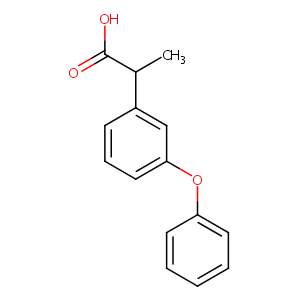
Fenoprofen FDA Label
|
| 3 |
URL: http://www.guidetopharmacology.org Nucleic Acids Res. 2015 Oct 12. pii: gkv1037. The IUPHAR/BPS Guide to PHARMACOLOGY in 2016: towards curated quantitative interactions between 1300 protein targets and 6000 ligands. (Ligand id: 4820).
|
| 4 |
Trifluoperazine FDA Label
|
| 5 |
Drugs@FDA. U.S. Food and Drug Administration. U.S. Department of Health & Human Services. 2015
|
| 6 |
Complementary deoxyribonucleic acid cloning and expression of a human liver uridine diphosphate-glucuronosyltransferase glucuronidating carboxylic acid-containing drugs. J Pharmacol Exp Ther. 1993 Jan;264(1):475-9.
|
| 7 |
Gastrointestinally distributed UDP-glucuronosyltransferase 1A10, which metabolizes estrogens and nonsteroidal anti-inflammatory drugs, depends upon phosphorylation. J Biol Chem. 2004 Jul 2;279(27):28320-9. doi: 10.1074/jbc.M401396200. Epub 2004 Apr 26.
|
| 8 |
The aryl propionic acid R-flurbiprofen selectively induces p75NTR-dependent decreased survival of prostate tumor cells. Cancer Res. 2007 Apr 1;67(7):3254-62.
|
| 9 |
Systems pharmacological analysis of drugs inducing stevens-johnson syndrome and toxic epidermal necrolysis. Chem Res Toxicol. 2015 May 18;28(5):927-34. doi: 10.1021/tx5005248. Epub 2015 Apr 3.
|
| 10 |
A protein-coated magnetic beads as a tool for the rapid drug-protein binding study. J Pharm Biomed Anal. 2010 Jul 8;52(3):420-4. doi: 10.1016/j.jpba.2009.06.023. Epub 2009 Jun 18.
|
| 11 |
Rabbit dehydrogenase/reductase SDR family member 11 (DHRS11): Its identity with acetohexamide reductase with broad substrate specificity and inhibitor sensitivity, different from human DHRS11. Chem Biol Interact. 2019 May 25;305:12-20. doi: 10.1016/j.cbi.2019.03.026. Epub 2019 Mar 26.
|
| 12 |
Assessment of the inhibition potential of Licochalcone A against human UDP-glucuronosyltransferases. Food Chem Toxicol. 2016 Apr;90:112-22.
|
| 13 |
Inhibitory effect of jujuboside A on glutamate-mediated excitatory signal pathway in hippocampus. Planta Med. 2003 Aug;69(8):692-5.
|
| 14 |
Mammalian drug efflux transporters of the ATP binding cassette (ABC) family in multidrug resistance: A review of the past decade. Cancer Lett. 2016 Jan 1;370(1):153-64.
|
| 15 |
Psychotropic Medications Metabolized by Cytochromes P450 (CYP) 1A2 Enzyme and Relevant Drug Interactions: Review of Articles
|
| 16 |
Human FMO2-based microbial whole-cell catalysts for drug metabolite synthesis. Microb Cell Fact. 2015 Jun 12;14:82.
|
| 17 |
Characterization of the ATPase activity of the Mr 170,000 to 180,000 membrane glycoprotein (P-glycoprotein) associated with multidrug resistance in K562/ADM cells. Cancer Res. 1988 Sep 1;48(17):4926-32.
|
| 18 |
Rescue of Pink1 Deficiency by Stress-Dependent Activation of Autophagy. Cell Chem Biol. 2017 Apr 20;24(4):471-480.e4. doi: 10.1016/j.chembiol.2017.03.005. Epub 2017 Mar 30.
|
| 19 |
Stonin 2 activates lysosomal-mTOR axis for cell survival in oral cancer. Toxicol In Vitro. 2023 Apr;88:105561. doi: 10.1016/j.tiv.2023.105561. Epub 2023 Jan 23.
|
| 20 |
ADReCS-Target: target profiles for aiding drug safety research and application. Nucleic Acids Res. 2018 Jan 4;46(D1):D911-D917. doi: 10.1093/nar/gkx899.
|
|
|
|
|
|
|