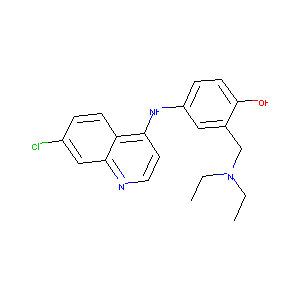
General Information of Drug (ID: DME4RA8)

Drug Name
Amodiaquine
Synonyms
Amodiachin; Amodiachinum; Amodiaquin; Amodiaquina; Amodiaquinum; Basoquin; CQA; Camochin; Camoquin; Camoquinal; Camoquine; Flavoquin; Flavoquine; Miaquin; Sunoquine; Amodiaquine hydrochloride; Amodiaquine USP24; SN 10751; AMODIAQUINE, FLAVOQUINE; Amodiaquina [INN-Spanish]; Amodiaquinum [INN-Latin]; CAM-AQ 1; CAM-AQI; Cam-AQ1; Camoquin (TN); Flavoquine (TN); SN 10,751; WR-002977; Amodiaquine (USAN/INN); Amodiaquine [USAN:INN:BAN]; Amodiaquine, ring-closed; S. N. 10751
Indication
Disease Entry ICD 11 Status REF
Malaria 1F40-1F45 Approved [1]
Middle East Respiratory Syndrome (MERS) 1D64 Preclinical [2]
Severe acute respiratory syndrome (SARS) 1D65 Preclinical [2]
Therapeutic Class
Antimalarials
Affected Organisms
Plasmodium
ATC Code
P01BA06: Amodiaquine
P01BA: Aminoquinolines
P01B: ANTIMALARIALS
P01: ANTIPROTOZOALS
P: ANTIPARASITIC PRODUCTS, INSECTICIDES AND REPELLENTS
Drug Type
Small molecular drug
Structure
3D MOL 2D MOL
#Ro5 Violations (Lipinski): 0 Molecular Weight (mw) 355.9
Logarithm of the Partition Coefficient (xlogp) 2.6
Rotatable Bond Count (rotbonds) 6
Hydrogen Bond Donor Count (hbonddonor) 2
Hydrogen Bond Acceptor Count (hbondacc) 4
ADMET Property
Absorption
The drug is rapidly absorbed following oral administration []
Bioavailability
75% of drug becomes completely available to its intended biological destination(s) [3]
Clearance
The drug present in the plasma can be removed from the body at the rate of 217 mL/min/kg [4]
Half-life
The concentration or amount of drug in body reduced by one-half in 5.2 +/-1.7 (range 0.4 - 5.5) minutes [4]
Metabolism
The drug is metabolized via the hepatic []
Vd
Fluid volume that would be required to contain the amount of drug present in the body at the same concentration as in the plasma 17.4 L/kg [4]
Chemical Identifiers
Formula
C20H22ClN3O
IUPAC Name
4-[(7-chloroquinolin-4-yl)amino]-2-(diethylaminomethyl)phenol
Canonical SMILES
CCN(CC)CC1=C(C=CC(=C1)NC2=C3C=CC(=CC3=NC=C2)Cl)O
InChI
InChI=1S/C20H22ClN3O/c1-3-24(4-2)13-14-11-16(6-8-20(14)25)23-18-9-10-22-19-12-15(21)5-7-17(18)19/h5-12,25H,3-4,13H2,1-2H3,(H,22,23)
InChIKey
OVCDSSHSILBFBN-UHFFFAOYSA-N
Cross-matching ID
PubChem CID
2165
ChEBI ID
CHEMBL682
CAS Number
86-42-0
UNII
220236ED28
DrugBank ID
DB00613
TTD ID
D04NQI
VARIDT ID
DR00976
INTEDE ID
DR0102
Drug-Molecule Activity Atlas (DMA)NEW Click to Jump to the Detailed DMA Information of This Drug
Drug Pharmacogenomic Perturbation (DPP)NEW Click to Jump to the Detailed DPP Information of This Drug
Drug ADMET Endpoint Profile (DAE)NEW Click to Jump to the Detailed DAE Information of This Drug
Combinatorial Drugs (CBD) Click to Jump to the Detailed CBD Information of This Drug
Repurposed Drugs (RPD) Click to Jump to the Detailed RPD Information of This Drug

Molecular Interaction Atlas of This Drug


Drug Therapeutic Target (DTT)
DTT Name DTT ID UniProt ID MOA REF
Histamine N-methyltransferase (HNMT) TT2B6EV HNMT_HUMAN Inhibitor [5]

Drug-Metabolizing Enzyme (DME)
DME Name DME ID UniProt ID MOA REF
Cytochrome P450 1A1 (CYP1A1) DE6OQ3W CP1A1_HUMAN Substrate [6]
Cytochrome P450 1B1 (CYP1B1) DE9QHP6 CP1B1_HUMAN Substrate [6]
Cytochrome P450 2C8 (CYP2C8) DES5XRU CP2C8_HUMAN Substrate [7]
Glutathione S-transferase mu-4 (GSTM4) DERQ52Z GSTM4_HUMAN Substrate [8]
Cytochrome P450 102A1 (cyp102) DE4OGUF CPXB_BACMB Substrate [9]

Drug Off-Target (DOT)
DOT Name DOT ID UniProt ID Interaction REF
Cyclin-dependent kinase inhibitor 1 (CDKN1A) OTQWHCZE CDN1A_HUMAN Gene/Protein Processing [10]
Cytochrome P450 2C19 (CYP2C19) OTFMJYYE CP2CJ_HUMAN Gene/Protein Processing [11]
Hepatocyte growth factor receptor (MET) OT7K55MU MET_HUMAN Gene/Protein Processing [12]
Proepiregulin (EREG) OTRM4NQY EREG_HUMAN Gene/Protein Processing [12]
PTB-containing, cubilin and LRP1-interacting protein (PID1) OT5YJ7FI PCLI1_HUMAN Gene/Protein Processing [12]
Retinoblastoma-associated protein (RB1) OTQJUJMZ RB_HUMAN Post-Translational Modifications [10]
Transcription factor E2F1 (E2F1) OTLKYBBC E2F1_HUMAN Gene/Protein Processing [10]
Tumor necrosis factor-inducible gene 6 protein (TNFAIP6) OT1SLUZH TSG6_HUMAN Gene/Protein Processing [12]
Molecular Interaction Atlas (MIA) Jump to Detail Molecular Interaction Atlas of This Drug

References

1 Drug information of Amodiaquine, 2008. eduDrugs.
2 Repurposing of clinically developed drugs for treatment of Middle East respiratory syndrome coronavirus infection. Antimicrob Agents Chemother. 2014 Aug;58(8):4885-93.
3 Critical Evaluation of Human Oral Bioavailability for Pharmaceutical Drugs by Using Various Cheminformatics Approaches
4 Trend Analysis of a Database of Intravenous Pharmacokinetic Parameters in Humans for 1352 Drug Compounds
5 Effect of amodiaquine, a histamine N-methyltransferase inhibitor, on, Propionibacterium acnes and lipopolysaccharide-induced hepatitis in mice. Eur J Pharmacol. 2007 Mar 8;558(1-3):179-84.
6 Amodiaquine clearance and its metabolism to N-desethylamodiaquine is mediated by CYP2C8: a new high affinity and turnover enzyme-specific probe substrate. J Pharmacol Exp Ther. 2002 Feb;300(2):399-407.
7 Amodiaquine metabolism is impaired by common polymorphisms in CYP2C8: implications for malaria treatment in Africa. Clin Pharmacol Ther. 2007 Aug;82(2):197-203.
8 Human glutathione S-transferases- and NAD(P)H:quinone oxidoreductase 1-catalyzed inactivation of reactive quinoneimines of amodiaquine and N-desethylamodiaquine: possible implications for susceptibility to amodiaquine-induced liver toxicity. Toxicol Lett. 2017 Jun 5;275:83-91.
9 The bacterial P450 BM3: a prototype for a biocatalyst with human P450 activities. Trends Biotechnol. 2007 Jul;25(7):289-98.
10 The antimalarial amodiaquine causes autophagic-lysosomal and proliferative blockade sensitizing human melanoma cells to starvation- and chemotherapy-induced cell death. Autophagy. 2013 Dec;9(12):2087-102. doi: 10.4161/auto.26506. Epub 2013 Oct 8.
11 Application of higher throughput screening (HTS) inhibition assays to evaluate the interaction of antiparasitic drugs with cytochrome P450s. Drug Metab Dispos. 2001 Jan;29(1):30-5.
12 An in vitro coculture system of human peripheral blood mononuclear cells with hepatocellular carcinoma-derived cells for predicting drug-induced liver injury. Arch Toxicol. 2021 Jan;95(1):149-168. doi: 10.1007/s00204-020-02882-4. Epub 2020 Aug 20.