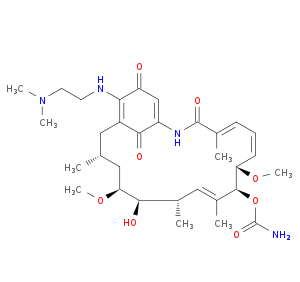
General Information of Drug (ID: DMJS4RP)

Drug Name
PMID26882240-Compound-32
Affected Organisms
Humans and other mammals
Drug Type
Small molecular drug
Structure
3D MOL 2D MOL
#Ro5 Violations (Lipinski): 1 Molecular Weight (mw) 616.7
Logarithm of the Partition Coefficient (xlogp) 2
Rotatable Bond Count (rotbonds) 8
Hydrogen Bond Donor Count (hbonddonor) 4
Hydrogen Bond Acceptor Count (hbondacc) 10
ADMET Property
Elimination
10.6C14.8% of delivered dose is excreted in urine in unchanged form (in a mice study) [1]
Half-life
The concentration or amount of drug in body reduced by one-half in 9.9 - 54.1 hours [2]
Metabolism
The drug is metabolized via purified human cytochrome P450 reductase (CYP3A4/3A5) to quinones and hydroquinones [3]
Vd
The volume of distribution (Vd) of drug is 385 L []
Chemical Identifiers
Formula
C32H48N4O8
IUPAC Name
[(4E,6Z,8S,9S,10E,12S,13R,14S,16R)-19-[2-(dimethylamino)ethylamino]-13-hydroxy-8,14-dimethoxy-4,10,12,16-tetramethyl-3,20,22-trioxo-2-azabicyclo[16.3.1]docosa-1(21),4,6,10,18-pentaen-9-yl] carbamate
Canonical SMILES
C[C@H]1C[C@@H]([C@@H]([C@H](/C=C(/[C@@H]([C@H](/C=C\\C=C(\\C(=O)NC2=CC(=O)C(=C(C1)C2=O)NCCN(C)C)/C)OC)OC(=O)N)\\C)C)O)OC
InChI
InChI=1S/C32H48N4O8/c1-18-14-22-27(34-12-13-36(5)6)24(37)17-23(29(22)39)35-31(40)19(2)10-9-11-25(42-7)30(44-32(33)41)21(4)16-20(3)28(38)26(15-18)43-8/h9-11,16-18,20,25-26,28,30,34,38H,12-15H2,1-8H3,(H2,33,41)(H,35,40)/b11-9-,19-10+,21-16+/t18-,20+,25+,26+,28-,30+/m1/s1
InChIKey
KUFRQPKVAWMTJO-LMZWQJSESA-N
Cross-matching ID
PubChem CID
5288674
ChEBI ID
CHEMBL65324
CAS Number
467214-20-6
UNII
001L2FE0M3
DrugBank ID
DB12442
TTD ID
D03OYJ
Drug-Molecule Activity Atlas (DMA)NEW Click to Jump to the Detailed DMA Information of This Drug
Drug Pharmacogenomic Perturbation (DPP)NEW Click to Jump to the Detailed DPP Information of This Drug

Molecular Interaction Atlas of This Drug


Drug Therapeutic Target (DTT)
DTT Name DTT ID UniProt ID MOA REF
Hypoxia-inducible factor 1 (HIF-1) TTUX68I NOUNIPROTAC Inhibitor [4]

Drug Off-Target (DOT)
DOT Name DOT ID UniProt ID Interaction REF
Bcl-2-like protein 11 (BCL2L11) OTNQQWFJ B2L11_HUMAN Gene/Protein Processing [5]
Cyclin-dependent kinase inhibitor 1 (CDKN1A) OTQWHCZE CDN1A_HUMAN Gene/Protein Processing [6]
Cyclin-dependent kinase inhibitor 1B (CDKN1B) OTNY5LLZ CDN1B_HUMAN Gene/Protein Processing [6]
Heat shock factor protein 1 (HSF1) OTYNJ4KP HSF1_HUMAN Gene/Protein Processing [7]
Mitogen-activated protein kinase 1 (MAPK1) OTH85PI5 MK01_HUMAN Post-Translational Modifications [5]
Mitogen-activated protein kinase 3 (MAPK3) OTCYKGKO MK03_HUMAN Post-Translational Modifications [5]
Myc proto-oncogene protein (MYC) OTPV5LUK MYC_HUMAN Gene/Protein Processing [6]
RAF proto-oncogene serine/threonine-protein kinase (RAF1) OT51LSFO RAF1_HUMAN Gene/Protein Processing [6]
Receptor tyrosine-protein kinase erbB-2 (ERBB2) OTOAUNCK ERBB2_HUMAN Gene/Protein Processing [5]
Serine/threonine-protein kinase Chk1 (CHEK1) OTTTI622 CHK1_HUMAN Gene/Protein Processing [8]
Molecular Interaction Atlas (MIA) Jump to Detail Molecular Interaction Atlas of This Drug

References

1 Hu ZY, Lu J, Zhao Y: A physiologically based pharmacokinetic model of alvespimycin in mice and extrapolation to rats and humans. Br J Pharmacol. 2014 Jun;171(11):2778-89. doi: 10.1111/bph.12609.
2 Phase I trial of 17-dimethylaminoethylamino-17-demethoxygeldanamycin (17-DMAG), a heat shock protein inhibitor, administered twice weekly in patients with advanced malignancies. Eur J Cancer. 2010 Jan;46(2):340-7. doi: 10.1016/j.ejca.2009.10.026. Epub 2009 Nov 27.
3 Shill HA, Stacy M: Update on ropinirole in the treatment of Parkinson's disease. Neuropsychiatr Dis Treat. 2009;5:33-6. Epub 2009 Apr 8.
4 Hypoxia-inducible factor (HIF) inhibitors: a patent survey (2011-2015).Expert Opin Ther Pat. 2016;26(3):309-22.
5 FGFR3 translocations in bladder cancer: differential sensitivity to HSP90 inhibition based on drug metabolism. Mol Cancer Res. 2014 Jul;12(7):1042-54. doi: 10.1158/1541-7786.MCR-14-0004. Epub 2014 Apr 30.
6 Co-treatment with heat shock protein 90 inhibitor 17-dimethylaminoethylamino-17-demethoxygeldanamycin (DMAG) and vorinostat: a highly active combination against human mantle cell lymphoma (MCL) cells. Cancer Biol Ther. 2009 Jul;8(13):1273-80. doi: 10.4161/cbt.8.13.8726.
7 A Gene Expression Biomarker Predicts Heat Shock Factor 1 Activation in a Gene Expression Compendium. Chem Res Toxicol. 2021 Jul 19;34(7):1721-1737. doi: 10.1021/acs.chemrestox.0c00510. Epub 2021 Jun 25.
8 Schedule-dependent synergy between the heat shock protein 90 inhibitor 17-(dimethylaminoethylamino)-17-demethoxygeldanamycin and doxorubicin restores apoptosis to p53-mutant lymphoma cell lines. Clin Cancer Res. 2006 Nov 1;12(21):6547-56. doi: 10.1158/1078-0432.CCR-06-1178.