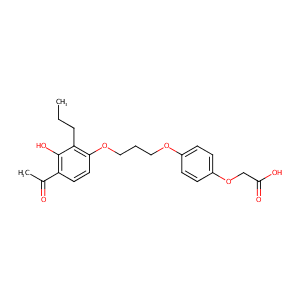
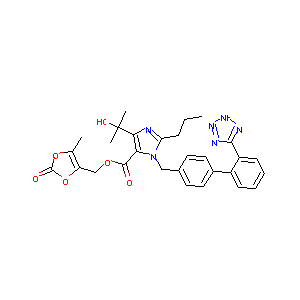
General Information of Drug Combination (ID: DCSB59I)

Drug Combination Name
L-165041 Olmesartan medoxomil
Indication
Disease Entry Status REF
Chronic myelogenous leukemia Investigative [1]
Component Drugs L-165041   DMZP7YM Olmesartan medoxomil   DMWBHRY
Small molecular drug Small molecular drug
2D MOL 2D MOL
3D MOL is unavailable 3D MOL
High-throughput Screening Result Testing Cell Line: KBM-7
Zero Interaction Potency (ZIP) Score: 30.35
Bliss Independence Score: 30.35
Loewe Additivity Score: 43.95
LHighest Single Agent (HSA) Score: 43.96

Molecular Interaction Atlas of This Drug Combination

Molecular Interaction Atlas (MIA)
Indication(s) of L-165041
Disease Entry ICD 11 Status REF
Discovery agent N.A. Investigative [2]
L-165041 Interacts with 1 DTT Molecule(s)
DTT Name DTT ID UniProt ID Mode of Action REF
Peroxisome proliferator-activated receptor delta (PPARD) TT2JWF6 PPARD_HUMAN Agonist [5]
------------------------------------------------------------------------------------
L-165041 Interacts with 1 DOT Molecule(s)
DOT Name DOT ID UniProt ID Mode of Action REF
Fatty acid-binding protein, adipocyte (FABP4) OT3DKFOU FABP4_HUMAN Increases Expression [6]
------------------------------------------------------------------------------------
Indication(s) of Olmesartan medoxomil
Disease Entry ICD 11 Status REF
High blood pressure BA00 Approved [3]
Olmesartan medoxomil Interacts with 1 DTT Molecule(s)
DTT Name DTT ID UniProt ID Mode of Action REF
Angiotensin II receptor type-1 (AGTR1) TT8DBY3 AGTR1_HUMAN Antagonist [7]
------------------------------------------------------------------------------------
Olmesartan medoxomil Interacts with 8 DTP Molecule(s)
DTP Name DTP ID UniProt ID Mode of Action REF
Multidrug resistance-associated protein 2 (ABCC2) DTFI42L MRP2_HUMAN Substrate [8]
P-glycoprotein 1 (ABCB1) DTUGYRD MDR1_HUMAN Substrate [9]
Breast cancer resistance protein (ABCG2) DTI7UX6 ABCG2_HUMAN Substrate [10]
Organic anion transporting polypeptide 1B1 (SLCO1B1) DT3D8F0 SO1B1_HUMAN Substrate [11]
Multidrug resistance-associated protein 4 (ABCC4) DTCSGPB MRP4_HUMAN Substrate [8]
Organic anion transporter 1 (SLC22A6) DTQ23VB S22A6_HUMAN Substrate [8]
Organic anion transporter 3 (SLC22A8) DTVP67E S22A8_HUMAN Substrate [8]
Organic anion transporting polypeptide 1B3 (SLCO1B3) DT9C1TS SO1B3_HUMAN Substrate [8]
------------------------------------------------------------------------------------
⏷ Show the Full List of 8 DTP(s)
Olmesartan medoxomil Interacts with 2 DOT Molecule(s)
DOT Name DOT ID UniProt ID Mode of Action REF
Bile salt export pump (ABCB11) OTRU7THO ABCBB_HUMAN Decreases Activity [12]
Tight junction protein ZO-1 (TJP1) OTBDCUPK ZO1_HUMAN Affects Localization [13]
------------------------------------------------------------------------------------

References

1 CheMBL Affinity Phenotypic Cellular Interaction Assay ID: CHEMBL1125966
2 URL: http://www.guidetopharmacology.org Nucleic Acids Res. 2015 Oct 12. pii: gkv1037. The IUPHAR/BPS Guide to PHARMACOLOGY in 2016: towards curated quantitative interactions between 1300 protein targets and 6000 ligands. (Ligand id: 2691).
3 Effect of angiotensin receptor blockade on endothelial function: focus on olmesartan medoxomil. Vasc Health Risk Manag. 2009;5(1):301-14.
4 Keratinocyte-derived vascular endothelial growth factor biosynthesis represents a pleiotropic side effect of peroxisome proliferator-activated receptor-gamma agonist troglitazone but not rosiglitazone and involves activation of p38 mitogen-activated protein kinase: implications for diabetes-impaired skin repair. Mol Pharmacol. 2008 Oct;74(4):952-63. doi: 10.1124/mol.108.049395. Epub 2008 Jul 3.
5 Novel peroxisome proliferator-activated receptor (PPAR) gamma and PPARdelta ligands produce distinct biological effects. J Biol Chem. 1999 Mar 5;274(10):6718-25.
6 Human adipocyte fatty acid-binding protein (aP2) gene promoter-driven reporter assay discriminates nonlipogenic peroxisome proliferator-activated receptor gamma ligands. J Pharmacol Exp Ther. 2004 Nov;311(2):467-75. doi: 10.1124/jpet.104.068254. Epub 2004 Jul 23.
7 Mechanism of diastolic stiffening of the failing myocardium and its prevention by angiotensin receptor and calcium channel blockers. J Cardiovasc Pharmacol. 2009 Jul;54(1):47-56.
8 Multiple human isoforms of drug transporters contribute to the hepatic and renal transport of olmesartan, a selective antagonist of the angiotensin II AT1-receptor. Drug Metab Dispos. 2007 Dec;35(12):2166-76.
9 KEGG: new perspectives on genomes, pathways, diseases and drugs. Nucleic Acids Res. 2017 Jan 4;45(D1):D353-D361. (dg:DG01665)
10 KEGG: new perspectives on genomes, pathways, diseases and drugs. Nucleic Acids Res. 2017 Jan 4;45(D1):D353-D361. (dg:DG01913)
11 OATP1B1, OATP1B3, and mrp2 are involved in hepatobiliary transport of olmesartan, a novel angiotensin II blocker. Drug Metab Dispos. 2006 May;34(5):862-9.
12 A multifactorial approach to hepatobiliary transporter assessment enables improved therapeutic compound development. Toxicol Sci. 2013 Nov;136(1):216-41.
13 Immunopathogenesis of olmesartan-associated enteropathy. Aliment Pharmacol Ther. 2015 Dec;42(11-12):1303-14. doi: 10.1111/apt.13413. Epub 2015 Oct 1.