| 1 |
CheMBL Affinity Phenotypic Cellular Interaction Assay ID: CHEMBL1125966
|
| 2 |
URL: http://www.guidetopharmacology.org Nucleic Acids Res. 2015 Oct 12. pii: gkv1037. The IUPHAR/BPS Guide to PHARMACOLOGY in 2016: towards curated quantitative interactions between 1300 protein targets and 6000 ligands. (Ligand id: 6791).
|
| 3 |
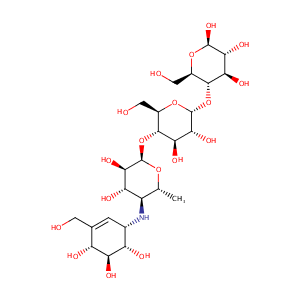
Acarbose FDA Label
|
| 4 |
Inhibition of cell growth and VEGF expression in ovarian cancer cells by flavonoids. Nutr Cancer. 2008;60(6):800-9.
|
| 5 |
Structure-dependent modulation of aryl hydrocarbon receptor-mediated activities by flavonoids. Toxicol Sci. 2018 Jul 1;164(1):205-217.
|
| 6 |
Antitumor activity of luteolin in human colon cancer SW620 cells is mediated by the ERK/FOXO3a signaling pathway. Toxicol In Vitro. 2020 Aug;66:104852. doi: 10.1016/j.tiv.2020.104852. Epub 2020 Apr 5.
|
| 7 |
Cytotoxicity of flavones and flavonols to a human esophageal squamous cell carcinoma cell line (KYSE-510) by induction of G2/M arrest and apoptosis. Toxicol In Vitro. 2009 Aug;23(5):797-807. doi: 10.1016/j.tiv.2009.04.007. Epub 2009 May 3.
|
| 8 |
Genetic variants of human UGT1A3: functional characterization and frequency distribution in a Chinese Han population. Drug Metab Dispos. 2006 Sep;34(9):1462-7. doi: 10.1124/dmd.106.009761. Epub 2006 May 31.
|
| 9 |
A STAT inhibitor patent review: progress since 2011.Expert Opin Ther Pat. 2015;25(12):1397-421.
|
| 10 |
Drug interaction study of flavonoids toward CYP3A4 and their quantitative structure activity relationship (QSAR) analysis for predicting potential effects. Toxicol Lett. 2018 Sep 15;294:27-36.
|
| 11 |
Flavones and flavonols exert cytotoxic effects on a human oesophageal adenocarcinoma cell line (OE33) by causing G2/M arrest and inducing apoptosis. Food Chem Toxicol. 2008 Jun;46(6):2042-53. doi: 10.1016/j.fct.2008.01.049. Epub 2008 Feb 7.
|
| 12 |
Luteolin, a flavonoid, inhibits AP-1 activation by basophils. Biochem Biophys Res Commun. 2006 Feb 3;340(1):1-7. doi: 10.1016/j.bbrc.2005.11.157. Epub 2005 Dec 6.
|
| 13 |
The flavonoids apigenin and luteolin suppress ultraviolet A-induced matrix metalloproteinase-1 expression via MAPKs and AP-1-dependent signaling in HaCaT cells. J Dermatol Sci. 2011 Jan;61(1):23-31. doi: 10.1016/j.jdermsci.2010.10.016. Epub 2010 Nov 9.
|
| 14 |
Suppressive Effects of Selected Food Phytochemicals on CD74 Expression in NCI-N87 Gastric Carcinoma Cells. J Clin Biochem Nutr. 2008 Sep;43(2):109-17. doi: 10.3164/jcbn.2008054.
|
| 15 |
Structure-activity relationship and mechanism of flavonoids on the inhibitory activity of P-glycoprotein (P-gp)-mediated transport of rhodamine123 and daunorubicin in P-gp overexpressed human mouth epidermal carcinoma (KB/MDR) cells. Food Chem Toxicol. 2021 Sep;155:112381. doi: 10.1016/j.fct.2021.112381. Epub 2021 Jul 1.
|
| 16 |
Blockade of the epidermal growth factor receptor tyrosine kinase activity by quercetin and luteolin leads to growth inhibition and apoptosis of pancreatic tumor cells. Anticancer Res. 2002 May-Jun;22(3):1615-27.
|
| 17 |
Luteolin exerts pro-apoptotic effect and anti-migration effects on A549 lung adenocarcinoma cells through the activation of MEK/ERK signaling pathway. Chem Biol Interact. 2016 Sep 25;257:26-34. doi: 10.1016/j.cbi.2016.07.028. Epub 2016 Jul 26.
|
| 18 |
The genotoxicity potential of luteolin is enhanced by CYP1A1 and CYP1A2 in human lymphoblastoid TK6 cells. Toxicol Lett. 2021 Jun 15;344:58-68. doi: 10.1016/j.toxlet.2021.03.006. Epub 2021 Mar 13.
|
| 19 |
Luteolin, quercetin and ursolic acid are potent inhibitors of proliferation and inducers of apoptosis in both KRAS and BRAF mutated human colorectal cancer cells. Cancer Lett. 2009 Aug 28;281(2):162-70. doi: 10.1016/j.canlet.2009.02.041. Epub 2009 Apr 2.
|
| 20 |
Luteolin induced G2 phase cell cycle arrest and apoptosis on non-small cell lung cancer cells. Toxicol In Vitro. 2011 Oct;25(7):1385-91. doi: 10.1016/j.tiv.2011.05.009. Epub 2011 May 13.
|
| 21 |
Effects of structurally related flavonoids on cell cycle progression of human melanoma cells: regulation of cyclin-dependent kinases CDK2 and CDK1. Biochem Pharmacol. 2001 May 15;61(10):1205-15. doi: 10.1016/s0006-2952(01)00583-4.
|
| 22 |
Luteolin exerts anti-tumor activity through the suppression of epidermal growth factor receptor-mediated pathway in MDA-MB-231 ER-negative breast cancer cells. Food Chem Toxicol. 2012 Nov;50(11):4136-43. doi: 10.1016/j.fct.2012.08.025. Epub 2012 Aug 20.
|
| 23 |
Luteolin prevents liver from tunicamycin-induced endoplasmic reticulum stress via nuclear factor erythroid 2-related factor 2-dependent sestrin 2 induction. Toxicol Appl Pharmacol. 2020 Jul 15;399:115036. doi: 10.1016/j.taap.2020.115036. Epub 2020 May 11.
|
| 24 |
Potent Inhibitors of Organic Anion Transporters 1 and 3 From Natural Compounds and Their Protective Effect on Aristolochic Acid Nephropathy. Toxicol Sci. 2020 Jun 1;175(2):279-291. doi: 10.1093/toxsci/kfaa033.
|
| 25 |
Rabbit dehydrogenase/reductase SDR family member 11 (DHRS11): Its identity with acetohexamide reductase with broad substrate specificity and inhibitor sensitivity, different from human DHRS11. Chem Biol Interact. 2019 May 25;305:12-20. doi: 10.1016/j.cbi.2019.03.026. Epub 2019 Mar 26.
|
| 26 |
Luteolin enhances the bioavailability of benzo(a)pyrene in human colon carcinoma cells. Arch Biochem Biophys. 2010 Jun 15;498(2):111-8. doi: 10.1016/j.abb.2010.04.009. Epub 2010 Apr 18.
|
| 27 |
Drug interaction study of flavonoids toward OATP1B1 and their 3D structure activity relationship analysis for predicting hepatoprotective effects. Toxicology. 2020 May 15;437:152445. doi: 10.1016/j.tox.2020.152445. Epub 2020 Apr 4.
|
| 28 |
Drugs@FDA. U.S. Food and Drug Administration. U.S. Department of Health & Human Services.
|
|
|
|
|
|
|