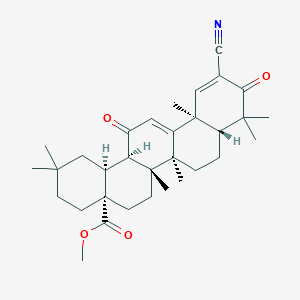
General Information of Drug Combination (ID: DCEU165)

Drug Combination Name
Bardoxolone methyl Mebendazole
Indication
Disease Entry Status REF
Primitive neuroectodermal tumor Investigative [1]
Component Drugs Bardoxolone methyl   DMODA2X Mebendazole   DMO14SG
Small molecular drug Small molecular drug
2D MOL 2D MOL
3D MOL 3D MOL
High-throughput Screening Result Testing Cell Line: TC-32
Zero Interaction Potency (ZIP) Score: 16.58
Bliss Independence Score: 19.19
Loewe Additivity Score: 3.16
LHighest Single Agent (HSA) Score: 3.95

Molecular Interaction Atlas of This Drug Combination

Molecular Interaction Atlas (MIA)
Indication(s) of Bardoxolone methyl
Disease Entry ICD 11 Status REF
Mixed connective tissue disease 4A43.3 Phase 3 [2]
Pulmonary arterial hypertension BB01.0 Phase 2 [3]
Pulmonary hypertension BB01 Phase 2 [2]
Bardoxolone methyl Interacts with 1 DTT Molecule(s)
DTT Name DTT ID UniProt ID Mode of Action REF
PPAR-gamma messenger RNA (PPARG mRNA) TTT2SVW PPARG_HUMAN Antagonist [7]
------------------------------------------------------------------------------------
Bardoxolone methyl Interacts with 44 DOT Molecule(s)
DOT Name DOT ID UniProt ID Mode of Action REF
D(2) dopamine receptor (DRD2) OTBLXKEG DRD2_HUMAN Decreases Activity [8]
Alpha-2C adrenergic receptor (ADRA2C) OT5B9RKP ADA2C_HUMAN Decreases Activity [8]
D(1A) dopamine receptor (DRD1) OTLZPBT7 DRD1_HUMAN Decreases Activity [8]
5-hydroxytryptamine receptor 2A (HTR2A) OTWXJX0M 5HT2A_HUMAN Decreases Activity [8]
5-hydroxytryptamine receptor 2C (HTR2C) OT6H8DE0 5HT2C_HUMAN Decreases Activity [8]
Alpha-1B adrenergic receptor (ADRA1B) OTSAYAFD ADA1B_HUMAN Decreases Activity [8]
Mu-type opioid receptor (OPRM1) OT16AAT8 OPRM_HUMAN Decreases Activity [8]
Kappa-type opioid receptor (OPRK1) OTXCZF4L OPRK_HUMAN Decreases Activity [8]
3',5'-cyclic-AMP phosphodiesterase 4B (PDE4B) OTOA8WU2 PDE4B_HUMAN Decreases Activity [8]
Voltage-dependent L-type calcium channel subunit alpha-1C (CACNA1C) OT6KFNMS CAC1C_HUMAN Decreases Activity [8]
NF-kappa-B inhibitor epsilon (NFKBIE) OTLAYEL9 IKBE_HUMAN Increases Expression [6]
Transcription factor MafG (MAFG) OTBQFUZH MAFG_HUMAN Decreases Expression [6]
SH3 domain-binding protein 5 (SH3BP5) OTOOEGUJ 3BP5_HUMAN Affects Expression [9]
Dynamin-like 120 kDa protein, mitochondrial (OPA1) OTJGNWPW OPA1_HUMAN Increases Cleavage [10]
Mitofusin-2 (MFN2) OTPYN8A3 MFN2_HUMAN Decreases Expression [10]
Annexin A1 (ANXA1) OT5OFDJC ANXA1_HUMAN Affects Expression [9]
Amino acid transporter heavy chain SLC3A2 (SLC3A2) OTBR33M9 4F2_HUMAN Decreases Expression [6]
ATP-dependent 6-phosphofructokinase, muscle type (PFKM) OT1QY9JM PFKAM_HUMAN Decreases Expression [10]
Growth-regulated alpha protein (CXCL1) OT3WCTZV GROA_HUMAN Increases Expression [6]
Poly polymerase 1 (PARP1) OT310QSG PARP1_HUMAN Increases Cleavage [11]
C-C motif chemokine 2 (CCL2) OTAD2HEL CCL2_HUMAN Increases Expression [6]
Beta-1,4-galactosyltransferase 1 (B4GALT1) OTBCXEK7 B4GT1_HUMAN Increases Expression [6]
Glutathione peroxidase 2 (GPX2) OTXI2NTI GPX2_HUMAN Affects Expression [9]
Tumor necrosis factor alpha-induced protein 3 (TNFAIP3) OTVLI4DD TNAP3_HUMAN Increases Expression [6]
Growth arrest and DNA damage-inducible protein GADD45 alpha (GADD45A) OTDRV63V GA45A_HUMAN Affects Expression [9]
DnaJ homolog subfamily B member 1 (DNAJB1) OTCOSEVH DNJB1_HUMAN Affects Expression [9]
DNA damage-inducible transcript 3 protein (DDIT3) OTI8YKKE DDIT3_HUMAN Increases Expression [6]
Lon protease homolog, mitochondrial (LONP1) OT665WYT LONM_HUMAN Decreases Expression [12]
Small ribosomal subunit protein eS6 (RPS6) OTT4D1LN RS6_HUMAN Decreases Expression [10]
Oxidized low-density lipoprotein receptor 1 (OLR1) OTS44RIC OLR1_HUMAN Increases Expression [6]
C-C motif chemokine 20 (CCL20) OTUCJY4N CCL20_HUMAN Increases Expression [6]
Heat shock factor protein 1 (HSF1) OTYNJ4KP HSF1_HUMAN Increases Activity [13]
Tumor necrosis factor receptor superfamily member 9 (TNFRSF9) OTNOM26L TNR9_HUMAN Increases Expression [6]
Baculoviral IAP repeat-containing protein 3 (BIRC3) OT3E95KB BIRC3_HUMAN Increases Expression [6]
Kelch-like ECH-associated protein 1 (KEAP1) OTFHOD0C KEAP1_HUMAN Decreases Expression [6]
Neutral amino acid transporter B(0) (SLC1A5) OTE2H26Q AAAT_HUMAN Decreases Expression [10]
Mitofusin-1 (MFN1) OTCBXQZF MFN1_HUMAN Decreases Expression [10]
Thyroid hormone-inducible hepatic protein (THRSP) OTKYE01L THRSP_HUMAN Decreases Expression [14]
Multidrug and toxin extrusion protein 1 (SLC47A1) OTZX0U5Q S47A1_HUMAN Increases Expression [15]
Bcl-2-binding component 3, isoforms 3/4 (BBC3) OTUAXDAY BBC3B_HUMAN Increases Expression [6]
Tribbles homolog 3 (TRIB3) OTG5OS7X TRIB3_HUMAN Decreases Expression [6]
Sulfiredoxin-1 (SRXN1) OTYDBO4L SRXN1_HUMAN Decreases Expression [6]
Prolyl hydroxylase EGLN3 (EGLN3) OTXV3RYX EGLN3_HUMAN Affects Expression [9]
5'-AMP-activated protein kinase subunit gamma-2 (PRKAG2) OTHTAM54 AAKG2_HUMAN Affects Expression [6]
------------------------------------------------------------------------------------
⏷ Show the Full List of 44 DOT(s)
Indication(s) of Mebendazole
Disease Entry ICD 11 Status REF
Ascariasis 1F62 Approved [4]
Enterobiasis 1F65 Approved [4]
Helminth infection 1F90.0 Approved [4]
Trichuris trichiura infection 1F6G Approved [4]
Worm infection 1F90.Z Approved [5]
Mebendazole Interacts with 1 DTT Molecule(s)
DTT Name DTT ID UniProt ID Mode of Action REF
Tubulin beta (TUBB) TTYFKSZ NOUNIPROTAC Binder [17]
------------------------------------------------------------------------------------
Mebendazole Interacts with 1 DME Molecule(s)
DME Name DME ID UniProt ID Mode of Action REF
Cytochrome P450 3A4 (CYP3A4) DE4LYSA CP3A4_HUMAN Metabolism [18]
------------------------------------------------------------------------------------
Mebendazole Interacts with 23 DOT Molecule(s)
DOT Name DOT ID UniProt ID Mode of Action REF
Proepiregulin (EREG) OTRM4NQY EREG_HUMAN Increases Expression [19]
Protein c-Fos (FOS) OTJBUVWS FOS_HUMAN Increases Expression [20]
Myc proto-oncogene protein (MYC) OTPV5LUK MYC_HUMAN Decreases Expression [21]
Antileukoproteinase (SLPI) OTUNFUU8 SLPI_HUMAN Increases Expression [19]
Protein S100-A8 (S100A8) OTVMOB3F S10A8_HUMAN Increases Expression [22]
Protein S100-A9 (S100A9) OTOARHCS S10A9_HUMAN Increases Expression [22]
ATP-dependent translocase ABCB1 (ABCB1) OTEJROBO MDR1_HUMAN Decreases Expression [23]
Hepatocyte growth factor receptor (MET) OT7K55MU MET_HUMAN Increases Expression [19]
Interleukin-6 receptor subunit alpha (IL6R) OTCQL07Z IL6RA_HUMAN Increases Expression [16]
Interleukin-8 (CXCL8) OTS7T5VH IL8_HUMAN Increases Expression [24]
Solute carrier family 2, facilitated glucose transporter member 1 (SLC2A1) OTA675TJ GTR1_HUMAN Decreases Expression [25]
C-C motif chemokine 2 (CCL2) OTAD2HEL CCL2_HUMAN Increases Expression [16]
Hexokinase-1 (HK1) OTMPHE8O HXK1_HUMAN Decreases Expression [25]
Mitogen-activated protein kinase 3 (MAPK3) OTCYKGKO MK03_HUMAN Increases Phosphorylation [24]
Mitogen-activated protein kinase 1 (MAPK1) OTH85PI5 MK01_HUMAN Increases Phosphorylation [24]
Mitogen-activated protein kinase 8 (MAPK8) OTEREYS5 MK08_HUMAN Increases Phosphorylation [24]
Mitogen-activated protein kinase 9 (MAPK9) OTCEVJ9E MK09_HUMAN Increases Phosphorylation [24]
Neurogenic locus notch homolog protein 1 (NOTCH1) OTI1WADQ NOTC1_HUMAN Decreases Expression [26]
Transcription factor HES-1 (HES1) OT8P19W2 HES1_HUMAN Decreases Expression [26]
PTB-containing, cubilin and LRP1-interacting protein (PID1) OT5YJ7FI PCLI1_HUMAN Increases Expression [19]
Rho guanine nucleotide exchange factor 2 (ARHGEF2) OTBQTFRT ARHG2_HUMAN Decreases Expression [27]
Multidrug and toxin extrusion protein 1 (SLC47A1) OTZX0U5Q S47A1_HUMAN Decreases Expression [23]
NACHT, LRR and PYD domains-containing protein 3 (NLRP3) OTZM6MHU NLRP3_HUMAN Increases Expression [22]
------------------------------------------------------------------------------------
⏷ Show the Full List of 23 DOT(s)

Test Results of This Drug Combination in Other Disease Systems

Indication DrugCom ID Cell Line Status REF
Diffuse intrinsic pontine glioma DC8B6CJ SU-DIPG-XIII Investigative [1]
------------------------------------------------------------------------------------

References

1 CheMBL Affinity Phenotypic Cellular Interaction Assay ID: CHEMBL1125966
2 Clinical pipeline report, company report or official report of the Pharmaceutical Research and Manufacturers of America (PhRMA)
3 Clinical pipeline report, company report or official report of the Pharmaceutical Research and Manufacturers of America (PhRMA)
4 Mebendazole FDA Label
5 Emerging drugs for irritable bowel syndrome. Expert Opin Emerg Drugs. 2006 May;11(2):293-313.
6 Mapping the dynamics of Nrf2 antioxidant and NFB inflammatory responses by soft electrophilic chemicals in human liver cells defines the transition from adaptive to adverse responses. Toxicol In Vitro. 2022 Oct;84:105419. doi: 10.1016/j.tiv.2022.105419. Epub 2022 Jun 17.
7 A synthetic triterpenoid, 2-cyano-3,12-dioxooleana-1,9-dien-28-oic acid (CDDO), is a ligand for the peroxisome proliferator-activated receptor gamma. Mol Endocrinol. 2000 Oct;14(10):1550-6.
8 Characterization of the potent, selective Nrf2 activator, 3-(pyridin-3-ylsulfonyl)-5-(trifluoromethyl)-2H-chromen-2-one, in cellular and in vivo models of pulmonary oxidative stress. J Pharmacol Exp Ther. 2017 Oct;363(1):114-125.
9 Fluorescent tagging of endogenous Heme oxygenase-1 in human induced pluripotent stem cells for high content imaging of oxidative stress in various differentiated lineages. Arch Toxicol. 2021 Oct;95(10):3285-3302. doi: 10.1007/s00204-021-03127-8. Epub 2021 Sep 4.
10 Synthetic oleanane triterpenoid derivative CDDO-Me disrupts cellular bioenergetics to suppress pancreatic ductal adenocarcinoma via targeting SLC1A5. J Biochem Mol Toxicol. 2022 Nov;36(11):e23192. doi: 10.1002/jbt.23192. Epub 2022 Aug 5.
11 The synthetic triterpenoids CDDO-methyl ester and CDDO-ethyl amide prevent lung cancer induced by vinyl carbamate in A/J mice. Cancer Res. 2007 Mar 15;67(6):2414-9. doi: 10.1158/0008-5472.CAN-06-4534.
12 Lonp1 and Sig-1R contribute to the counteraction of ursolic acid against ochratoxin A-induced mitochondrial apoptosis. Food Chem Toxicol. 2023 Feb;172:113592. doi: 10.1016/j.fct.2022.113592. Epub 2022 Dec 29.
13 A Gene Expression Biomarker Predicts Heat Shock Factor 1 Activation in a Gene Expression Compendium. Chem Res Toxicol. 2021 Jul 19;34(7):1721-1737. doi: 10.1021/acs.chemrestox.0c00510. Epub 2021 Jun 25.
14 Fatty acid synthesis is a therapeutic target in human liposarcoma. Int J Oncol. 2010 May;36(5):1309-14. doi: 10.3892/ijo_00000616.
15 Bardoxolone methyl modulates efflux transporter and detoxifying enzyme expression in cisplatin-induced kidney cell injury. Toxicol Lett. 2016 Sep 30;259:52-59. doi: 10.1016/j.toxlet.2016.07.021. Epub 2016 Jul 29.
16 Cell-based and cytokine-directed chemical screen to identify potential anti-multiple myeloma agents. Leuk Res. 2010 Jul;34(7):917-24. doi: 10.1016/j.leukres.2009.12.002. Epub 2010 Feb 8.
17 Flubendazole interferes with a wide spectrum of cell homeostatic mechanisms in Echinococcus granulosus protoscoleces. Parasitol Int. 2009 Sep;58(3):270-7.
18 Alveolar echinococcosis of the liver in an adult with human immunodeficiency virus type-1 infection. Infection. 2004 Oct;32(5):299-302.
19 An in vitro coculture system of human peripheral blood mononuclear cells with hepatocellular carcinoma-derived cells for predicting drug-induced liver injury. Arch Toxicol. 2021 Jan;95(1):149-168. doi: 10.1007/s00204-020-02882-4. Epub 2020 Aug 20.
20 Selection of drugs to test the specificity of the Tg.AC assay by screening for induction of the gadd153 promoter in vitro. Toxicol Sci. 2003 Aug;74(2):260-70. doi: 10.1093/toxsci/kfg113. Epub 2003 May 2.
21 Mebendazole induces apoptosis via C-MYC inactivation in malignant ascites cell line (AGP01). Toxicol In Vitro. 2019 Oct;60:305-312. doi: 10.1016/j.tiv.2019.06.010. Epub 2019 Jun 14.
22 Development of a cell-based assay system considering drug metabolism and immune- and inflammatory-related factors for the risk assessment of drug-induced liver injury. Toxicol Lett. 2014 Jul 3;228(1):13-24. doi: 10.1016/j.toxlet.2014.04.005. Epub 2014 Apr 15.
23 Mebendazole, an antiparasitic drug, inhibits drug transporters expression in preclinical model of gastric peritoneal carcinomatosis. Toxicol In Vitro. 2017 Sep;43:87-91. doi: 10.1016/j.tiv.2017.06.007. Epub 2017 Jun 9.
24 Stimulation of pro-inflammatory responses by mebendazole in human monocytic THP-1 cells through an ERK signaling pathway. Arch Toxicol. 2011 Mar;85(3):199-207. doi: 10.1007/s00204-010-0584-y. Epub 2010 Sep 17.
25 Mebendazole targets essential proteins in glucose metabolism leading gastric cancer cells to death. Toxicol Appl Pharmacol. 2023 Sep 15;475:116630. doi: 10.1016/j.taap.2023.116630. Epub 2023 Jul 18.
26 Mebendazole is a potent inhibitor to chemoresistant T cell acute lymphoblastic leukemia cells. Toxicol Appl Pharmacol. 2020 Jun 1;396:115001. doi: 10.1016/j.taap.2020.115001. Epub 2020 Apr 8.
27 Flubendazole and mebendazole impair migration and epithelial to mesenchymal transition in oral cell lines. Chem Biol Interact. 2018 Sep 25;293:124-132. doi: 10.1016/j.cbi.2018.07.026. Epub 2018 Jul 31.