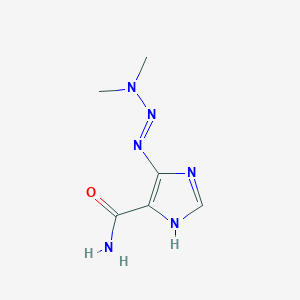
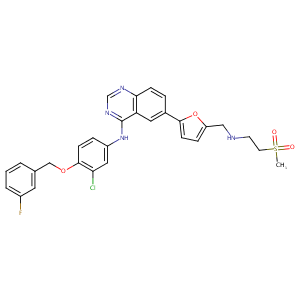
General Information of Drug Combination (ID: DCHOMR9)

Drug Combination Name
Dacarbazine Lapatinib
Indication
Disease Entry Status REF
Adenocarcinoma Investigative [1]
Component Drugs Dacarbazine   DMNPZL4 Lapatinib   DM3BH1Y
Small molecular drug Small molecular drug
2D MOL 2D MOL
3D MOL 3D MOL
High-throughput Screening Result Testing Cell Line: HCT116
Zero Interaction Potency (ZIP) Score: 2.42
Bliss Independence Score: 4.19
Loewe Additivity Score: 3.18
LHighest Single Agent (HSA) Score: 3.88

Molecular Interaction Atlas of This Drug Combination

Molecular Interaction Atlas (MIA)
Indication(s) of Dacarbazine
Disease Entry ICD 11 Status REF
Adenocarcinoma 2D40 Approved [2]
Astrocytoma 2A00.0Y Approved [2]
Brain disease 8C70-8E61 Approved [2]
Central nervous system disease 8A04-8D87 Approved [2]
Glioblastoma 2A00 Approved [2]
Gliosarcoma N.A. Approved [2]
Melanoma 2C30 Approved [3]
Classic Hodgkin lymphoma N.A. Investigative [2]
Neuroblastoma 2D11.2 Investigative [2]
Dacarbazine Interacts with 1 DTT Molecule(s)
DTT Name DTT ID UniProt ID Mode of Action REF
Human Deoxyribonucleic acid (hDNA) TTUTN1I NOUNIPROTAC Breaker [7]
------------------------------------------------------------------------------------
Dacarbazine Interacts with 3 DME Molecule(s)
DME Name DME ID UniProt ID Mode of Action REF
Cytochrome P450 1A2 (CYP1A2) DEJGDUW CP1A2_HUMAN Metabolism [8]
Cytochrome P450 1A1 (CYP1A1) DE6OQ3W CP1A1_HUMAN Metabolism [9]
Cytochrome P450 2E1 (CYP2E1) DEVDYN7 CP2E1_HUMAN Metabolism [10]
------------------------------------------------------------------------------------
Dacarbazine Interacts with 8 DOT Molecule(s)
DOT Name DOT ID UniProt ID Mode of Action REF
Baculoviral IAP repeat-containing protein 5 (BIRC5) OTILXZYL BIRC5_HUMAN Increases Expression [11]
Interleukin-8 (CXCL8) OTS7T5VH IL8_HUMAN Increases Expression [6]
Methylated-DNA--protein-cysteine methyltransferase (MGMT) OT40A9WH MGMT_HUMAN Decreases Activity [12]
DNA repair nuclease/redox regulator APEX1 (APEX1) OT53OI14 APEX1_HUMAN Increases Response To Substance [13]
Solute carrier family 2, facilitated glucose transporter member 1 (SLC2A1) OTA675TJ GTR1_HUMAN Decreases Response To Substance [14]
Mitogen-activated protein kinase 3 (MAPK3) OTCYKGKO MK03_HUMAN Decreases Response To Substance [15]
Mitogen-activated protein kinase 1 (MAPK1) OTH85PI5 MK01_HUMAN Decreases Response To Substance [15]
Mitogen-activated protein kinase kinase kinase 1 (MAP3K1) OTS3FVTY M3K1_HUMAN Decreases Response To Substance [15]
------------------------------------------------------------------------------------
⏷ Show the Full List of 8 DOT(s)
Indication(s) of Lapatinib
Disease Entry ICD 11 Status REF
Breast cancer 2C60-2C65 Approved [4]
Gastroesophageal junction adenocarcinoma 2B71 Approved [5]
Melanoma 2C30 Approved [5]
Lapatinib Interacts with 3 DTT Molecule(s)
DTT Name DTT ID UniProt ID Mode of Action REF
Erbb2 tyrosine kinase receptor (HER2) TT6EO5L ERBB2_HUMAN Inhibitor [17]
Epidermal growth factor receptor (EGFR) TTGKNB4 EGFR_HUMAN Inhibitor [17]
Eukaryotic elongation factor 2 kinase (eEF-2K) TT1QFLA EF2K_HUMAN Inhibitor [18]
------------------------------------------------------------------------------------
Lapatinib Interacts with 2 DTP Molecule(s)
DTP Name DTP ID UniProt ID Mode of Action REF
P-glycoprotein 1 (ABCB1) DTUGYRD MDR1_HUMAN Substrate [19]
Breast cancer resistance protein (ABCG2) DTI7UX6 ABCG2_HUMAN Substrate [20]
------------------------------------------------------------------------------------
Lapatinib Interacts with 4 DME Molecule(s)
DME Name DME ID UniProt ID Mode of Action REF
Cytochrome P450 3A4 (CYP3A4) DE4LYSA CP3A4_HUMAN Metabolism [21]
Cytochrome P450 3A5 (CYP3A5) DEIBDNY CP3A5_HUMAN Metabolism [22]
Cytochrome P450 2C8 (CYP2C8) DES5XRU CP2C8_HUMAN Metabolism [21]
Mephenytoin 4-hydroxylase (CYP2C19) DEGTFWK CP2CJ_HUMAN Metabolism [22]
------------------------------------------------------------------------------------
Lapatinib Interacts with 15 DOT Molecule(s)
DOT Name DOT ID UniProt ID Mode of Action REF
Bile salt export pump (ABCB11) OTRU7THO ABCBB_HUMAN Decreases Activity [23]
Superoxide dismutase , mitochondrial (SOD2) OTIWXGZ9 SODM_HUMAN Increases Expression [24]
Baculoviral IAP repeat-containing protein 5 (BIRC5) OTILXZYL BIRC5_HUMAN Decreases Expression [25]
Poly polymerase 1 (PARP1) OT310QSG PARP1_HUMAN Increases Cleavage [26]
Histone H2AX (H2AX) OT18UX57 H2AX_HUMAN Increases Expression [27]
Phosphatidylcholine translocator ABCB4 (ABCB4) OTE6PY83 MDR3_HUMAN Decreases Activity [28]
Receptor tyrosine-protein kinase erbB-3 (ERBB3) OTRSST0A ERBB3_HUMAN Decreases Activity [29]
Mitogen-activated protein kinase 3 (MAPK3) OTCYKGKO MK03_HUMAN Decreases Activity [26]
Mitogen-activated protein kinase 1 (MAPK1) OTH85PI5 MK01_HUMAN Decreases Activity [26]
Cyclin-dependent kinase inhibitor 1B (CDKN1B) OTNY5LLZ CDN1B_HUMAN Increases Expression [30]
HLA class II histocompatibility antigen, DQ alpha 1 chain (HLA-DQA1) OTC6GISG DQA1_HUMAN Increases ADR [31]
Zinc finger protein SNAI1 (SNAI1) OTDPYAMC SNAI1_HUMAN Decreases Response To Substance [32]
Transforming growth factor beta-1 proprotein (TGFB1) OTV5XHVH TGFB1_HUMAN Decreases Response To Substance [32]
Tenascin-X (TNXB) OTVBWAV5 TENX_HUMAN Increases ADR [31]
HLA class II histocompatibility antigen, DQ beta 1 chain (HLA-DQB1) OTVVI3UI DQB1_HUMAN Increases ADR [31]
------------------------------------------------------------------------------------
⏷ Show the Full List of 15 DOT(s)

Test Results of This Drug Combination in Other Disease Systems

Indication DrugCom ID Cell Line Status REF
Adenocarcinoma DCONUCV NCIH23 Investigative [1]
Adenocarcinoma DCBPCIF SW-620 Investigative [1]
Adenocarcinoma DC5MQGC HCT-15 Investigative [1]
Adult acute myeloid leukemia DCVTWBH HL-60(TB) Investigative [1]
Amelanotic melanoma DCV47KL MDA-MB-435 Investigative [1]
Amelanotic melanoma DC7GYHU M14 Investigative [1]
Anaplastic large cell lymphoma DC5ZLYQ SR Investigative [1]
Astrocytoma DCBZ75X SNB-19 Investigative [1]
Childhood T acute lymphoblastic leukemia DCOHM0D CCRF-CEM Investigative [1]
Cutaneous melanoma DCPYPW4 SK-MEL-5 Investigative [1]
Glioma DCBFCH4 SF-295 Investigative [1]
Glioma DCVBYCQ SF-268 Investigative [1]
High grade ovarian serous adenocarcinoma DCQKYJG OVCAR-8 Investigative [1]
Lung adenocarcinoma DCYBKQM HOP-62 Investigative [1]
Malignant melanoma DCHD6O8 LOX IMVI Investigative [1]
Pleural epithelioid mesothelioma DCVAKD7 NCI-H226 Investigative [1]
------------------------------------------------------------------------------------
⏷ Show the Full List of 16 DrugCom(s)

References

1 CheMBL Affinity Phenotypic Cellular Interaction Assay ID: CHEMBL1125966
2 Dacarbazine FDA Label
3 FDA Approved Drug Products from FDA Official Website. 2009. Application Number: (ANDA) 075259.
4 URL: http://www.guidetopharmacology.org Nucleic Acids Res. 2015 Oct 12. pii: gkv1037. The IUPHAR/BPS Guide to PHARMACOLOGY in 2016: towards curated quantitative interactions between 1300 protein targets and 6000 ligands. (Ligand id: 5692).
5 Lapatinib FDA Label
6 Dacarbazine causes transcriptional up-regulation of interleukin 8 and vascular endothelial growth factor in melanoma cells: a possible escape mechanism from chemotherapy. Mol Cancer Ther. 2003 Aug;2(8):753-63.
7 Predicting the myelotoxicity of chemotherapy: the use of pretreatment O6-methylguanine-DNA methyltransferase determination in peripheral blood mono... Melanoma Res. 2011 Dec;21(6):502-8.
8 Study on mesenchymal stem cells mediated enzyme-prodrug gene CYP1A2 targeting anti-tumor effect. Zhonghua Xue Ye Xue Za Zhi. 2009 Oct;30(10):667-71.
9 Metabolic activation of dacarbazine by human cytochromes P450: the role of CYP1A1, CYP1A2, and CYP2E1. Clin Cancer Res. 1999 Aug;5(8):2192-7.
10 Role of cytochrome P450 isoenzymes in metabolism of O(6)-benzylguanine: implications for dacarbazine activation. Clin Cancer Res. 2001 Dec;7(12):4239-44.
11 Serum bcl-2 and survivin levels in melanoma. Melanoma Res. 2004 Dec;14(6):543-6. doi: 10.1097/00008390-200412000-00017.
12 Pharmacokinetic, biochemical and clinical effects of dimethyltriazenoimidazole-4-carboxamide-bischloroethylnitrosourea combination therapy in patients with advanced breast cancer. Int J Cancer. 2003 Feb 20;103(5):686-92. doi: 10.1002/ijc.10849.
13 Impairment of APE1 function enhances cellular sensitivity to clinically relevant alkylators and antimetabolites. Mol Cancer Res. 2009 Jun;7(6):897-906. doi: 10.1158/1541-7786.MCR-08-0519. Epub 2009 May 26.
14 Glut-1 as a therapeutic target: increased chemoresistance and HIF-1-independent link with cell turnover is revealed through COMPARE analysis and metabolomic studies. Cancer Chemother Pharmacol. 2008 Mar;61(3):377-93. doi: 10.1007/s00280-007-0480-1. Epub 2007 May 23.
15 Exposure of melanoma cells to dacarbazine results in enhanced tumor growth and metastasis in vivo. J Clin Oncol. 2004 Jun 1;22(11):2092-100. doi: 10.1200/JCO.2004.11.070. Epub 2004 May 3.
16 UGT-dependent regioselective glucuronidation of ursodeoxycholic acid and obeticholic acid and selective transport of the consequent acyl glucuronides by OATP1B1 and 1B3. Chem Biol Interact. 2019 Sep 1;310:108745. doi: 10.1016/j.cbi.2019.108745. Epub 2019 Jul 9.
17 Triple negative breast cancer--current status and prospective targeted treatment based on HER1 (EGFR), TOP2A and C-MYC gene assessment. Biomed Pap Med Fac Univ Palacky Olomouc Czech Repub. 2009 Mar;153(1):13-7.
18 Inhibition of eEF-2 kinase sensitizes human nasopharyngeal carcinoma cells to lapatinib-induced apoptosis through the Src and Erk pathways.BMC Cancer. 2016 Oct 19;16(1):813.
19 Tarascon Pocket Pharmacopoeia 2018 Classic Shirt-Pocket Edition.
20 The role of efflux and uptake transporters in [N-{3-chloro-4-[(3-fluorobenzyl)oxy]phenyl}-6-[5-({[2-(methylsulfonyl)ethyl]amino}methyl)-2-furyl]-4-quinazolinamine (GW572016, lapatinib) disposition and drug interactions. Drug Metab Dispos. 2008 Apr;36(4):695-701.
21 Mechanism-based inactivation of cytochrome P450 3A4 by lapatinib. Mol Pharmacol. 2010 Oct;78(4):693-703.
22 Clinical pharmacokinetics of tyrosine kinase inhibitors. Cancer Treat Rev. 2009 Dec;35(8):692-706.
23 Interference with bile salt export pump function is a susceptibility factor for human liver injury in drug development. Toxicol Sci. 2010 Dec; 118(2):485-500.
24 P450 3A-catalyzed O-dealkylation of lapatinib induces mitochondrial stress and activates Nrf2. Chem Res Toxicol. 2016 May 16;29(5):784-96.
25 Combining lapatinib (GW572016), a small molecule inhibitor of ErbB1 and ErbB2 tyrosine kinases, with therapeutic anti-ErbB2 antibodies enhances apoptosis of ErbB2-overexpressing breast cancer cells. Oncogene. 2005 Sep 15;24(41):6213-21. doi: 10.1038/sj.onc.1208774.
26 CDK4/6 inhibition provides a potent adjunct to Her2-targeted therapies in preclinical breast cancer models. Genes Cancer. 2014 Jul;5(7-8):261-72. doi: 10.18632/genesandcancer.24.
27 The involvement of hepatic cytochrome P450s in the cytotoxicity of lapatinib. Toxicol Sci. 2023 Dec 21;197(1):69-78. doi: 10.1093/toxsci/kfad099.
28 Evaluating the Role of Multidrug Resistance Protein 3 (MDR3) Inhibition in Predicting Drug-Induced Liver Injury Using 125 Pharmaceuticals. Chem Res Toxicol. 2017 May 15;30(5):1219-1229. doi: 10.1021/acs.chemrestox.7b00048. Epub 2017 May 4.
29 Suppression of HER2/HER3-mediated growth of breast cancer cells with combinations of GDC-0941 PI3K inhibitor, trastuzumab, and pertuzumab. Clin Cancer Res. 2009 Jun 15;15(12):4147-56. doi: 10.1158/1078-0432.CCR-08-2814. Epub 2009 Jun 9.
30 The dual ErbB1/ErbB2 inhibitor, lapatinib (GW572016), cooperates with tamoxifen to inhibit both cell proliferation- and estrogen-dependent gene expression in antiestrogen-resistant breast cancer. Cancer Res. 2005 Jan 1;65(1):18-25.
31 HLA-DQA1*02:01 is a major risk factor for lapatinib-induced hepatotoxicity in women with advanced breast cancer. J Clin Oncol. 2011 Feb 20;29(6):667-73. doi: 10.1200/JCO.2010.31.3197. Epub 2011 Jan 18.
32 Niclosamide inhibits epithelial-mesenchymal transition and tumor growth in lapatinib-resistant human epidermal growth factor receptor 2-positive breast cancer. Int J Biochem Cell Biol. 2016 Feb;71:12-23. doi: 10.1016/j.biocel.2015.11.014. Epub 2015 Nov 28.