General Information of Drug Combination (ID: DCIQW6K)

Drug Combination Name
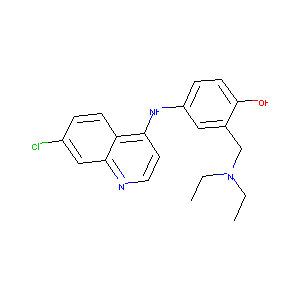
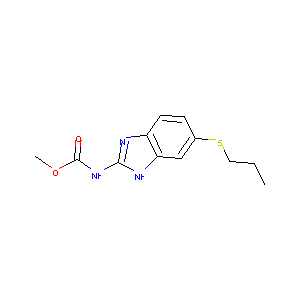
Amodiaquine Albendazole
Indication
Disease Entry Status REF
Chronic myelogenous leukemia Investigative [1]
Component Drugs Amodiaquine   DME4RA8 Albendazole   DMYZ57N
Small molecular drug Small molecular drug
2D MOL 2D MOL
3D MOL 3D MOL
High-throughput Screening Result Testing Cell Line: KBM-7
Zero Interaction Potency (ZIP) Score: 8.2
Bliss Independence Score: 8.2
Loewe Additivity Score: 19.82
LHighest Single Agent (HSA) Score: 19.84

Molecular Interaction Atlas of This Drug Combination

Molecular Interaction Atlas (MIA)
Indication(s) of Amodiaquine
Disease Entry ICD 11 Status REF
Malaria 1F40-1F45 Approved [2]
Middle East Respiratory Syndrome (MERS) 1D64 Preclinical [3]
Severe acute respiratory syndrome (SARS) 1D65 Preclinical [3]
Amodiaquine Interacts with 1 DTT Molecule(s)
DTT Name DTT ID UniProt ID Mode of Action REF
Histamine N-methyltransferase (HNMT) TT2B6EV HNMT_HUMAN Inhibitor [6]
------------------------------------------------------------------------------------
Amodiaquine Interacts with 5 DME Molecule(s)
DME Name DME ID UniProt ID Mode of Action REF
Cytochrome P450 1A1 (CYP1A1) DE6OQ3W CP1A1_HUMAN Metabolism [7]
Cytochrome P450 2C8 (CYP2C8) DES5XRU CP2C8_HUMAN Metabolism [8]
Cytochrome P450 1B1 (CYP1B1) DE9QHP6 CP1B1_HUMAN Metabolism [7]
Glutathione S-transferase mu-4 (GSTM4) DERQ52Z GSTM4_HUMAN Metabolism [9]
Cytochrome P450 102A1 (cyp102) DE4OGUF CPXB_BACMB Metabolism [10]
------------------------------------------------------------------------------------
Amodiaquine Interacts with 8 DOT Molecule(s)
DOT Name DOT ID UniProt ID Mode of Action REF
Cytochrome P450 2C19 (CYP2C19) OTFMJYYE CP2CJ_HUMAN Decreases Activity [11]
Proepiregulin (EREG) OTRM4NQY EREG_HUMAN Increases Expression [12]
Retinoblastoma-associated protein (RB1) OTQJUJMZ RB_HUMAN Affects Phosphorylation [13]
Hepatocyte growth factor receptor (MET) OT7K55MU MET_HUMAN Increases Expression [12]
Cyclin-dependent kinase inhibitor 1 (CDKN1A) OTQWHCZE CDN1A_HUMAN Affects Expression [13]
Tumor necrosis factor-inducible gene 6 protein (TNFAIP6) OT1SLUZH TSG6_HUMAN Decreases Expression [12]
Transcription factor E2F1 (E2F1) OTLKYBBC E2F1_HUMAN Affects Expression [13]
PTB-containing, cubilin and LRP1-interacting protein (PID1) OT5YJ7FI PCLI1_HUMAN Increases Expression [12]
------------------------------------------------------------------------------------
⏷ Show the Full List of 8 DOT(s)
Indication(s) of Albendazole
Disease Entry ICD 11 Status REF
Echinococcus granulosus infectious disease N.A. Approved [4]
Helminth infection 1F90.0 Approved [4]
Worm infection 1F90.Z Approved [5]
Albendazole Interacts with 1 DTT Molecule(s)
DTT Name DTT ID UniProt ID Mode of Action REF
Tubulin beta (TUBB) TTYFKSZ NOUNIPROTAC Binder [15]
------------------------------------------------------------------------------------
Albendazole Interacts with 1 DTP Molecule(s)
DTP Name DTP ID UniProt ID Mode of Action REF
P-glycoprotein 1 (ABCB1) DTUGYRD MDR1_HUMAN Substrate [16]
------------------------------------------------------------------------------------
Albendazole Interacts with 3 DME Molecule(s)
DME Name DME ID UniProt ID Mode of Action REF
Cytochrome P450 3A4 (CYP3A4) DE4LYSA CP3A4_HUMAN Metabolism [17]
Cytochrome P450 1A2 (CYP1A2) DEJGDUW CP1A2_HUMAN Metabolism [18]
Mephenytoin 4-hydroxylase (CYP2C19) DEGTFWK CP2CJ_HUMAN Metabolism [19]
------------------------------------------------------------------------------------
Albendazole Interacts with 5 DOT Molecule(s)
DOT Name DOT ID UniProt ID Mode of Action REF
Interleukin-6 receptor subunit alpha (IL6R) OTCQL07Z IL6RA_HUMAN Increases Expression [14]
Interleukin-8 (CXCL8) OTS7T5VH IL8_HUMAN Increases Expression [14]
C-C motif chemokine 2 (CCL2) OTAD2HEL CCL2_HUMAN Increases Expression [14]
HLA class II histocompatibility antigen, DM beta chain (HLA-DMB) OT17HGXJ DMB_HUMAN Affects Expression [20]
Heat shock factor protein 1 (HSF1) OTYNJ4KP HSF1_HUMAN Increases Activity [21]
------------------------------------------------------------------------------------

References

1 CheMBL Affinity Phenotypic Cellular Interaction Assay ID: CHEMBL1125966
2 Drug information of Amodiaquine, 2008. eduDrugs.
3 Repurposing of clinically developed drugs for treatment of Middle East respiratory syndrome coronavirus infection. Antimicrob Agents Chemother. 2014 Aug;58(8):4885-93.
4 Albendazole FDA Label
5 Opportunities and challenges in antiparasitic drug discovery. Nat Rev Drug Discov. 2005 Sep;4(9):727-40.
6 Effect of amodiaquine, a histamine N-methyltransferase inhibitor, on, Propionibacterium acnes and lipopolysaccharide-induced hepatitis in mice. Eur J Pharmacol. 2007 Mar 8;558(1-3):179-84.
7 Amodiaquine clearance and its metabolism to N-desethylamodiaquine is mediated by CYP2C8: a new high affinity and turnover enzyme-specific probe substrate. J Pharmacol Exp Ther. 2002 Feb;300(2):399-407.
8 Amodiaquine metabolism is impaired by common polymorphisms in CYP2C8: implications for malaria treatment in Africa. Clin Pharmacol Ther. 2007 Aug;82(2):197-203.
9 Human glutathione S-transferases- and NAD(P)H:quinone oxidoreductase 1-catalyzed inactivation of reactive quinoneimines of amodiaquine and N-desethylamodiaquine: possible implications for susceptibility to amodiaquine-induced liver toxicity. Toxicol Lett. 2017 Jun 5;275:83-91.
10 The bacterial P450 BM3: a prototype for a biocatalyst with human P450 activities. Trends Biotechnol. 2007 Jul;25(7):289-98.
11 Application of higher throughput screening (HTS) inhibition assays to evaluate the interaction of antiparasitic drugs with cytochrome P450s. Drug Metab Dispos. 2001 Jan;29(1):30-5.
12 An in vitro coculture system of human peripheral blood mononuclear cells with hepatocellular carcinoma-derived cells for predicting drug-induced liver injury. Arch Toxicol. 2021 Jan;95(1):149-168. doi: 10.1007/s00204-020-02882-4. Epub 2020 Aug 20.
13 The antimalarial amodiaquine causes autophagic-lysosomal and proliferative blockade sensitizing human melanoma cells to starvation- and chemotherapy-induced cell death. Autophagy. 2013 Dec;9(12):2087-102. doi: 10.4161/auto.26506. Epub 2013 Oct 8.
14 Cell-based and cytokine-directed chemical screen to identify potential anti-multiple myeloma agents. Leuk Res. 2010 Jul;34(7):917-24. doi: 10.1016/j.leukres.2009.12.002. Epub 2010 Feb 8.
15 Flubendazole interferes with a wide spectrum of cell homeostatic mechanisms in Echinococcus granulosus protoscoleces. Parasitol Int. 2009 Sep;58(3):270-7.
16 The anthelminthic agent albendazole does not interact with p-glycoprotein. Drug Metab Dispos. 2002 Apr;30(4):365-9.
17 Identification of human cytochrome P(450)s that metabolise anti-parasitic drugs and predictions of in vivo drug hepatic clearance from in vitro data. Eur J Clin Pharmacol. 2003 Sep;59(5-6):429-42.
18 Cytochrome P450 1A1/2 induction by antiparasitic drugs: dose-dependent increase in ethoxyresorufin O-deethylase activity and mRNA caused by quinine, primaquine and albendazole in HepG2 cells. Eur J Clin Pharmacol. 2002 Nov;58(8):537-42.
19 Danazol inhibits cytochrome P450 2J2 activity in a substrate-independent manner. Drug Metab Dispos. 2015 Aug;43(8):1250-3.
20 Systems pharmacological analysis of drugs inducing stevens-johnson syndrome and toxic epidermal necrolysis. Chem Res Toxicol. 2015 May 18;28(5):927-34. doi: 10.1021/tx5005248. Epub 2015 Apr 3.
21 A Gene Expression Biomarker Predicts Heat Shock Factor 1 Activation in a Gene Expression Compendium. Chem Res Toxicol. 2021 Jul 19;34(7):1721-1737. doi: 10.1021/acs.chemrestox.0c00510. Epub 2021 Jun 25.