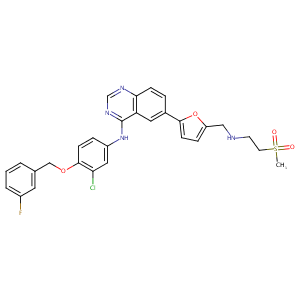
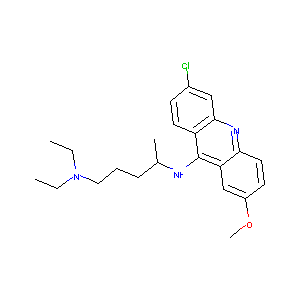
General Information of Drug Combination (ID: DCJMECB)

Drug Combination Name
Lapatinib Mepacrine
Indication
Disease Entry Status REF
Adenocarcinoma Investigative [1]
Component Drugs Lapatinib   DM3BH1Y Mepacrine   DMU8L7C
Small molecular drug Small molecular drug
2D MOL 2D MOL
3D MOL 3D MOL
High-throughput Screening Result Testing Cell Line: OVCAR3
Zero Interaction Potency (ZIP) Score: 0.74
Bliss Independence Score: 4
Loewe Additivity Score: 4.43
LHighest Single Agent (HSA) Score: 4.83

Molecular Interaction Atlas of This Drug Combination

Molecular Interaction Atlas (MIA)
Indication(s) of Lapatinib
Disease Entry ICD 11 Status REF
Breast cancer 2C60-2C65 Approved [2]
Gastroesophageal junction adenocarcinoma 2B71 Approved [3]
Melanoma 2C30 Approved [3]
Lapatinib Interacts with 3 DTT Molecule(s)
DTT Name DTT ID UniProt ID Mode of Action REF
Erbb2 tyrosine kinase receptor (HER2) TT6EO5L ERBB2_HUMAN Inhibitor [6]
Epidermal growth factor receptor (EGFR) TTGKNB4 EGFR_HUMAN Inhibitor [6]
Eukaryotic elongation factor 2 kinase (eEF-2K) TT1QFLA EF2K_HUMAN Inhibitor [7]
------------------------------------------------------------------------------------
Lapatinib Interacts with 2 DTP Molecule(s)
DTP Name DTP ID UniProt ID Mode of Action REF
P-glycoprotein 1 (ABCB1) DTUGYRD MDR1_HUMAN Substrate [8]
Breast cancer resistance protein (ABCG2) DTI7UX6 ABCG2_HUMAN Substrate [9]
------------------------------------------------------------------------------------
Lapatinib Interacts with 4 DME Molecule(s)
DME Name DME ID UniProt ID Mode of Action REF
Cytochrome P450 3A4 (CYP3A4) DE4LYSA CP3A4_HUMAN Metabolism [10]
Cytochrome P450 3A5 (CYP3A5) DEIBDNY CP3A5_HUMAN Metabolism [11]
Cytochrome P450 2C8 (CYP2C8) DES5XRU CP2C8_HUMAN Metabolism [10]
Mephenytoin 4-hydroxylase (CYP2C19) DEGTFWK CP2CJ_HUMAN Metabolism [11]
------------------------------------------------------------------------------------
Lapatinib Interacts with 15 DOT Molecule(s)
DOT Name DOT ID UniProt ID Mode of Action REF
Bile salt export pump (ABCB11) OTRU7THO ABCBB_HUMAN Decreases Activity [12]
Superoxide dismutase , mitochondrial (SOD2) OTIWXGZ9 SODM_HUMAN Increases Expression [13]
Baculoviral IAP repeat-containing protein 5 (BIRC5) OTILXZYL BIRC5_HUMAN Decreases Expression [14]
Poly polymerase 1 (PARP1) OT310QSG PARP1_HUMAN Increases Cleavage [15]
Histone H2AX (H2AX) OT18UX57 H2AX_HUMAN Increases Expression [16]
Phosphatidylcholine translocator ABCB4 (ABCB4) OTE6PY83 MDR3_HUMAN Decreases Activity [17]
Receptor tyrosine-protein kinase erbB-3 (ERBB3) OTRSST0A ERBB3_HUMAN Decreases Activity [18]
Mitogen-activated protein kinase 3 (MAPK3) OTCYKGKO MK03_HUMAN Decreases Activity [15]
Mitogen-activated protein kinase 1 (MAPK1) OTH85PI5 MK01_HUMAN Decreases Activity [15]
Cyclin-dependent kinase inhibitor 1B (CDKN1B) OTNY5LLZ CDN1B_HUMAN Increases Expression [19]
HLA class II histocompatibility antigen, DQ alpha 1 chain (HLA-DQA1) OTC6GISG DQA1_HUMAN Increases ADR [20]
Zinc finger protein SNAI1 (SNAI1) OTDPYAMC SNAI1_HUMAN Decreases Response To Substance [21]
Transforming growth factor beta-1 proprotein (TGFB1) OTV5XHVH TGFB1_HUMAN Decreases Response To Substance [21]
Tenascin-X (TNXB) OTVBWAV5 TENX_HUMAN Increases ADR [20]
HLA class II histocompatibility antigen, DQ beta 1 chain (HLA-DQB1) OTVVI3UI DQB1_HUMAN Increases ADR [20]
------------------------------------------------------------------------------------
⏷ Show the Full List of 15 DOT(s)
Indication(s) of Mepacrine
Disease Entry ICD 11 Status REF
Discovery agent N.A. Investigative [4]
Mepacrine Interacts with 1 DTT Molecule(s)
DTT Name DTT ID UniProt ID Mode of Action REF
Phospholipase A2 (PLA2G1B) TT9V5JH PA21B_HUMAN Inhibitor [4]
------------------------------------------------------------------------------------
Mepacrine Interacts with 1 DTP Molecule(s)
DTP Name DTP ID UniProt ID Mode of Action REF
Breast cancer resistance protein (ABCG2) DTI7UX6 ABCG2_HUMAN Substrate [22]
------------------------------------------------------------------------------------
Mepacrine Interacts with 2 DME Molecule(s)
DME Name DME ID UniProt ID Mode of Action REF
Cytochrome P450 3A4 (CYP3A4) DE4LYSA CP3A4_HUMAN Metabolism [23]
Cytochrome P450 3A5 (CYP3A5) DEIBDNY CP3A5_HUMAN Metabolism [23]
------------------------------------------------------------------------------------
Mepacrine Interacts with 11 DOT Molecule(s)
DOT Name DOT ID UniProt ID Mode of Action REF
Myc proto-oncogene protein (MYC) OTPV5LUK MYC_HUMAN Decreases Expression [24]
Poly polymerase 1 (PARP1) OT310QSG PARP1_HUMAN Increases Cleavage [25]
1-phosphatidylinositol 4,5-bisphosphate phosphodiesterase gamma-1 (PLCG1) OTSBQR6D PLCG1_HUMAN Decreases Phosphorylation [26]
Mitogen-activated protein kinase 3 (MAPK3) OTCYKGKO MK03_HUMAN Decreases Phosphorylation [25]
Mitogen-activated protein kinase 1 (MAPK1) OTH85PI5 MK01_HUMAN Decreases Phosphorylation [25]
Catenin beta-1 (CTNNB1) OTZ932A3 CTNB1_HUMAN Decreases Expression [24]
Cyclin-dependent kinase inhibitor 1 (CDKN1A) OTQWHCZE CDN1A_HUMAN Decreases Expression [27]
Casein kinase I isoform alpha (CSNK1A1) OTJ6O1IC KC1A_HUMAN Increases Expression [24]
Forkhead box protein P3 (FOXP3) OTA9Z9OC FOXP3_HUMAN Increases Expression [25]
F-box/WD repeat-containing protein 1A (BTRC) OT2EZDGR FBW1A_HUMAN Decreases Expression [25]
ATP-dependent translocase ABCB1 (ABCB1) OTEJROBO MDR1_HUMAN Increases Transport [23]
------------------------------------------------------------------------------------
⏷ Show the Full List of 11 DOT(s)

References

1 CheMBL Affinity Phenotypic Cellular Interaction Assay ID: CHEMBL1125976
2 URL: http://www.guidetopharmacology.org Nucleic Acids Res. 2015 Oct 12. pii: gkv1037. The IUPHAR/BPS Guide to PHARMACOLOGY in 2016: towards curated quantitative interactions between 1300 protein targets and 6000 ligands. (Ligand id: 5692).
3 Lapatinib FDA Label
4 Involvement of protein kinase C activation in L-leucine-induced stimulation of protein synthesis in l6 myotubes. Cytotechnology. 2003 Nov;43(1-3):97-103.
5 UGT-dependent regioselective glucuronidation of ursodeoxycholic acid and obeticholic acid and selective transport of the consequent acyl glucuronides by OATP1B1 and 1B3. Chem Biol Interact. 2019 Sep 1;310:108745. doi: 10.1016/j.cbi.2019.108745. Epub 2019 Jul 9.
6 Triple negative breast cancer--current status and prospective targeted treatment based on HER1 (EGFR), TOP2A and C-MYC gene assessment. Biomed Pap Med Fac Univ Palacky Olomouc Czech Repub. 2009 Mar;153(1):13-7.
7 Inhibition of eEF-2 kinase sensitizes human nasopharyngeal carcinoma cells to lapatinib-induced apoptosis through the Src and Erk pathways.BMC Cancer. 2016 Oct 19;16(1):813.
8 Tarascon Pocket Pharmacopoeia 2018 Classic Shirt-Pocket Edition.
9 The role of efflux and uptake transporters in [N-{3-chloro-4-[(3-fluorobenzyl)oxy]phenyl}-6-[5-({[2-(methylsulfonyl)ethyl]amino}methyl)-2-furyl]-4-quinazolinamine (GW572016, lapatinib) disposition and drug interactions. Drug Metab Dispos. 2008 Apr;36(4):695-701.
10 Mechanism-based inactivation of cytochrome P450 3A4 by lapatinib. Mol Pharmacol. 2010 Oct;78(4):693-703.
11 Clinical pharmacokinetics of tyrosine kinase inhibitors. Cancer Treat Rev. 2009 Dec;35(8):692-706.
12 Interference with bile salt export pump function is a susceptibility factor for human liver injury in drug development. Toxicol Sci. 2010 Dec; 118(2):485-500.
13 P450 3A-catalyzed O-dealkylation of lapatinib induces mitochondrial stress and activates Nrf2. Chem Res Toxicol. 2016 May 16;29(5):784-96.
14 Combining lapatinib (GW572016), a small molecule inhibitor of ErbB1 and ErbB2 tyrosine kinases, with therapeutic anti-ErbB2 antibodies enhances apoptosis of ErbB2-overexpressing breast cancer cells. Oncogene. 2005 Sep 15;24(41):6213-21. doi: 10.1038/sj.onc.1208774.
15 CDK4/6 inhibition provides a potent adjunct to Her2-targeted therapies in preclinical breast cancer models. Genes Cancer. 2014 Jul;5(7-8):261-72. doi: 10.18632/genesandcancer.24.
16 The involvement of hepatic cytochrome P450s in the cytotoxicity of lapatinib. Toxicol Sci. 2023 Dec 21;197(1):69-78. doi: 10.1093/toxsci/kfad099.
17 Evaluating the Role of Multidrug Resistance Protein 3 (MDR3) Inhibition in Predicting Drug-Induced Liver Injury Using 125 Pharmaceuticals. Chem Res Toxicol. 2017 May 15;30(5):1219-1229. doi: 10.1021/acs.chemrestox.7b00048. Epub 2017 May 4.
18 Suppression of HER2/HER3-mediated growth of breast cancer cells with combinations of GDC-0941 PI3K inhibitor, trastuzumab, and pertuzumab. Clin Cancer Res. 2009 Jun 15;15(12):4147-56. doi: 10.1158/1078-0432.CCR-08-2814. Epub 2009 Jun 9.
19 The dual ErbB1/ErbB2 inhibitor, lapatinib (GW572016), cooperates with tamoxifen to inhibit both cell proliferation- and estrogen-dependent gene expression in antiestrogen-resistant breast cancer. Cancer Res. 2005 Jan 1;65(1):18-25.
20 HLA-DQA1*02:01 is a major risk factor for lapatinib-induced hepatotoxicity in women with advanced breast cancer. J Clin Oncol. 2011 Feb 20;29(6):667-73. doi: 10.1200/JCO.2010.31.3197. Epub 2011 Jan 18.
21 Niclosamide inhibits epithelial-mesenchymal transition and tumor growth in lapatinib-resistant human epidermal growth factor receptor 2-positive breast cancer. Int J Biochem Cell Biol. 2016 Feb;71:12-23. doi: 10.1016/j.biocel.2015.11.014. Epub 2015 Nov 28.
22 Arginine-482 is not essential for transport of antibiotics, primary bile acids and unconjugated sterols by the human breast cancer resistance protein (ABCG2). Biochem J. 2005 Jan 15;385(Pt 2):419-26.
23 Quinacrine is mainly metabolized to mono-desethyl quinacrine by CYP3A4/5 and its brain accumulation is limited by P-glycoprotein. Drug Metab Dispos. 2006 Jul;34(7):1136-44.
24 Nanoquinacrine caused apoptosis in oral cancer stem cells by disrupting the interaction between GLI1 and catenin through activation of GSK3. Toxicol Appl Pharmacol. 2017 Sep 1;330:53-64. doi: 10.1016/j.taap.2017.07.008. Epub 2017 Jul 15.
25 Quinacrine induces the apoptosis of human leukemia U937 cells through FOXP3/miR-183/-TrCP/SP1 axis-mediated BAX upregulation. Toxicol Appl Pharmacol. 2017 Nov 1;334:35-46. doi: 10.1016/j.taap.2017.08.019. Epub 2017 Sep 1.
26 Quinacrine is active in preclinical models of glioblastoma through suppressing angiogenesis, inducing oxidative stress and activating AMPK. Toxicol In Vitro. 2022 Sep;83:105420. doi: 10.1016/j.tiv.2022.105420. Epub 2022 Jun 17.
27 Multiple-endpoint in vitro carcinogenicity test in human cell line TK6 distinguishes carcinogens from non-carcinogens and highlights mechanisms of action. Arch Toxicol. 2021 Jan;95(1):321-336. doi: 10.1007/s00204-020-02902-3. Epub 2020 Sep 10.