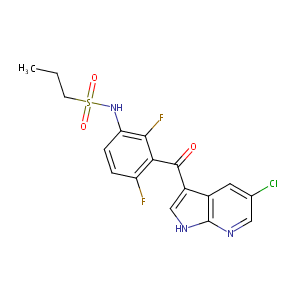
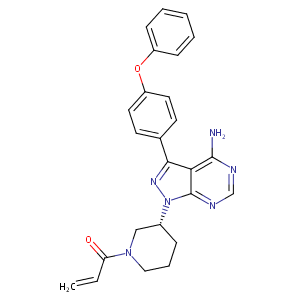
General Information of Drug Combination (ID: DCLZP62)

Drug Combination Name
PLX-4720 Ibrutinib
Indication
Disease Entry Status REF
Diffuse large B cell lymphoma Investigative [1]
Component Drugs PLX-4720   DMBK9AM Ibrutinib   DMHZCPO
Small molecular drug Small molecular drug
2D MOL 2D MOL
3D MOL is unavailable 3D MOL
High-throughput Screening Result Testing Cell Line: TMD8
Zero Interaction Potency (ZIP) Score: 19.95
Bliss Independence Score: 19.26
Loewe Additivity Score: 4.41
LHighest Single Agent (HSA) Score: 5.92

Molecular Interaction Atlas of This Drug Combination

Molecular Interaction Atlas (MIA)
Indication(s) of PLX-4720
Disease Entry ICD 11 Status REF
Cutaneous melanoma 2C30 Phase 1 [2]
PLX-4720 Interacts with 2 DTT Molecule(s)
DTT Name DTT ID UniProt ID Mode of Action REF
Vascular endothelial growth factor receptor 2 (KDR) TTUTJGQ VGFR2_HUMAN Inhibitor [7]
B-Raf messenger RNA (BRAF mRNA) TT0EOB8 BRAF_HUMAN Inhibitor [8]
------------------------------------------------------------------------------------
PLX-4720 Interacts with 1 DOT Molecule(s)
DOT Name DOT ID UniProt ID Mode of Action REF
Heat shock factor protein 1 (HSF1) OTYNJ4KP HSF1_HUMAN Decreases Activity [9]
------------------------------------------------------------------------------------
Indication(s) of Ibrutinib
Disease Entry ICD 11 Status REF
Mantle cell lymphoma 2A85.5 Approved [3]
Small lymphocytic lymphoma 2A82.0 Approved [4]
Waldenstrom macroglobulinemia 2A85.4 Approved [4]
B-cell non-hodgkin lymphoma 2B33.5 Phase 3 [5]
Diffuse large B-cell lymphoma 2A81 Phase 3 [5]
Follicular lymphoma 2A80 Phase 3 [5]
Non-hodgkin lymphoma 2B33.5 Phase 3 [5]
Pancreatic cancer 2C10 Phase 3 [5]
Coronavirus Disease 2019 (COVID-19) 1D6Y Phase 2 [6]
Solid tumour/cancer 2A00-2F9Z Phase 2 [5]
Ibrutinib Interacts with 1 DTT Molecule(s)
DTT Name DTT ID UniProt ID Mode of Action REF
Tyrosine-protein kinase BTK (ATK) TTGM6VW BTK_HUMAN Inhibitor [10]
------------------------------------------------------------------------------------
Ibrutinib Interacts with 1 DTP Molecule(s)
DTP Name DTP ID UniProt ID Mode of Action REF
P-glycoprotein 1 (ABCB1) DTUGYRD MDR1_HUMAN Substrate [11]
------------------------------------------------------------------------------------
Ibrutinib Interacts with 3 DME Molecule(s)
DME Name DME ID UniProt ID Mode of Action REF
Cytochrome P450 3A4 (CYP3A4) DE4LYSA CP3A4_HUMAN Metabolism [12]
Cytochrome P450 2D6 (CYP2D6) DECB0K3 CP2D6_HUMAN Metabolism [12]
Cytochrome P450 3A5 (CYP3A5) DEIBDNY CP3A5_HUMAN Metabolism [12]
------------------------------------------------------------------------------------
Ibrutinib Interacts with 11 DOT Molecule(s)
DOT Name DOT ID UniProt ID Mode of Action REF
CASP8 and FADD-like apoptosis regulator (CFLAR) OTX14BAS CFLAR_HUMAN Decreases Expression [13]
PR domain zinc finger protein 1 (PRDM1) OTQLSVBS PRDM1_HUMAN Decreases Expression [13]
1-phosphatidylinositol 4,5-bisphosphate phosphodiesterase gamma-2 (PLCG2) OTGVC9MY PLCG2_HUMAN Decreases Phosphorylation [13]
Tumor necrosis factor alpha-induced protein 3 (TNFAIP3) OTVLI4DD TNAP3_HUMAN Decreases Expression [13]
Transcription factor p65 (RELA) OTUJP9CN TF65_HUMAN Affects Localization [13]
Bcl-2-like protein 1 (BCL2L1) OTRC5K9O B2CL1_HUMAN Decreases Expression [13]
Baculoviral IAP repeat-containing protein 3 (BIRC3) OT3E95KB BIRC3_HUMAN Decreases Expression [13]
Albumin (ALB) OTVMM513 ALBU_HUMAN Affects Binding [14]
TNF receptor-associated factor 2 (TRAF2) OT1MEZZN TRAF2_HUMAN Decreases Response To Substance [13]
TNF receptor-associated factor 3 (TRAF3) OT5TQBGV TRAF3_HUMAN Decreases Response To Substance [13]
Mitogen-activated protein kinase kinase kinase 14 (MAP3K14) OTT3DOOL M3K14_HUMAN Decreases Response To Substance [13]
------------------------------------------------------------------------------------
⏷ Show the Full List of 11 DOT(s)

References

1 CheMBL Affinity Phenotypic Cellular Interaction Assay ID: CHEMBL1125966
2 Targeting BRAFV600E with PLX4720 displays potent antimigratory and anti-invasive activity in preclinical models of human thyroid cancer. Oncologist. 2011;16(3):296-309.
3 URL: http://www.guidetopharmacology.org Nucleic Acids Res. 2015 Oct 12. pii: gkv1037. The IUPHAR/BPS Guide to PHARMACOLOGY in 2016: towards curated quantitative interactions between 1300 protein targets and 6000 ligands. (Ligand id: 6912).
4 Ibrutinib FDA Label
5 Clinical pipeline report, company report or official report of the Pharmaceutical Research and Manufacturers of America (PhRMA)
6 Ibrutinib for the Treatment of COVID-19 in Patients Requiring Hospitalization
7 In vivo antitumor activity of SU11248, a novel tyrosine kinase inhibitor targeting vascular endothelial growth factor and platelet-derived growth factor receptors: determination of a pharmacokinetic/pharmacodynamic relationship. Clin Cancer Res. 2003 Jan;9(1):327-37.
8 Comprehensive analysis of kinase inhibitor selectivity. Nat Biotechnol. 2011 Oct 30;29(11):1046-51.
9 A Gene Expression Biomarker Predicts Heat Shock Factor 1 Activation in a Gene Expression Compendium. Chem Res Toxicol. 2021 Jul 19;34(7):1721-1737. doi: 10.1021/acs.chemrestox.0c00510. Epub 2021 Jun 25.
10 URL: http://www.guidetopharmacology.org Nucleic Acids Res. 2015 Oct 12. pii: gkv1037. The IUPHAR/BPS Guide to PHARMACOLOGY in 2016: towards curated quantitative interactions between 1300 protein targets and 6000 ligands. (Target id: 1948).
11 P-Glycoprotein (MDR1/ABCB1) Restricts Brain Penetration of the Bruton's Tyrosine Kinase Inhibitor Ibrutinib, While Cytochrome P450-3A (CYP3A) Limits Its Oral Bioavailability. Mol Pharm. 2018 Nov 5;15(11):5124-5134.
12 Absorption, metabolism, and excretion of oral 14C radiolabeled ibrutinib: an open-label, phase I, single-dose study in healthy men. Drug Metab Dispos. 2015 Feb;43(2):289-97.
13 Synergistic activity of BET protein antagonist-based combinations in mantle cell lymphoma cells sensitive or resistant to ibrutinib. Blood. 2015 Sep 24;126(13):1565-74.
14 Label-Free Bottom-Up Proteomic Workflow for Simultaneously Assessing the Target Specificity of Covalent Drug Candidates and Their Off-Target Reactivity to Selected Proteins. Chem Res Toxicol. 2016 Jan 19;29(1):109-16. doi: 10.1021/acs.chemrestox.5b00460. Epub 2015 Dec 29.