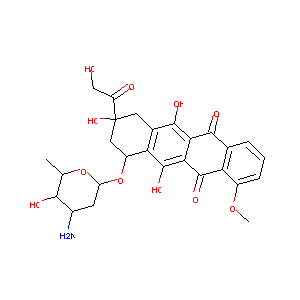
General Information of Drug Combination (ID: DCPCONN)

Drug Combination Name
Crizotinib Epirubicin
Indication
Disease Entry Status REF
Adenocarcinoma Investigative [1]
Component Drugs Crizotinib   DM4F29C Epirubicin   DMPDW6T
Small molecular drug Small molecular drug
2D MOL 2D MOL
3D MOL 3D MOL
High-throughput Screening Result Testing Cell Line: OVCAR3
Zero Interaction Potency (ZIP) Score: 5.61
Bliss Independence Score: 9.54
Loewe Additivity Score: 7.03
LHighest Single Agent (HSA) Score: 6.32

Molecular Interaction Atlas of This Drug Combination

Molecular Interaction Atlas (MIA)
Indication(s) of Crizotinib
Disease Entry ICD 11 Status REF
Non-small-cell lung cancer 2C25.Y Approved [2]
Crizotinib Interacts with 4 DTT Molecule(s)
DTT Name DTT ID UniProt ID Mode of Action REF
Proto-oncogene c-Met (MET) TTNDSF4 MET_HUMAN Modulator [7]
ALK tyrosine kinase receptor (ALK) TTPMQSO ALK_HUMAN Modulator [7]
Proto-oncogene c-Ros (ROS1) TTSZ6Y3 ROS1_HUMAN Modulator [7]
HGF/Met signaling pathway (HGF/Met pathway) TTKA5LP NOUNIPROTAC Inhibitor [8]
------------------------------------------------------------------------------------
Crizotinib Interacts with 3 DTP Molecule(s)
DTP Name DTP ID UniProt ID Mode of Action REF
P-glycoprotein 1 (ABCB1) DTUGYRD MDR1_HUMAN Substrate [9]
Organic anion transporting polypeptide 1B1 (SLCO1B1) DT3D8F0 SO1B1_HUMAN Substrate [10]
Organic anion transporting polypeptide 1B3 (SLCO1B3) DT9C1TS SO1B3_HUMAN Substrate [10]
------------------------------------------------------------------------------------
Crizotinib Interacts with 2 DME Molecule(s)
DME Name DME ID UniProt ID Mode of Action REF
Cytochrome P450 3A4 (CYP3A4) DE4LYSA CP3A4_HUMAN Metabolism [11]
Cytochrome P450 3A5 (CYP3A5) DEIBDNY CP3A5_HUMAN Metabolism [11]
------------------------------------------------------------------------------------
Crizotinib Interacts with 24 DOT Molecule(s)
DOT Name DOT ID UniProt ID Mode of Action REF
ATP-dependent translocase ABCB1 (ABCB1) OTEJROBO MDR1_HUMAN Decreases Activity [12]
Hepatocyte growth factor receptor (MET) OT7K55MU MET_HUMAN Increases Response To Substance [5]
CD44 antigen (CD44) OT9TTJ41 CD44_HUMAN Decreases Expression [4]
Epithelial cell adhesion molecule (EPCAM) OTHBZK5X EPCAM_HUMAN Decreases Expression [4]
Insulin-induced gene 1 protein (INSIG1) OTZF5X1D INSI1_HUMAN Increases Expression [13]
Hydroxymethylglutaryl-CoA synthase, cytoplasmic (HMGCS1) OTCO26FV HMCS1_HUMAN Increases Expression [13]
Sterol regulatory element-binding protein 2 (SREBF2) OTBXUNPL SRBP2_HUMAN Increases Expression [13]
Acetyl-CoA carboxylase 1 (ACACA) OT5CQPZY ACACA_HUMAN Increases Phosphorylation [13]
Voltage-dependent L-type calcium channel subunit alpha-1C (CACNA1C) OT6KFNMS CAC1C_HUMAN Decreases Activity [13]
Sodium channel protein type 5 subunit alpha (SCN5A) OTGYZWR6 SCN5A_HUMAN Decreases Activity [13]
Baculoviral IAP repeat-containing protein 5 (BIRC5) OTILXZYL BIRC5_HUMAN Decreases Expression [5]
Bcl-2-like protein 11 (BCL2L11) OTNQQWFJ B2L11_HUMAN Increases Expression [5]
Follitropin subunit beta (FSHB) OTGLS283 FSHB_HUMAN Decreases Secretion [14]
Lutropin subunit beta (LHB) OT5GBOVJ LSHB_HUMAN Decreases Secretion [14]
Tyrosine-protein kinase Lck (LCK) OT883FG9 LCK_HUMAN Decreases Activity [15]
Poly polymerase 1 (PARP1) OT310QSG PARP1_HUMAN Increases Cleavage [16]
Histone H2AX (H2AX) OT18UX57 H2AX_HUMAN Increases Phosphorylation [16]
Mitogen-activated protein kinase 3 (MAPK3) OTCYKGKO MK03_HUMAN Decreases Phosphorylation [17]
Mitogen-activated protein kinase 1 (MAPK1) OTH85PI5 MK01_HUMAN Decreases Phosphorylation [17]
Ras GTPase-activating-like protein IQGAP1 (IQGAP1) OTZRWTGA IQGA1_HUMAN Decreases Phosphorylation [18]
Small ribosomal subunit protein eS6 (RPS6) OTT4D1LN RS6_HUMAN Decreases Phosphorylation [19]
Baculoviral IAP repeat-containing protein 2 (BIRC2) OTFXFREP BIRC2_HUMAN Decreases Expression [5]
Broad substrate specificity ATP-binding cassette transporter ABCG2 (ABCG2) OTW8V2V1 ABCG2_HUMAN Decreases Activity [12]
Mast/stem cell growth factor receptor Kit (KIT) OTHUY3VZ KIT_HUMAN Decreases Response To Substance [20]
------------------------------------------------------------------------------------
⏷ Show the Full List of 24 DOT(s)
Indication(s) of Epirubicin
Disease Entry ICD 11 Status REF
Solid tumour/cancer 2A00-2F9Z Approved [3]
Epirubicin Interacts with 1 DTT Molecule(s)
DTT Name DTT ID UniProt ID Mode of Action REF
DNA topoisomerase II (TOP2) TT0IHXV TOP2A_HUMAN; TOP2B_HUMAN Modulator [21]
------------------------------------------------------------------------------------
Epirubicin Interacts with 4 DTP Molecule(s)
DTP Name DTP ID UniProt ID Mode of Action REF
Multidrug resistance-associated protein 1 (ABCC1) DTSYQGK MRP1_HUMAN Substrate [22]
Multidrug resistance-associated protein 2 (ABCC2) DTFI42L MRP2_HUMAN Substrate [23]
P-glycoprotein 1 (ABCB1) DTUGYRD MDR1_HUMAN Substrate [23]
Breast cancer resistance protein (ABCG2) DTI7UX6 ABCG2_HUMAN Substrate [23]
------------------------------------------------------------------------------------
Epirubicin Interacts with 1 DME Molecule(s)
DME Name DME ID UniProt ID Mode of Action REF
UDP-glucuronosyltransferase 2B7 (UGT2B7) DEB3CV1 UD2B7_HUMAN Metabolism [24]
------------------------------------------------------------------------------------
Epirubicin Interacts with 19 DOT Molecule(s)
DOT Name DOT ID UniProt ID Mode of Action REF
ATP-dependent translocase ABCB1 (ABCB1) OTEJROBO MDR1_HUMAN Increases Expression [25]
Broad substrate specificity ATP-binding cassette transporter ABCG2 (ABCG2) OTW8V2V1 ABCG2_HUMAN Decreases Response To Substance [26]
Natriuretic peptides A (NPPA) OTMQNTNX ANF_HUMAN Increases Expression [27]
Interleukin-6 receptor subunit alpha (IL6R) OTCQL07Z IL6RA_HUMAN Increases Expression [28]
Mitogen-activated protein kinase 3 (MAPK3) OTCYKGKO MK03_HUMAN Increases Phosphorylation [29]
Mitogen-activated protein kinase 1 (MAPK1) OTH85PI5 MK01_HUMAN Increases Phosphorylation [29]
Protein PML (PML) OT6SM2GD PML_HUMAN Affects Mutagenesis [30]
FK506-binding protein-like (FKBPL) OTR9ND6K FKBPL_HUMAN Increases Expression [31]
Tumor necrosis factor receptor superfamily member 1A (TNFRSF1A) OT2D9DOV TNR1A_HUMAN Increases ADR [32]
MARVEL domain-containing protein 1 (MARVELD1) OT5CPOJE MALD1_HUMAN Increases Response To Substance [33]
Phospholysine phosphohistidine inorganic pyrophosphate phosphatase (LHPP) OT9AGAIJ LHPP_HUMAN Increases ADR [32]
Alpha-protein kinase 1 (ALPK1) OTBW6SGD ALPK1_HUMAN Increases ADR [34]
Baculoviral IAP repeat-containing protein 6 (BIRC6) OTCQJAB0 BIRC6_HUMAN Decreases Response To Substance [35]
Baculoviral IAP repeat-containing protein 5 (BIRC5) OTILXZYL BIRC5_HUMAN Decreases Response To Substance [36]
Superoxide dismutase , mitochondrial (SOD2) OTIWXGZ9 SODM_HUMAN Affects Response To Substance [37]
Protein S100-P (S100P) OTJCXNJG S100P_HUMAN Increases Response To Substance [38]
Pleckstrin homology-like domain family A member 2 (PHLDA2) OTMV9DPP PHLA2_HUMAN Increases Response To Substance [39]
Little elongation complex subunit 1 (ICE1) OTOXTBUH ICE1_HUMAN Increases ADR [32]
Microcephalin (MCPH1) OTYT3TT5 MCPH1_HUMAN Increases ADR [34]
------------------------------------------------------------------------------------
⏷ Show the Full List of 19 DOT(s)

Test Results of This Drug Combination in Other Disease Systems

Indication DrugCom ID Cell Line Status REF
Adult T acute lymphoblastic leukemia DC6WDN7 MOLT-4 Investigative [1]
Amelanotic melanoma DC8LF53 M14 Investigative [1]
Astrocytoma DCFSTQV U251 Investigative [1]
Clear cell renal cell carcinoma DCD527H CAKI-1 Investigative [1]
Cutaneous melanoma DCIUO2Y SK-MEL-5 Investigative [1]
Cutaneous melanoma DC60HAJ SK-MEL-28 Investigative [1]
Glioma DCRSUTD SF-539 Investigative [1]
High grade ovarian serous adenocarcinoma DC4IQB6 NCI\\/ADR-RES Investigative [1]
Lung adenocarcinoma DC4ZNSR HOP-62 Investigative [1]
Malignant melanoma DCXIWF3 LOX IMVI Investigative [1]
Melanoma DC84ONC UACC-257 Investigative [1]
Minimally invasive lung adenocarcinoma DCTW6ZC NCI-H322M Investigative [1]
Papillary renal cell carcinoma DC488S2 ACHN Investigative [1]
Plasma cell myeloma DCO05AN RPMI-8226 Investigative [1]
Breast adenocarcinoma DCBFSJ0 MDA-MB-468 Investigative [40]
Invasive ductal carcinoma DC3XL78 BT-549 Investigative [40]
Invasive ductal carcinoma DCADJTY T-47D Investigative [40]
Invasive ductal carcinoma DCJUULH HS 578T Investigative [40]
------------------------------------------------------------------------------------
⏷ Show the Full List of 18 DrugCom(s)

References

1 CheMBL Affinity Phenotypic Cellular Interaction Assay ID: CHEMBL1125966
2 URL: http://www.guidetopharmacology.org Nucleic Acids Res. 2015 Oct 12. pii: gkv1037. The IUPHAR/BPS Guide to PHARMACOLOGY in 2016: towards curated quantitative interactions between 1300 protein targets and 6000 ligands. (Ligand id: 4903).
3 New drugs for the treatment of cancer, 1990-2001. Isr Med Assoc J. 2002 Dec;4(12):1124-31.
4 Enhancement of the antiproliferative activity of gemcitabine by modulation of c-Met pathway in pancreatic cancer. Curr Pharm Des. 2013;19(5):940-50.
5 Antitumor action of the MET tyrosine kinase inhibitor crizotinib (PF-02341066) in gastric cancer positive for MET amplification. Mol Cancer Ther. 2012 Jul;11(7):1557-64. doi: 10.1158/1535-7163.MCT-11-0934. Epub 2012 Jun 22.
6 Aberrant expression of the transcriptional factor Twist1 promotes invasiveness in ALK-positive anaplastic large cell lymphoma. Cell Signal. 2012 Apr;24(4):852-8. doi: 10.1016/j.cellsig.2011.11.020. Epub 2011 Dec 8.
7 Drugs@FDA. U.S. Food and Drug Administration. U.S. Department of Health & Human Services. 2015
8 Met tyrosine kinase inhibitor, PF-2341066, suppresses growth and invasion of nasopharyngeal carcinoma.Drug Des Devel Ther. 2015 Aug 26;9:4897-907.
9 Increased oral availability and brain accumulation of the ALK inhibitor crizotinib by coadministration of the P-glycoprotein (ABCB1) and breast cancer resistance protein (ABCG2) inhibitor elacridar. Int J Cancer. 2014 Mar 15;134(6):1484-94.
10 Contribution of OATP1B1 and OATP1B3 to the disposition of sorafenib and sorafenib-glucuronide. Clin Cancer Res. 2013 Mar 15;19(6):1458-66.
11 Crizotinib for the treatment of non-small-cell lung cancer. Am J Health Syst Pharm. 2013 Jun 1;70(11):943-7.
12 Editor's Highlight: PlacentalDisposition and Effects of Crizotinib: An Ex Vivo Study in the Isolated Dual-Side Perfused Human Cotyledon. Toxicol Sci. 2017 Jun 1;157(2):500-509. doi: 10.1093/toxsci/kfx063.
13 Multi-parameter in vitro toxicity testing of crizotinib, sunitinib, erlotinib, and nilotinib in human cardiomyocytes. Toxicol Appl Pharmacol. 2013 Oct 1;272(1):245-55.
14 Rapid-onset hypogonadism secondary to crizotinib use in men with metastatic nonsmall cell lung cancer. Cancer. 2012 Nov 1;118(21):5302-9. doi: 10.1002/cncr.27450. Epub 2012 Apr 4.
15 Structure based drug design of crizotinib (PF-02341066), a potent and selective dual inhibitor of mesenchymal-epithelial transition factor (c-MET) kinase and anaplastic lymphoma kinase (ALK). J Med Chem. 2011 Sep 22;54(18):6342-63. doi: 10.1021/jm2007613. Epub 2011 Aug 18.
16 ROS-dependent DNA damage contributes to crizotinib-induced hepatotoxicity via the apoptotic pathway. Toxicol Appl Pharmacol. 2019 Nov 15;383:114768. doi: 10.1016/j.taap.2019.114768. Epub 2019 Oct 19.
17 Therapeutic strategies to overcome crizotinib resistance in non-small cell lung cancers harboring the fusion oncogene EML4-ALK. Proc Natl Acad Sci U S A. 2011 May 3;108(18):7535-40. doi: 10.1073/pnas.1019559108. Epub 2011 Apr 18.
18 Tyrosine phosphorylation of the scaffold protein IQGAP1 in the MET pathway alters function. J Biol Chem. 2020 Dec 25;295(52):18105-18121. doi: 10.1074/jbc.RA120.015891. Epub 2020 Oct 21.
19 Crizotinib-resistant mutants of EML4-ALK identified through an accelerated mutagenesis screen. Chem Biol Drug Des. 2011 Dec;78(6):999-1005. doi: 10.1111/j.1747-0285.2011.01239.x. Epub 2011 Oct 31.
20 Mechanisms of acquired crizotinib resistance in ALK-rearranged lung Cancers. Sci Transl Med. 2012 Feb 8;4(120):120ra17. doi: 10.1126/scitranslmed.3003316. Epub 2012 Jan 25.
21 Drugs@FDA. U.S. Food and Drug Administration. U.S. Department of Health & Human Services.
22 Sulindac sulfide selectively increases sensitivity of ABCC1 expressing tumor cells to doxorubicin and glutathione depletion. J Biomed Res. 2016 Mar;30(2):120-133.
23 Mammalian drug efflux transporters of the ATP binding cassette (ABC) family in multidrug resistance: A review of the past decade. Cancer Lett. 2016 Jan 1;370(1):153-64.
24 Epirubicin glucuronidation and UGT2B7 developmental expression. Drug Metab Dispos. 2006 Dec;34(12):2097-101.
25 Co-encapsulation of chrysophsin-1 and epirubicin in PEGylated liposomes circumvents multidrug resistance in HeLa cells. Chem Biol Interact. 2015 Dec 5;242:13-23. doi: 10.1016/j.cbi.2015.08.023. Epub 2015 Sep 1.
26 Camptothecin resistance: role of the ATP-binding cassette (ABC), mitoxantrone-resistance half-transporter (MXR), and potential for glucuronidation in MXR-expressing cells. Cancer Res. 1999 Dec 1;59(23):5938-46.
27 Preliminary study on behaviour of atrial natriuretic factor in anthracycline-related cardiac toxicity. Int J Clin Pharmacol Res. 1991;11(2):75-81.
28 Persistence, up to 18 months of follow-up, of epirubicin-induced myocardial dysfunction detected early by serial tissue Doppler echocardiography: correlation with inflammatory and oxidative stress markers. Oncologist. 2008 Dec;13(12):1296-305. doi: 10.1634/theoncologist.2008-0151. Epub 2008 Dec 5.
29 (-)-Gossypol enhances the anticancer activity of epirubicin via downregulating survivin in hepatocellular carcinoma. Chem Biol Interact. 2022 Sep 1;364:110060. doi: 10.1016/j.cbi.2022.110060. Epub 2022 Jul 22.
30 Evidence for direct involvement of epirubicin in the formation of chromosomal translocations in t(15;17) therapy-related acute promyelocytic leukemia. Blood. 2010 Jan 14;115(2):326-30. doi: 10.1182/blood-2009-07-235051. Epub 2009 Nov 2.
31 The differential effects of cyclophosphamide, epirubicin and 5-fluorouracil on apoptotic marker (CPP-32), pro-apoptotic protein (p21(WAF-1)) and anti-apoptotic protein (bcl-2) in breast cancer cells. Breast Cancer Res Treat. 2003 Aug;80(3):239-44. doi: 10.1023/A:1024995202135.
32 Genome-wide association study of chemotherapeutic agent-induced severe neutropenia/leucopenia for patients in Biobank Japan. Cancer Sci. 2013 Aug;104(8):1074-82. doi: 10.1111/cas.12186. Epub 2013 Jun 10.
33 MARVELD1 attenuates arsenic trioxide-induced apoptosis in liver cancer cells by inhibiting reactive oxygen species production. Ann Transl Med. 2019 May;7(9):200. doi: 10.21037/atm.2019.04.38.
34 Genome-wide association study of epirubicin-induced leukopenia in Japanese patients. Pharmacogenet Genomics. 2011 Sep;21(9):552-8. doi: 10.1097/FPC.0b013e328348e48f.
35 [Knock-down of apollon gene by antisense oligodeoxynucleotide inhibits the proliferation of Lovo cells and enhances chemo-sensitivity]. Yao Xue Xue Bao. 2011 Feb;46(2):138-45.
36 [Antisense oligonucleotide targeting survivin induces apoptosis of renal clear-cell carcinoma cells and enhances their sensitivity to epirubicin in vitro]. Zhonghua Zhong Liu Za Zhi. 2005 Aug;27(8):468-70.
37 Endogenous antioxidant enzymes and glutathione S-transferase in protection of mesothelioma cells against hydrogen peroxide and epirubicin toxicity. Br J Cancer. 1998 Apr;77(7):1097-102. doi: 10.1038/bjc.1998.182.
38 S100P contributes to chemosensitivity of human ovarian cancer cell line OVCAR3. Oncol Rep. 2008 Aug;20(2):325-32.
39 TSSC3 overexpression associates with growth inhibition, apoptosis induction and enhances chemotherapeutic effects in human osteosarcoma. Carcinogenesis. 2012 Jan;33(1):30-40. doi: 10.1093/carcin/bgr232. Epub 2011 Oct 21.
40 CheMBL Affinity Phenotypic Cellular Interaction Assay ID: CHEMBL1126165