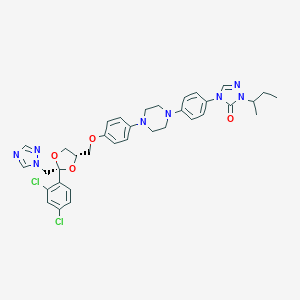
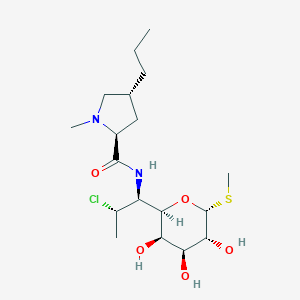
General Information of Drug Combination (ID: DCRL3XB)

Drug Combination Name
Itraconazole Clindamycin
Indication
Disease Entry Status REF
Chronic myelogenous leukemia Investigative [1]
Component Drugs Itraconazole   DMCR1MV Clindamycin   DM15HL8
Small molecular drug Small molecular drug
2D MOL 2D MOL
3D MOL 3D MOL
High-throughput Screening Result Testing Cell Line: KBM-7
Zero Interaction Potency (ZIP) Score: 14.68
Bliss Independence Score: 14.68
Loewe Additivity Score: 27.23
LHighest Single Agent (HSA) Score: 27.23

Molecular Interaction Atlas of This Drug Combination

Molecular Interaction Atlas (MIA)
Indication(s) of Itraconazole
Disease Entry ICD 11 Status REF
Aspergillosis 1F20 Approved [2]
Blastomycosis 1F22 Approved [2]
Fungal infection 1F29-1F2F Approved [3]
Fusariosis N.A. Approved [2]
Histoplasmosis N.A. Approved [2]
Invasive candidiasis 1F23 Approved [2]
Mycoses 1F2Z Approved [2]
Candidemia 1F23.3Y Investigative [2]
Esophageal candidiasis N.A. Investigative [2]
Itraconazole Interacts with 2 DTT Molecule(s)
DTT Name DTT ID UniProt ID Mode of Action REF
Hedgehog signaling pathway (HS pathway) TT4LXBC NOUNIPROTAC Inhibitor [6]
Candida Cytochrome P450 51 (Candi ERG11) TTTSOUD CP51_CANAL Modulator [7]
------------------------------------------------------------------------------------
Itraconazole Interacts with 1 DTP Molecule(s)
DTP Name DTP ID UniProt ID Mode of Action REF
P-glycoprotein 1 (ABCB1) DTUGYRD MDR1_HUMAN Substrate [8]
------------------------------------------------------------------------------------
Itraconazole Interacts with 2 DME Molecule(s)
DME Name DME ID UniProt ID Mode of Action REF
Cytochrome P450 3A4 (CYP3A4) DE4LYSA CP3A4_HUMAN Metabolism [9]
UDP-glucuronosyltransferase 1A1 (UGT1A1) DEYGVN4 UD11_HUMAN Metabolism [10]
------------------------------------------------------------------------------------
Itraconazole Interacts with 4 DOT Molecule(s)
DOT Name DOT ID UniProt ID Mode of Action REF
ATP-dependent translocase ABCB1 (ABCB1) OTEJROBO MDR1_HUMAN Decreases Activity [11]
1,25-dihydroxyvitamin D(3) 24-hydroxylase, mitochondrial (CYP24A1) OTG2T749 CP24A_HUMAN Decreases Activity [12]
Nuclear receptor subfamily 1 group I member 2 (NR1I2) OTC5U0N5 NR1I2_HUMAN Increases Expression [13]
Bile salt export pump (ABCB11) OTRU7THO ABCBB_HUMAN Decreases Activity [14]
------------------------------------------------------------------------------------
Indication(s) of Clindamycin
Disease Entry ICD 11 Status REF
Acne vulgaris ED80 Approved [4]
Aspiration pneumonia N.A. Approved [5]
Bacteremia 1A73 Approved [5]
Bacterial vaginosis MF3A Approved [5]
Pleural empyema N.A. Approved [5]
Staphylococcal pneumonia N.A. Approved [5]
Staphylococcus aureus infection N.A. Approved [5]
Streptococcal pneumonia N.A. Approved [5]
Pelvic inflammatory disease GA05 Investigative [5]
Clindamycin Interacts with 1 DTT Molecule(s)
DTT Name DTT ID UniProt ID Mode of Action REF
Bacterial 50S ribosomal RNA (Bact 50S rRNA) TTUWYEA NOUNIPROTAC Binder [15]
------------------------------------------------------------------------------------
Clindamycin Interacts with 2 DME Molecule(s)
DME Name DME ID UniProt ID Mode of Action REF
Cytochrome P450 3A4 (CYP3A4) DE4LYSA CP3A4_HUMAN Metabolism [16]
Beta-lactamase (blaB) DEMSNER A4LA84_EDWTA Metabolism [17]
------------------------------------------------------------------------------------
Clindamycin Interacts with 2 DOT Molecule(s)
DOT Name DOT ID UniProt ID Mode of Action REF
HLA class I histocompatibility antigen, alpha chain E (HLA-E) OTX1CTFB HLAE_HUMAN Affects Expression [18]
Collagenase 3 (MMP13) OTY8BZIE MMP13_HUMAN Increases Expression [19]
------------------------------------------------------------------------------------

References

1 CheMBL Affinity Phenotypic Cellular Interaction Assay ID: CHEMBL1125966
2 Itraconazole FDA Label
3 FDA Approved Drug Products from FDA Official Website. 2009. Application Number: (ANDA) 076104.
4 Drugs@FDA. U.S. Food and Drug Administration. U.S. Department of Health & Human Services. 2015
5 Clindamycin FDA Label
6 Clinical pipeline report, company report or official report of the Pharmaceutical Research and Manufacturers of America (PhRMA)
7 Drugs@FDA. U.S. Food and Drug Administration. U.S. Department of Health & Human Services.
8 Mammalian drug efflux transporters of the ATP binding cassette (ABC) family in multidrug resistance: A review of the past decade. Cancer Lett. 2016 Jan 1;370(1):153-64.
9 Effects of itraconazole and tandospirone on the pharmacokinetics of perospirone. Ther Drug Monit. 2006 Feb;28(1):73-5.
10 Investigation into UDP-glucuronosyltransferase (UGT) enzyme kinetics of imidazole- and triazole-containing antifungal drugs in human liver microsomes and recombinant UGT enzymes. Drug Metab Dispos. 2010 Jun;38(6):923-9.
11 Clinical pharmacokinetic monitoring of itraconazole is warranted in only a subset of patients. Ther Drug Monit. 2005 Jun;27(3):322-33. doi: 10.1097/01.ftd.0000150135.22645.ea.
12 The novel azole R126638 is a selective inhibitor of ergosterol synthesis in Candida albicans, Trichophyton spp., and Microsporum canis. Antimicrob Agents Chemother. 2004 Sep;48(9):3272-8.
13 Azole antimycotics differentially affect rifampicin-induced pregnane X receptor-mediated CYP3A4 gene expression. Drug Metab Dispos. 2008 Feb;36(2):339-48.
14 Interference with bile salt export pump function is a susceptibility factor for human liver injury in drug development. Toxicol Sci. 2010 Dec; 118(2):485-500.
15 Structural basis for the interaction of antibiotics with the peptidyl transferase centre in eubacteria. Nature. 2001 Oct 25;413(6858):814-21.
16 In vitro metabolism of clindamycin in human liver and intestinal microsomes. Drug Metab Dispos. 2003 Jul;31(7):878-87.
17 Comparison of antimicrobial susceptibility, beta-lactamase production, plasmid analysis and serum bactericidal activity in Edwardsiella tarda, E. ictaluri and E. hoshinae. J Med Microbiol. 1993 Oct;39(4):273-81.
18 Systems pharmacological analysis of drugs inducing stevens-johnson syndrome and toxic epidermal necrolysis. Chem Res Toxicol. 2015 May 18;28(5):927-34. doi: 10.1021/tx5005248. Epub 2015 Apr 3.
19 Chloramphenicol causes mitochondrial stress, decreases ATP biosynthesis, induces matrix metalloproteinase-13 expression, and solid-tumor cell invasion. Toxicol Sci. 2010 Jul;116(1):140-50. doi: 10.1093/toxsci/kfq085. Epub 2010 Mar 25.