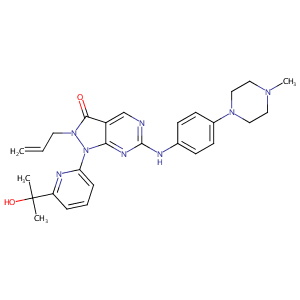
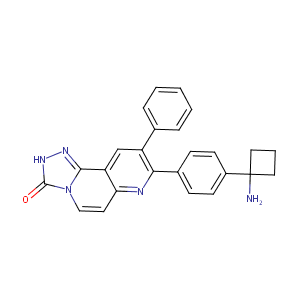
General Information of Drug Combination (ID: DCYS0LN)

Drug Combination Name
MK-1775 MK-2206
Indication
Disease Entry Status REF
Adenocarcinoma Investigative [1]
Component Drugs MK-1775   DM3WDZ5 MK-2206   DMT1OZ6
Small molecular drug Small molecular drug
2D MOL 2D MOL
3D MOL 3D MOL
High-throughput Screening Result Testing Cell Line: SW-620
Zero Interaction Potency (ZIP) Score: 1.65
Bliss Independence Score: 2.38
Loewe Additivity Score: 6.43
LHighest Single Agent (HSA) Score: 7.12

Molecular Interaction Atlas of This Drug Combination

Molecular Interaction Atlas (MIA)
Indication(s) of MK-1775
Disease Entry ICD 11 Status REF
Ovarian cancer 2C73 Phase 2 [2]
Solid tumour/cancer 2A00-2F9Z Phase 1 [3]
MK-1775 Interacts with 1 DTT Molecule(s)
DTT Name DTT ID UniProt ID Mode of Action REF
Wee1-like protein kinase (WEE1) TTJFOAL WEE1_HUMAN Inhibitor [7]
------------------------------------------------------------------------------------
Indication(s) of MK-2206
Disease Entry ICD 11 Status REF
Rectal adenocarcinoma 2B92 Phase 2 [4]
Nasopharyngeal carcinoma 2B6B Investigative [5]
MK-2206 Interacts with 2 DTT Molecule(s)
DTT Name DTT ID UniProt ID Mode of Action REF
RAC-gamma serine/threonine-protein kinase (AKT3) TTAZ05C AKT3_HUMAN Modulator [9]
E2 ubiquitin-conjugating enzyme T (UBE2T) TT0A1R8 UBE2T_HUMAN Inhibitor [5]
------------------------------------------------------------------------------------
MK-2206 Interacts with 9 DOT Molecule(s)
DOT Name DOT ID UniProt ID Mode of Action REF
Receptor tyrosine-protein kinase erbB-2 (ERBB2) OTOAUNCK ERBB2_HUMAN Increases Expression [10]
Endothelin receptor type B (EDNRB) OTLLZV3P EDNRB_HUMAN Increases Expression [8]
Tumor necrosis factor receptor superfamily member 6 (FAS) OTP9XG86 TNR6_HUMAN Affects Response To Substance [11]
T-lymphocyte activation antigen CD80 (CD80) OTJBLUQE CD80_HUMAN Decreases Expression [8]
CCAAT/enhancer-binding protein alpha (CEBPA) OTOM9OE4 CEBPA_HUMAN Decreases Expression [8]
Actin, aortic smooth muscle (ACTA2) OTEDLG8E ACTA_HUMAN Decreases Expression [12]
Small ribosomal subunit protein eS6 (RPS6) OTT4D1LN RS6_HUMAN Decreases Phosphorylation [13]
Interferon regulatory factor 8 (IRF8) OT8YSNI4 IRF8_HUMAN Decreases Expression [8]
Proline-rich AKT1 substrate 1 (AKT1S1) OT4JHN4Y AKTS1_HUMAN Decreases Phosphorylation [14]
------------------------------------------------------------------------------------
⏷ Show the Full List of 9 DOT(s)

Test Results of This Drug Combination in Other Disease Systems

Indication DrugCom ID Cell Line Status REF
Adenocarcinoma DCFC43W CAOV3 Investigative [1]
Adenocarcinoma DCCO6X0 A427 Investigative [1]
Adenocarcinoma DC7JPOQ NCIH2122 Investigative [1]
Adenocarcinoma DCPF5PE NCIH23 Investigative [1]
Adenocarcinoma DC369HV NCIH520 Investigative [1]
Adenocarcinoma DC52IWZ COLO320DM Investigative [1]
Adenocarcinoma DCQHCN2 HCT116 Investigative [1]
Adenocarcinoma DCQJKT4 HT29 Investigative [1]
Amelanotic melanoma DCPZ8QH A2058 Investigative [1]
Ewing sarcoma-peripheral primitive neuroectodermal tumour DC3JZJ4 ES2 Investigative [1]
Germ cell tumour DC3R8WO PA1 Investigative [1]
Large cell lung carcinoma DCB8UL3 NCI-H460 Investigative [1]
Malignant melanoma DCXGS5G A375 Investigative [1]
Malignant melanoma DCI0AK7 RPMI7951 Investigative [1]
Malignant melanoma DCAUF9J SKMEL30 Investigative [1]
Malignant melanoma DCOP21X UACC62 Investigative [1]
Non small cell carcinoma DCK8X1R SKMES1 Investigative [1]
Ovarian endometrioid adenocarcinoma DCDJCT3 A2780 Investigative [1]
Prostate carcinoma DC9S7QC VCAP Investigative [1]
Breast and ovarian cancer syndrome DCHT9J8 UWB1289 Investigative [15]
Breast carcinoma DC2MXPD KPL1 Investigative [15]
Breast carcinoma DCCFBFL OCUBM Investigative [15]
Carcinoma DCIIOM2 MDAMB436 Investigative [15]
Colon carcinoma DCQ1TMN RKO Investigative [15]
Invasive ductal carcinoma DCY9QLV T-47D Investigative [15]
Rectal adenocarcinoma DCQ8DJH SW837 Investigative [15]
------------------------------------------------------------------------------------
⏷ Show the Full List of 26 DrugCom(s)

References

1 CheMBL Affinity Phenotypic Cellular Interaction Assay ID: CHEMBL1125966
2 URL: http://www.guidetopharmacology.org Nucleic Acids Res. 2015 Oct 12. pii: gkv1037. The IUPHAR/BPS Guide to PHARMACOLOGY in 2016: towards curated quantitative interactions between 1300 protein targets and 6000 ligands. (Ligand id: 7702).
3 Clinical pipeline report, company report or official report of the Pharmaceutical Research and Manufacturers of America (PhRMA)
4 URL: http://www.guidetopharmacology.org Nucleic Acids Res. 2015 Oct 12. pii: gkv1037. The IUPHAR/BPS Guide to PHARMACOLOGY in 2016: towards curated quantitative interactions between 1300 protein targets and 6000 ligands. (Ligand id: 7945).
5 UBE2T promotes nasopharyngeal carcinoma cell proliferation, invasion, and metastasis by activating the AKT/GSK3/-catenin pathway.Oncotarget. 2016 Mar 22;7(12):15161-72.
6 Functional kinomics identifies candidate therapeutic targets in head and neck cancer. Clin Cancer Res. 2014 Aug 15;20(16):4274-88. doi: 10.1158/1078-0432.CCR-13-2858.
7 A novel c-Met inhibitor, MK8033, synergizes with carboplatin plus paclitaxel to inhibit ovarian cancer cell growth. Oncol Rep. 2013 May;29(5):2011-8.
8 Chemerin promotes the pathogenesis of preeclampsia by activating CMKLR1/p-Akt/CEBP axis and inducing M1 macrophage polarization. Cell Biol Toxicol. 2022 Aug;38(4):611-628. doi: 10.1007/s10565-021-09636-7. Epub 2021 Aug 16.
9 First-in-man clinical trial of the oral pan-AKT inhibitor MK-2206 in patients with advanced solid tumors.J Clin Oncol.2011 Dec 10;29(35):4688-95.
10 Platycodin D potentiates proliferation inhibition and apoptosis induction upon AKT inhibition via feedback blockade in non-small cell lung cancer cells. Sci Rep. 2016 Nov 29;6:37997. doi: 10.1038/srep37997.
11 PI3K/AKT inhibitors aggravate death receptor-mediated hepatocyte apoptosis and liver injury. Toxicol Appl Pharmacol. 2019 Oct 15;381:114729. doi: 10.1016/j.taap.2019.114729. Epub 2019 Aug 22.
12 -Mangostin alleviates liver fibrosis through Sirtuin 3-superoxide-high mobility group box 1 signaling axis. Toxicol Appl Pharmacol. 2019 Jan 15;363:142-153. doi: 10.1016/j.taap.2018.11.011. Epub 2018 Nov 29.
13 Harnessing the PI3K/Akt/mTOR pathway in T-cell acute lymphoblastic leukemia: eliminating activity by targeting at different levels. Oncotarget. 2012 Aug;3(8):811-23. doi: 10.18632/oncotarget.579.
14 Akt activation by Ca(2+)/calmodulin-dependent protein kinase kinase 2 (CaMKK2) in ovarian cancer cells. J Biol Chem. 2017 Aug 25;292(34):14188-14204. doi: 10.1074/jbc.M117.778464. Epub 2017 Jun 20.
15 CheMBL Affinity Phenotypic Cellular Interaction Assay ID: CHEMBL1126165