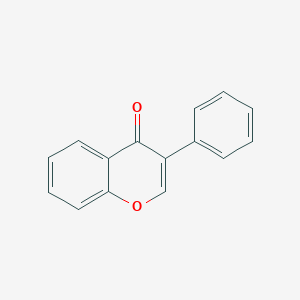
General Information of Drug (ID: DM7U58J)

Drug Name
Isoflavone
Synonyms
Isoflavone; Isoflavone (8CI); Isoflavone skeleton; LS-191186; MCULE-2586547916; OVO2KUW8H8; SBB068618; SCHEMBL8028; ST098957; VN10014; ZINC895390; isoflavon; 3-Phenylchromone; 3-phenyl-4H-1-benzopyran-4-one; 3-phenyl-4H-chromen-4-one; 3-phenylchromen-4-one; 4H-1-Benzopyran-4-one, 3-phenyl-; 574-12-9; AC-12802; AK114020; AKOS015918505; AX8135136; BCP22856; BCP9000133; CCG-214095; CHEBI:18220; CHEMBL366460; CS-W006405; DB12007; DS-6374; DTXSID90205986; KS-00000GFW; NSC 135405; NSC-135405; NSC135405; GOMNOOKGLZYEJT-UHFFFAOYSA-N; UNII-OVO2KUW8H8
Structure
3D MOL 2D MOL
#Ro5 Violations (Lipinski): 0 Molecular Weight (mw) 222.24
Logarithm of the Partition Coefficient (xlogp) 3.2
Rotatable Bond Count (rotbonds) 1
Hydrogen Bond Donor Count (hbonddonor) 0
Hydrogen Bond Acceptor Count (hbondacc) 2
ADMET Property
Absorption Tmax
The time to maximum plasma concentration (Tmax) is 5-6 h [1]
Clearance
The clearance of drug is 30.09 L/h [2]
Elimination
Renal excretion is the predominant route of elimination for dietary isoflavones, where approximately 10-60% of total administered dose is excreted in urine [2]
Half-life
The concentration or amount of drug in body reduced by one-half in 4 - 8 hours [1]
Metabolism
The drug is metabolized via the intestinal lactase phlorizin hydrolase [2]
Vd
The volume of distribution (Vd) of drug is 336.25 L [2]
Chemical Identifiers
Formula
C15H10O2
IUPAC Name
3-phenylchromen-4-one
Canonical SMILES
C1=CC=C(C=C1)C2=COC3=CC=CC=C3C2=O
InChI
InChI=1S/C15H10O2/c16-15-12-8-4-5-9-14(12)17-10-13(15)11-6-2-1-3-7-11/h1-10H
InChIKey
GOMNOOKGLZYEJT-UHFFFAOYSA-N
Cross-matching ID
PubChem CID
72304
ChEBI ID
CHEMBL18220
CAS Number
574-12-9
UNII
OVO2KUW8H8
DrugBank ID
DB12007
INTEDE ID
DR2435
Drug ADMET Endpoint Profile (DAE)NEW Click to Jump to the Detailed DAE Information of This Drug

Molecular Interaction Atlas of This Drug


Drug-Metabolizing Enzyme (DME)
DME Name DME ID UniProt ID MOA REF
Naphthalene dioxygenase (doxB) DEE76YZ NDOB_PSEU8 Substrate [3]
Biphenyl dioxygenase (bphC) DEUX61H BPHC_PSEFK Substrate [3]

Drug Off-Target (DOT)
DOT Name DOT ID UniProt ID Interaction REF
15-hydroxyprostaglandin dehydrogenase (HPGD) OTYZI6JB PGDH_HUMAN Gene/Protein Processing [4]
3-hydroxyisobutyryl-CoA hydrolase, mitochondrial (HIBCH) OTU2VHWR HIBCH_HUMAN Gene/Protein Processing [5]
6-phosphogluconate dehydrogenase, decarboxylating (PGD) OTVG296F 6PGD_HUMAN Gene/Protein Processing [5]
Acidic leucine-rich nuclear phosphoprotein 32 family member A (ANP32A) OTRHPFO2 AN32A_HUMAN Gene/Protein Processing [4]
Alpha-globin transcription factor CP2 (TFCP2) OTA246TE TFCP2_HUMAN Gene/Protein Processing [4]
Arginase-2, mitochondrial (ARG2) OTCPI0E8 ARGI2_HUMAN Gene/Protein Processing [5]
Aspartyl/asparaginyl beta-hydroxylase (ASPH) OT3KGDEE ASPH_HUMAN Gene/Protein Processing [5]
BMP and activin membrane-bound inhibitor homolog (BAMBI) OTCEJ8W5 BAMBI_HUMAN Gene/Protein Processing [5]
Calcium/calmodulin-dependent protein kinase kinase 2 (CAMKK2) OT9C3KFI KKCC2_HUMAN Gene/Protein Processing [5]
CCAAT/enhancer-binding protein delta (CEBPD) OTNBIPMY CEBPD_HUMAN Gene/Protein Processing [5]
Molecular Interaction Atlas (MIA) Jump to Detail Molecular Interaction Atlas of This Drug

References

1 Soy foods, isoflavones, and the health of postmenopausal women. Am J Clin Nutr. 2014 Jul;100 Suppl 1:423S-30S. doi: 10.3945/ajcn.113.071464. Epub 2014 Jun 4.
2 Brigo F, Bragazzi NL, Igwe SC, Nardone R, Trinka E: Topiramate in the Treatment of Generalized Convulsive Status Epilepticus in Adults: A Systematic Review with Individual Patient Data Analysis. Drugs. 2017 Jan;77(1):67-74. doi: 10.1007/s40265-016-0672-2.
3 Flavonoids biotransformation by bacterial non-heme dioxygenases, biphenyl and naphthalene dioxygenase. Appl Microbiol Biotechnol. 2011 Jul;91(2):219-28.
4 Soy isoflavones alter expression of genes associated with cancer progression, including interleukin-8, in androgen-independent PC-3 human prostate cancer cells. J Nutr. 2006 Jan;136(1):75-82.
5 Soy isoflavones exert differential effects on androgen responsive genes in LNCaP human prostate cancer cells. J Nutr. 2007 Apr;137(4):964-72.