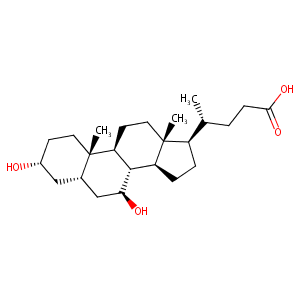
General Information of Drug Combination (ID: DC3M7BY)

Drug Combination Name
Ursodeoxycholic acid Mebendazole
Indication
Disease Entry Status REF
Chronic myelogenous leukemia Investigative [1]
Component Drugs Ursodeoxycholic acid   DMCUT21 Mebendazole   DMO14SG
Small molecular drug Small molecular drug
2D MOL 2D MOL
3D MOL 3D MOL
High-throughput Screening Result Testing Cell Line: KBM-7
Zero Interaction Potency (ZIP) Score: 6.66
Bliss Independence Score: 6.66
Loewe Additivity Score: 20.91
LHighest Single Agent (HSA) Score: 20.93

Molecular Interaction Atlas of This Drug Combination

Molecular Interaction Atlas (MIA)
Indication(s) of Ursodeoxycholic acid
Disease Entry ICD 11 Status REF
Cholelithiasis DC11 Approved [2]
Primary biliary cholangitis DB96.1 Approved [3]
Primary biliary cirrhosis DB96.1 Approved [4]
Colon cancer 2B90.Z Investigative [5]
Ursodeoxycholic acid Interacts with 2 DTT Molecule(s)
DTT Name DTT ID UniProt ID Mode of Action REF
Solute carrier family 23 member 2 (SLC23A2) TTOP832 S23A2_HUMAN Activator [10]
Biliverdin reductase A (BLVRA) TTJBPN3 BIEA_HUMAN Activator [10]
------------------------------------------------------------------------------------
Ursodeoxycholic acid Interacts with 1 DTP Molecule(s)
DTP Name DTP ID UniProt ID Mode of Action REF
Organic anion transporting polypeptide 1B1 (SLCO1B1) DT3D8F0 SO1B1_HUMAN Substrate [11]
------------------------------------------------------------------------------------
Ursodeoxycholic acid Interacts with 1 DME Molecule(s)
DME Name DME ID UniProt ID Mode of Action REF
Beta-hydroxysteroid dehydrogenase (hdhB) DEOMLHG A4ECA9_9ACTN Metabolism [12]
------------------------------------------------------------------------------------
Ursodeoxycholic acid Interacts with 69 DOT Molecule(s)
DOT Name DOT ID UniProt ID Mode of Action REF
Solute carrier organic anion transporter family member 1B1 (SLCO1B1) OTNEN8QK SO1B1_HUMAN Increases Uptake [11]
Aldo-keto reductase family 1 member C3 (AKR1C3) OTU2SXBA AK1C3_HUMAN Decreases Activity [13]
Aldo-keto reductase family 1 member C2 (AKR1C2) OTQ2XMO3 AK1C2_HUMAN Decreases Activity [13]
Aldo-keto reductase family 1 member C1 (AKR1C1) OTQKR4CM AK1C1_HUMAN Decreases Activity [13]
ATP-dependent translocase ABCB1 (ABCB1) OTEJROBO MDR1_HUMAN Increases Expression [14]
Nuclear receptor subfamily 1 group I member 2 (NR1I2) OTC5U0N5 NR1I2_HUMAN Increases Expression [15]
Nuclear receptor subfamily 0 group B member 2 (NR0B2) OT7UVICX NR0B2_HUMAN Increases Expression [15]
Stearoyl-CoA desaturase (SCD) OTB1073G SCD_HUMAN Decreases Expression [16]
Tumor necrosis factor receptor superfamily member 10B (TNFRSF10B) OTA1CPBV TR10B_HUMAN Increases Expression [17]
Serine/threonine-protein phosphatase 6 regulatory ankyrin repeat subunit A (ANKRD28) OTRBREQ9 ANR28_HUMAN Affects Expression [8]
ATP-binding cassette sub-family C member 3 (ABCC3) OTC3IJV4 MRP3_HUMAN Increases Expression [18]
CASP8 and FADD-like apoptosis regulator (CFLAR) OTX14BAS CFLAR_HUMAN Increases Expression [19]
Splicing factor 3B subunit 1 (SF3B1) OTNTX2DG SF3B1_HUMAN Affects Expression [8]
Rho-related BTB domain-containing protein 3 (RHOBTB3) OT1BFKPH RHBT3_HUMAN Affects Expression [8]
Bile salt export pump (ABCB11) OTRU7THO ABCBB_HUMAN Increases Expression [20]
HLA class II histocompatibility antigen, DR alpha chain (HLA-DRA) OT7KZMP2 DRA_HUMAN Increases Expression [21]
Fibrinogen gamma chain (FGG) OT5BJSEX FIBG_HUMAN Affects Expression [8]
C4b-binding protein alpha chain (C4BPA) OTHNH6Y8 C4BPA_HUMAN Affects Expression [8]
ADP/ATP translocase 2 (SLC25A5) OT1XIBMN ADT2_HUMAN Affects Expression [8]
Large ribosomal subunit protein P2 (RPLP2) OT2YBK3W RLA2_HUMAN Affects Expression [8]
Retinoblastoma-associated protein (RB1) OTQJUJMZ RB_HUMAN Decreases Expression [22]
Involucrin (IVL) OT4VPNGY INVO_HUMAN Decreases Expression [23]
Growth-regulated alpha protein (CXCL1) OT3WCTZV GROA_HUMAN Increases Expression [16]
2',3'-cyclic-nucleotide 3'-phosphodiesterase (CNP) OTB8HCED CN37_HUMAN Affects Expression [8]
Poly polymerase 1 (PARP1) OT310QSG PARP1_HUMAN Increases Cleavage [17]
Dihydrolipoyllysine-residue acetyltransferase component of pyruvate dehydrogenase complex, mitochondrial (DLAT) OT9LBJVN ODP2_HUMAN Affects Expression [8]
C-C motif chemokine 2 (CCL2) OTAD2HEL CCL2_HUMAN Increases Expression [16]
Fatty acid-binding protein, adipocyte (FABP4) OT3DKFOU FABP4_HUMAN Decreases Expression [16]
Large ribosomal subunit protein eL33 (RPL35A) OTDDJUWF RL35A_HUMAN Affects Expression [8]
Cyclic AMP-dependent transcription factor ATF-4 (ATF4) OTRFV19J ATF4_HUMAN Decreases Expression [16]
Alpha-1-acid glycoprotein 2 (ORM2) OTRJGZP8 A1AG2_HUMAN Affects Expression [8]
Mitogen-activated protein kinase 3 (MAPK3) OTCYKGKO MK03_HUMAN Increases Phosphorylation [16]
Large ribosomal subunit protein uL16 (RPL10) OTBHOZGC RL10_HUMAN Affects Expression [8]
Mitogen-activated protein kinase 1 (MAPK1) OTH85PI5 MK01_HUMAN Increases Phosphorylation [16]
G1/S-specific cyclin-D3 (CCND3) OTNKPQ22 CCND3_HUMAN Decreases Expression [22]
Intercellular adhesion molecule 3 (ICAM3) OTTZ5A5D ICAM3_HUMAN Affects Expression [8]
Glycine--tRNA ligase (GARS1) OT5B6R9Y GARS_HUMAN Affects Expression [8]
Eukaryotic translation initiation factor 1 (EIF1) OTB4GZ0V EIF1_HUMAN Affects Expression [8]
T-complex protein 1 subunit epsilon (CCT5) OTPZ38BT TCPE_HUMAN Affects Expression [8]
T-complex protein 1 subunit gamma (CCT3) OTL6EOS1 TCPG_HUMAN Affects Expression [8]
Gastrotropin (FABP6) OTIRQWLW FABP6_HUMAN Increases Expression [24]
Small ribosomal subunit protein mS29 (DAP3) OTNPEZYM RT29_HUMAN Affects Expression [8]
Nucleosome assembly protein 1-like 1 (NAP1L1) OTI7WBZV NP1L1_HUMAN Affects Expression [8]
Large ribosomal subunit protein eL27 (RPL27) OTWEOUTX RL27_HUMAN Affects Expression [8]
Small ribosomal subunit protein uS15 (RPS13) OTOMDIJ2 RS13_HUMAN Affects Expression [8]
Small ribosomal subunit protein eS28 (RPS28) OT12IES1 RS28_HUMAN Affects Expression [8]
Large ribosomal subunit protein eL32 (RPL32) OTKRQJT4 RL32_HUMAN Affects Expression [8]
Large ribosomal subunit protein eL6 (RPL6) OTRU71O4 RL6_HUMAN Affects Expression [8]
Single-stranded DNA-binding protein, mitochondrial (SSBP1) OTH2PZWH SSBP_HUMAN Affects Expression [8]
ATP-dependent RNA helicase A (DHX9) OT5AAOQI DHX9_HUMAN Affects Expression [8]
Fibrinogen-like protein 1 (FGL1) OTT0QHQ1 FGL1_HUMAN Affects Expression [8]
Serine/threonine-protein kinase 3 (STK3) OTLNSCQD STK3_HUMAN Affects Expression [8]
DnaJ homolog subfamily C member 3 (DNAJC3) OT7ROIJF DNJC3_HUMAN Decreases Expression [16]
Protein Smaug homolog 2 (SAMD4B) OTVRZJ5D SMAG2_HUMAN Affects Expression [8]
Ribosomal protein eS27-like (RPS27L) OTZWHU0N RS27L_HUMAN Affects Expression [8]
Endoplasmic reticulum metallopeptidase 1 (ERMP1) OT9CIEO2 ERMP1_HUMAN Affects Expression [8]
E3 ubiquitin-protein ligase RBBP6 (RBBP6) OTTVG4HU RBBP6_HUMAN Affects Expression [8]
Out at first protein homolog (OAF) OTOR9CR5 OAF_HUMAN Affects Expression [8]
Organic solute transporter subunit alpha (SLC51A) OTDJRZ0P OSTA_HUMAN Increases Expression [18]
Organic solute transporter subunit beta (SLC51B) OT4WYPSR OSTB_HUMAN Increases Expression [18]
Shieldin complex subunit 2 (SHLD2) OTMLERXL SHLD2_HUMAN Affects Expression [8]
E3 ubiquitin-protein ligase rififylin (RFFL) OT85MGDH RFFL_HUMAN Affects Expression [8]
AP-2 complex subunit mu (AP2M1) OTQCOSFN AP2M1_HUMAN Affects Expression [8]
Ribosomal protein eL39-like 2 (RPL39L) OTAV1MJQ RL39L_HUMAN Affects Expression [8]
Rho GTPase-activating protein 7 (DLC1) OTP8LMCR RHG07_HUMAN Increases Expression [25]
Bile acid receptor (NR1H4) OTWZLPTB NR1H4_HUMAN Decreases Expression [16]
Protein sprouty homolog 4 (SPRY4) OT2VK9N0 SPY4_HUMAN Affects Expression [8]
Soluble lamin-associated protein of 75 kDa (FAM169A) OT2FDMA1 F169A_HUMAN Affects Expression [8]
Solute carrier organic anion transporter family member 1B3 (SLCO1B3) OTOM3BUH SO1B3_HUMAN Increases Uptake [11]
------------------------------------------------------------------------------------
⏷ Show the Full List of 69 DOT(s)
Indication(s) of Mebendazole
Disease Entry ICD 11 Status REF
Ascariasis 1F62 Approved [6]
Enterobiasis 1F65 Approved [6]
Helminth infection 1F90.0 Approved [6]
Trichuris trichiura infection 1F6G Approved [6]
Worm infection 1F90.Z Approved [7]
Mebendazole Interacts with 1 DTT Molecule(s)
DTT Name DTT ID UniProt ID Mode of Action REF
Tubulin beta (TUBB) TTYFKSZ NOUNIPROTAC Binder [27]
------------------------------------------------------------------------------------
Mebendazole Interacts with 1 DME Molecule(s)
DME Name DME ID UniProt ID Mode of Action REF
Cytochrome P450 3A4 (CYP3A4) DE4LYSA CP3A4_HUMAN Metabolism [28]
------------------------------------------------------------------------------------
Mebendazole Interacts with 23 DOT Molecule(s)
DOT Name DOT ID UniProt ID Mode of Action REF
Proepiregulin (EREG) OTRM4NQY EREG_HUMAN Increases Expression [29]
Protein c-Fos (FOS) OTJBUVWS FOS_HUMAN Increases Expression [30]
Myc proto-oncogene protein (MYC) OTPV5LUK MYC_HUMAN Decreases Expression [31]
Antileukoproteinase (SLPI) OTUNFUU8 SLPI_HUMAN Increases Expression [29]
Protein S100-A8 (S100A8) OTVMOB3F S10A8_HUMAN Increases Expression [32]
Protein S100-A9 (S100A9) OTOARHCS S10A9_HUMAN Increases Expression [32]
ATP-dependent translocase ABCB1 (ABCB1) OTEJROBO MDR1_HUMAN Decreases Expression [33]
Hepatocyte growth factor receptor (MET) OT7K55MU MET_HUMAN Increases Expression [29]
Interleukin-6 receptor subunit alpha (IL6R) OTCQL07Z IL6RA_HUMAN Increases Expression [26]
Interleukin-8 (CXCL8) OTS7T5VH IL8_HUMAN Increases Expression [34]
Solute carrier family 2, facilitated glucose transporter member 1 (SLC2A1) OTA675TJ GTR1_HUMAN Decreases Expression [35]
C-C motif chemokine 2 (CCL2) OTAD2HEL CCL2_HUMAN Increases Expression [26]
Hexokinase-1 (HK1) OTMPHE8O HXK1_HUMAN Decreases Expression [35]
Mitogen-activated protein kinase 3 (MAPK3) OTCYKGKO MK03_HUMAN Increases Phosphorylation [34]
Mitogen-activated protein kinase 1 (MAPK1) OTH85PI5 MK01_HUMAN Increases Phosphorylation [34]
Mitogen-activated protein kinase 8 (MAPK8) OTEREYS5 MK08_HUMAN Increases Phosphorylation [34]
Mitogen-activated protein kinase 9 (MAPK9) OTCEVJ9E MK09_HUMAN Increases Phosphorylation [34]
Neurogenic locus notch homolog protein 1 (NOTCH1) OTI1WADQ NOTC1_HUMAN Decreases Expression [36]
Transcription factor HES-1 (HES1) OT8P19W2 HES1_HUMAN Decreases Expression [36]
PTB-containing, cubilin and LRP1-interacting protein (PID1) OT5YJ7FI PCLI1_HUMAN Increases Expression [29]
Rho guanine nucleotide exchange factor 2 (ARHGEF2) OTBQTFRT ARHG2_HUMAN Decreases Expression [37]
Multidrug and toxin extrusion protein 1 (SLC47A1) OTZX0U5Q S47A1_HUMAN Decreases Expression [33]
NACHT, LRR and PYD domains-containing protein 3 (NLRP3) OTZM6MHU NLRP3_HUMAN Increases Expression [32]
------------------------------------------------------------------------------------
⏷ Show the Full List of 23 DOT(s)

References

1 CheMBL Affinity Phenotypic Cellular Interaction Assay ID: CHEMBL1125966
2 Management of symptomatic cholelithiasis: a systematic review. Syst Rev. 2022 Dec 12;11(1):267.
3 Primary biliary cholangitis: pathogenesis and therapeutic opportunities. Nat Rev Gastroenterol Hepatol. 2020 Feb;17(2):93-110.
4 URL: http://www.guidetopharmacology.org Nucleic Acids Res. 2015 Oct 12. pii: gkv1037. The IUPHAR/BPS Guide to PHARMACOLOGY in 2016: towards curated quantitative interactions between 1300 protein targets and 6000 ligands. (Ligand id: 7104).
5 Design and synthesis of bile acid derivatives and their activity against colon cancer. RSC Med Chem. 2022 Aug 19;13(11):1391-1409.
6 Mebendazole FDA Label
7 Emerging drugs for irritable bowel syndrome. Expert Opin Emerg Drugs. 2006 May;11(2):293-313.
8 Gene expression profiling of early primary biliary cirrhosis: possible insights into the mechanism of action of ursodeoxycholic acid. Liver Int. 2008 Aug;28(7):997-1010. doi: 10.1111/j.1478-3231.2008.01744.x. Epub 2008 Apr 15.
9 UGT-dependent regioselective glucuronidation of ursodeoxycholic acid and obeticholic acid and selective transport of the consequent acyl glucuronides by OATP1B1 and 1B3. Chem Biol Interact. 2019 Sep 1;310:108745. doi: 10.1016/j.cbi.2019.108745. Epub 2019 Jul 9.
10 Role of vitamin C transporters and biliverdin reductase in the dual pro-oxidant and anti-oxidant effect of biliary compounds on the placental-fetal... Toxicol Appl Pharmacol. 2008 Oct 15;232(2):327-36.
11 Transport of fluorescent chenodeoxycholic acid via the human organic anion transporters OATP1B1 and OATP1B3. J Lipid Res. 2006 Jun;47(6):1196-202.
12 Identification, cloning, heterologous expression, and characterization of a NADPH-dependent 7beta-hydroxysteroid dehydrogenase from Collinsella aerofaciens. Appl Microbiol Biotechnol. 2011 Apr;90(1):127-35.
13 Selective and potent inhibitors of human 20alpha-hydroxysteroid dehydrogenase (AKR1C1) that metabolizes neurosteroids derived from progesterone. Chem Biol Interact. 2003 Feb 1;143-144:503-13.
14 Effects of ursodeoxycholic acid on P-glycoprotein and cytochrome P450 3A4-dependent pharmacokinetics in humans. Clin Pharmacol Ther. 2006 May;79(5):449-60.
15 Role of vitamin C transporters and biliverdin reductase in the dual pro-oxidant and anti-oxidant effect of biliary compounds on the placental-fetal unit in cholestasis during pregnancy. Toxicol Appl Pharmacol. 2008 Oct 15;232(2):327-36.
16 Ursodeoxycholic acid but not tauroursodeoxycholic acid inhibits proliferation and differentiation of human subcutaneous adipocytes. PLoS One. 2013 Dec 3;8(12):e82086. doi: 10.1371/journal.pone.0082086. eCollection 2013.
17 Lipid raft-dependent death receptor 5 (DR5) expression and activation are critical for ursodeoxycholic acid-induced apoptosis in gastric cancer cells. Carcinogenesis. 2011 May;32(5):723-31. doi: 10.1093/carcin/bgr038. Epub 2011 Feb 28.
18 Potency of individual bile acids to regulate bile acid synthesis and transport genes in primary human hepatocyte cultures. Toxicol Sci. 2014 Oct;141(2):538-46. doi: 10.1093/toxsci/kfu151. Epub 2014 Jul 23.
19 The synthetic bile acid-phospholipid conjugate ursodeoxycholyl lysophosphatidylethanolamide suppresses TNF-induced liver injury. J Hepatol. 2011 Apr;54(4):674-84. doi: 10.1016/j.jhep.2010.07.028. Epub 2010 Sep 27.
20 The farnesoid X receptor controls gene expression in a ligand- and promoter-selective fashion. J Biol Chem. 2004 Mar 5;279(10):8856-61. doi: 10.1074/jbc.M306422200. Epub 2003 Dec 18.
21 Ligand-independent activation of the glucocorticoid receptor by ursodeoxycholic acid. Repression of IFN-gamma-induced MHC class II gene expression via a glucocorticoid receptor-dependent pathway. J Immunol. 1996 Feb 15;156(4):1601-8.
22 Mechanism of apoptotic effects induced selectively by ursodeoxycholic acid on human hepatoma cell lines. World J Gastroenterol. 2007 Mar 21;13(11):1652-8. doi: 10.3748/wjg.v13.i11.1652.
23 Correlation of chemopreventive efficacy data from the human epidermal cell assay with in vivo data. Anticancer Res. 2000 Jan-Feb;20(1A):27-32.
24 Regulation of ileal bile acid-binding protein expression in Caco-2 cells by ursodeoxycholic acid: role of the farnesoid X receptor. Biochem Pharmacol. 2005 Jun 15;69(12):1755-63. doi: 10.1016/j.bcp.2005.03.019.
25 Ursodeoxycholic acid-induced inhibition of DLC1 protein degradation leads to suppression of hepatocellular carcinoma cell growth. Oncol Rep. 2011 Jun;25(6):1739-46. doi: 10.3892/or.2011.1239. Epub 2011 Mar 29.
26 Cell-based and cytokine-directed chemical screen to identify potential anti-multiple myeloma agents. Leuk Res. 2010 Jul;34(7):917-24. doi: 10.1016/j.leukres.2009.12.002. Epub 2010 Feb 8.
27 Flubendazole interferes with a wide spectrum of cell homeostatic mechanisms in Echinococcus granulosus protoscoleces. Parasitol Int. 2009 Sep;58(3):270-7.
28 Alveolar echinococcosis of the liver in an adult with human immunodeficiency virus type-1 infection. Infection. 2004 Oct;32(5):299-302.
29 An in vitro coculture system of human peripheral blood mononuclear cells with hepatocellular carcinoma-derived cells for predicting drug-induced liver injury. Arch Toxicol. 2021 Jan;95(1):149-168. doi: 10.1007/s00204-020-02882-4. Epub 2020 Aug 20.
30 Selection of drugs to test the specificity of the Tg.AC assay by screening for induction of the gadd153 promoter in vitro. Toxicol Sci. 2003 Aug;74(2):260-70. doi: 10.1093/toxsci/kfg113. Epub 2003 May 2.
31 Mebendazole induces apoptosis via C-MYC inactivation in malignant ascites cell line (AGP01). Toxicol In Vitro. 2019 Oct;60:305-312. doi: 10.1016/j.tiv.2019.06.010. Epub 2019 Jun 14.
32 Development of a cell-based assay system considering drug metabolism and immune- and inflammatory-related factors for the risk assessment of drug-induced liver injury. Toxicol Lett. 2014 Jul 3;228(1):13-24. doi: 10.1016/j.toxlet.2014.04.005. Epub 2014 Apr 15.
33 Mebendazole, an antiparasitic drug, inhibits drug transporters expression in preclinical model of gastric peritoneal carcinomatosis. Toxicol In Vitro. 2017 Sep;43:87-91. doi: 10.1016/j.tiv.2017.06.007. Epub 2017 Jun 9.
34 Stimulation of pro-inflammatory responses by mebendazole in human monocytic THP-1 cells through an ERK signaling pathway. Arch Toxicol. 2011 Mar;85(3):199-207. doi: 10.1007/s00204-010-0584-y. Epub 2010 Sep 17.
35 Mebendazole targets essential proteins in glucose metabolism leading gastric cancer cells to death. Toxicol Appl Pharmacol. 2023 Sep 15;475:116630. doi: 10.1016/j.taap.2023.116630. Epub 2023 Jul 18.
36 Mebendazole is a potent inhibitor to chemoresistant T cell acute lymphoblastic leukemia cells. Toxicol Appl Pharmacol. 2020 Jun 1;396:115001. doi: 10.1016/j.taap.2020.115001. Epub 2020 Apr 8.
37 Flubendazole and mebendazole impair migration and epithelial to mesenchymal transition in oral cell lines. Chem Biol Interact. 2018 Sep 25;293:124-132. doi: 10.1016/j.cbi.2018.07.026. Epub 2018 Jul 31.