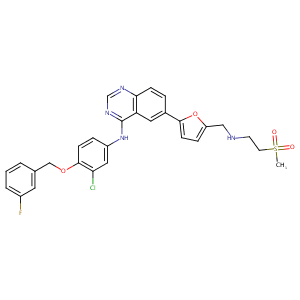
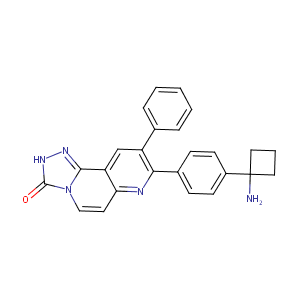
General Information of Drug Combination (ID: DC7IBU4)

Drug Combination Name
Lapatinib MK-2206
Indication
Disease Entry Status REF
Breast carcinoma Investigative [1]
Component Drugs Lapatinib   DM3BH1Y MK-2206   DMT1OZ6
Small molecular drug Small molecular drug
2D MOL 2D MOL
3D MOL 3D MOL
High-throughput Screening Result Testing Cell Line: KPL1
Zero Interaction Potency (ZIP) Score: 9.32
Bliss Independence Score: 9.28
Loewe Additivity Score: 10.12
LHighest Single Agent (HSA) Score: 15.2

Molecular Interaction Atlas of This Drug Combination

Molecular Interaction Atlas (MIA)
Indication(s) of Lapatinib
Disease Entry ICD 11 Status REF
Breast cancer 2C60-2C65 Approved [2]
Gastroesophageal junction adenocarcinoma 2B71 Approved [3]
Melanoma 2C30 Approved [3]
Lapatinib Interacts with 3 DTT Molecule(s)
DTT Name DTT ID UniProt ID Mode of Action REF
Erbb2 tyrosine kinase receptor (HER2) TT6EO5L ERBB2_HUMAN Inhibitor [7]
Epidermal growth factor receptor (EGFR) TTGKNB4 EGFR_HUMAN Inhibitor [7]
Eukaryotic elongation factor 2 kinase (eEF-2K) TT1QFLA EF2K_HUMAN Inhibitor [8]
------------------------------------------------------------------------------------
Lapatinib Interacts with 2 DTP Molecule(s)
DTP Name DTP ID UniProt ID Mode of Action REF
P-glycoprotein 1 (ABCB1) DTUGYRD MDR1_HUMAN Substrate [9]
Breast cancer resistance protein (ABCG2) DTI7UX6 ABCG2_HUMAN Substrate [10]
------------------------------------------------------------------------------------
Lapatinib Interacts with 4 DME Molecule(s)
DME Name DME ID UniProt ID Mode of Action REF
Cytochrome P450 3A4 (CYP3A4) DE4LYSA CP3A4_HUMAN Metabolism [11]
Cytochrome P450 3A5 (CYP3A5) DEIBDNY CP3A5_HUMAN Metabolism [12]
Cytochrome P450 2C8 (CYP2C8) DES5XRU CP2C8_HUMAN Metabolism [11]
Mephenytoin 4-hydroxylase (CYP2C19) DEGTFWK CP2CJ_HUMAN Metabolism [12]
------------------------------------------------------------------------------------
Lapatinib Interacts with 15 DOT Molecule(s)
DOT Name DOT ID UniProt ID Mode of Action REF
Bile salt export pump (ABCB11) OTRU7THO ABCBB_HUMAN Decreases Activity [13]
Superoxide dismutase , mitochondrial (SOD2) OTIWXGZ9 SODM_HUMAN Increases Expression [14]
Baculoviral IAP repeat-containing protein 5 (BIRC5) OTILXZYL BIRC5_HUMAN Decreases Expression [15]
Poly polymerase 1 (PARP1) OT310QSG PARP1_HUMAN Increases Cleavage [16]
Histone H2AX (H2AX) OT18UX57 H2AX_HUMAN Increases Expression [17]
Phosphatidylcholine translocator ABCB4 (ABCB4) OTE6PY83 MDR3_HUMAN Decreases Activity [18]
Receptor tyrosine-protein kinase erbB-3 (ERBB3) OTRSST0A ERBB3_HUMAN Decreases Activity [19]
Mitogen-activated protein kinase 3 (MAPK3) OTCYKGKO MK03_HUMAN Decreases Activity [16]
Mitogen-activated protein kinase 1 (MAPK1) OTH85PI5 MK01_HUMAN Decreases Activity [16]
Cyclin-dependent kinase inhibitor 1B (CDKN1B) OTNY5LLZ CDN1B_HUMAN Increases Expression [20]
HLA class II histocompatibility antigen, DQ alpha 1 chain (HLA-DQA1) OTC6GISG DQA1_HUMAN Increases ADR [21]
Zinc finger protein SNAI1 (SNAI1) OTDPYAMC SNAI1_HUMAN Decreases Response To Substance [22]
Transforming growth factor beta-1 proprotein (TGFB1) OTV5XHVH TGFB1_HUMAN Decreases Response To Substance [22]
Tenascin-X (TNXB) OTVBWAV5 TENX_HUMAN Increases ADR [21]
HLA class II histocompatibility antigen, DQ beta 1 chain (HLA-DQB1) OTVVI3UI DQB1_HUMAN Increases ADR [21]
------------------------------------------------------------------------------------
⏷ Show the Full List of 15 DOT(s)
Indication(s) of MK-2206
Disease Entry ICD 11 Status REF
Rectal adenocarcinoma 2B92 Phase 2 [4]
Nasopharyngeal carcinoma 2B6B Investigative [5]
MK-2206 Interacts with 2 DTT Molecule(s)
DTT Name DTT ID UniProt ID Mode of Action REF
RAC-gamma serine/threonine-protein kinase (AKT3) TTAZ05C AKT3_HUMAN Modulator [24]
E2 ubiquitin-conjugating enzyme T (UBE2T) TT0A1R8 UBE2T_HUMAN Inhibitor [5]
------------------------------------------------------------------------------------
MK-2206 Interacts with 9 DOT Molecule(s)
DOT Name DOT ID UniProt ID Mode of Action REF
Receptor tyrosine-protein kinase erbB-2 (ERBB2) OTOAUNCK ERBB2_HUMAN Increases Expression [25]
Endothelin receptor type B (EDNRB) OTLLZV3P EDNRB_HUMAN Increases Expression [23]
Tumor necrosis factor receptor superfamily member 6 (FAS) OTP9XG86 TNR6_HUMAN Affects Response To Substance [26]
T-lymphocyte activation antigen CD80 (CD80) OTJBLUQE CD80_HUMAN Decreases Expression [23]
CCAAT/enhancer-binding protein alpha (CEBPA) OTOM9OE4 CEBPA_HUMAN Decreases Expression [23]
Actin, aortic smooth muscle (ACTA2) OTEDLG8E ACTA_HUMAN Decreases Expression [27]
Small ribosomal subunit protein eS6 (RPS6) OTT4D1LN RS6_HUMAN Decreases Phosphorylation [28]
Interferon regulatory factor 8 (IRF8) OT8YSNI4 IRF8_HUMAN Decreases Expression [23]
Proline-rich AKT1 substrate 1 (AKT1S1) OT4JHN4Y AKTS1_HUMAN Decreases Phosphorylation [29]
------------------------------------------------------------------------------------
⏷ Show the Full List of 9 DOT(s)

Test Results of This Drug Combination in Other Disease Systems

Indication DrugCom ID Cell Line Status REF
Breast and ovarian cancer syndrome DC3R796 UWB1289 Investigative [1]
Breast and ovarian cancer syndrome DCT0I92 UWB1289+BRCA1 Investigative [1]
Breast carcinoma DCAYZK0 ZR751 Investigative [1]
Breast carcinoma DCSKIAU OCUBM Investigative [1]
Carcinoma DCP0JBD EFM192B Investigative [1]
Colon carcinoma DCG52ZA RKO Investigative [1]
Rectal adenocarcinoma DCRMVVH SW837 Investigative [1]
Adenocarcinoma DC7QF2K CAOV3 Investigative [30]
Adenocarcinoma DCW5M62 OVCAR3 Investigative [30]
Adenocarcinoma DCP8ZUS NCIH1650 Investigative [30]
Adenocarcinoma DC9KE08 NCIH2122 Investigative [30]
Adenocarcinoma DC756UX NCIH23 Investigative [30]
Adenocarcinoma DC4DSH3 NCIH520 Investigative [30]
Adenocarcinoma DC8FGX3 COLO320DM Investigative [30]
Adenocarcinoma DC02DNR DLD1 Investigative [30]
Adenocarcinoma DCBNHUK HCT116 Investigative [30]
Adenocarcinoma DC0RBBL HT29 Investigative [30]
Adenocarcinoma DCP6STQ SW-620 Investigative [30]
Amelanotic melanoma DCXMDRK A2058 Investigative [30]
Ewing sarcoma-peripheral primitive neuroectodermal tumour DCJZG20 ES2 Investigative [30]
Germ cell tumour DC1P5B6 PA1 Investigative [30]
Malignant melanoma DC4CHS1 A375 Investigative [30]
Malignant melanoma DCJ3JUF HT144 Investigative [30]
Malignant melanoma DCHSPRB RPMI7951 Investigative [30]
Malignant melanoma DCEUHVI SKMEL30 Investigative [30]
Malignant melanoma DCR0WTW UACC62 Investigative [30]
Mesothelioma DCAA2AP MSTO Investigative [30]
Non small cell carcinoma DCSMH6T SKMES1 Investigative [30]
Ovarian endometrioid adenocarcinoma DCAL8I7 A2780 Investigative [30]
Ovarian serous cystadenocarcinoma DCFB2IT SK-OV-3 Investigative [30]
Prostate carcinoma DC5XC2V VCAP Investigative [30]
------------------------------------------------------------------------------------
⏷ Show the Full List of 31 DrugCom(s)

References

1 CheMBL Affinity Phenotypic Cellular Interaction Assay ID: CHEMBL1126165
2 URL: http://www.guidetopharmacology.org Nucleic Acids Res. 2015 Oct 12. pii: gkv1037. The IUPHAR/BPS Guide to PHARMACOLOGY in 2016: towards curated quantitative interactions between 1300 protein targets and 6000 ligands. (Ligand id: 5692).
3 Lapatinib FDA Label
4 URL: http://www.guidetopharmacology.org Nucleic Acids Res. 2015 Oct 12. pii: gkv1037. The IUPHAR/BPS Guide to PHARMACOLOGY in 2016: towards curated quantitative interactions between 1300 protein targets and 6000 ligands. (Ligand id: 7945).
5 UBE2T promotes nasopharyngeal carcinoma cell proliferation, invasion, and metastasis by activating the AKT/GSK3/-catenin pathway.Oncotarget. 2016 Mar 22;7(12):15161-72.
6 UGT-dependent regioselective glucuronidation of ursodeoxycholic acid and obeticholic acid and selective transport of the consequent acyl glucuronides by OATP1B1 and 1B3. Chem Biol Interact. 2019 Sep 1;310:108745. doi: 10.1016/j.cbi.2019.108745. Epub 2019 Jul 9.
7 Triple negative breast cancer--current status and prospective targeted treatment based on HER1 (EGFR), TOP2A and C-MYC gene assessment. Biomed Pap Med Fac Univ Palacky Olomouc Czech Repub. 2009 Mar;153(1):13-7.
8 Inhibition of eEF-2 kinase sensitizes human nasopharyngeal carcinoma cells to lapatinib-induced apoptosis through the Src and Erk pathways.BMC Cancer. 2016 Oct 19;16(1):813.
9 Tarascon Pocket Pharmacopoeia 2018 Classic Shirt-Pocket Edition.
10 The role of efflux and uptake transporters in [N-{3-chloro-4-[(3-fluorobenzyl)oxy]phenyl}-6-[5-({[2-(methylsulfonyl)ethyl]amino}methyl)-2-furyl]-4-quinazolinamine (GW572016, lapatinib) disposition and drug interactions. Drug Metab Dispos. 2008 Apr;36(4):695-701.
11 Mechanism-based inactivation of cytochrome P450 3A4 by lapatinib. Mol Pharmacol. 2010 Oct;78(4):693-703.
12 Clinical pharmacokinetics of tyrosine kinase inhibitors. Cancer Treat Rev. 2009 Dec;35(8):692-706.
13 Interference with bile salt export pump function is a susceptibility factor for human liver injury in drug development. Toxicol Sci. 2010 Dec; 118(2):485-500.
14 P450 3A-catalyzed O-dealkylation of lapatinib induces mitochondrial stress and activates Nrf2. Chem Res Toxicol. 2016 May 16;29(5):784-96.
15 Combining lapatinib (GW572016), a small molecule inhibitor of ErbB1 and ErbB2 tyrosine kinases, with therapeutic anti-ErbB2 antibodies enhances apoptosis of ErbB2-overexpressing breast cancer cells. Oncogene. 2005 Sep 15;24(41):6213-21. doi: 10.1038/sj.onc.1208774.
16 CDK4/6 inhibition provides a potent adjunct to Her2-targeted therapies in preclinical breast cancer models. Genes Cancer. 2014 Jul;5(7-8):261-72. doi: 10.18632/genesandcancer.24.
17 The involvement of hepatic cytochrome P450s in the cytotoxicity of lapatinib. Toxicol Sci. 2023 Dec 21;197(1):69-78. doi: 10.1093/toxsci/kfad099.
18 Evaluating the Role of Multidrug Resistance Protein 3 (MDR3) Inhibition in Predicting Drug-Induced Liver Injury Using 125 Pharmaceuticals. Chem Res Toxicol. 2017 May 15;30(5):1219-1229. doi: 10.1021/acs.chemrestox.7b00048. Epub 2017 May 4.
19 Suppression of HER2/HER3-mediated growth of breast cancer cells with combinations of GDC-0941 PI3K inhibitor, trastuzumab, and pertuzumab. Clin Cancer Res. 2009 Jun 15;15(12):4147-56. doi: 10.1158/1078-0432.CCR-08-2814. Epub 2009 Jun 9.
20 The dual ErbB1/ErbB2 inhibitor, lapatinib (GW572016), cooperates with tamoxifen to inhibit both cell proliferation- and estrogen-dependent gene expression in antiestrogen-resistant breast cancer. Cancer Res. 2005 Jan 1;65(1):18-25.
21 HLA-DQA1*02:01 is a major risk factor for lapatinib-induced hepatotoxicity in women with advanced breast cancer. J Clin Oncol. 2011 Feb 20;29(6):667-73. doi: 10.1200/JCO.2010.31.3197. Epub 2011 Jan 18.
22 Niclosamide inhibits epithelial-mesenchymal transition and tumor growth in lapatinib-resistant human epidermal growth factor receptor 2-positive breast cancer. Int J Biochem Cell Biol. 2016 Feb;71:12-23. doi: 10.1016/j.biocel.2015.11.014. Epub 2015 Nov 28.
23 Chemerin promotes the pathogenesis of preeclampsia by activating CMKLR1/p-Akt/CEBP axis and inducing M1 macrophage polarization. Cell Biol Toxicol. 2022 Aug;38(4):611-628. doi: 10.1007/s10565-021-09636-7. Epub 2021 Aug 16.
24 First-in-man clinical trial of the oral pan-AKT inhibitor MK-2206 in patients with advanced solid tumors.J Clin Oncol.2011 Dec 10;29(35):4688-95.
25 Platycodin D potentiates proliferation inhibition and apoptosis induction upon AKT inhibition via feedback blockade in non-small cell lung cancer cells. Sci Rep. 2016 Nov 29;6:37997. doi: 10.1038/srep37997.
26 PI3K/AKT inhibitors aggravate death receptor-mediated hepatocyte apoptosis and liver injury. Toxicol Appl Pharmacol. 2019 Oct 15;381:114729. doi: 10.1016/j.taap.2019.114729. Epub 2019 Aug 22.
27 -Mangostin alleviates liver fibrosis through Sirtuin 3-superoxide-high mobility group box 1 signaling axis. Toxicol Appl Pharmacol. 2019 Jan 15;363:142-153. doi: 10.1016/j.taap.2018.11.011. Epub 2018 Nov 29.
28 Harnessing the PI3K/Akt/mTOR pathway in T-cell acute lymphoblastic leukemia: eliminating activity by targeting at different levels. Oncotarget. 2012 Aug;3(8):811-23. doi: 10.18632/oncotarget.579.
29 Akt activation by Ca(2+)/calmodulin-dependent protein kinase kinase 2 (CaMKK2) in ovarian cancer cells. J Biol Chem. 2017 Aug 25;292(34):14188-14204. doi: 10.1074/jbc.M117.778464. Epub 2017 Jun 20.
30 CheMBL Affinity Phenotypic Cellular Interaction Assay ID: CHEMBL1125976