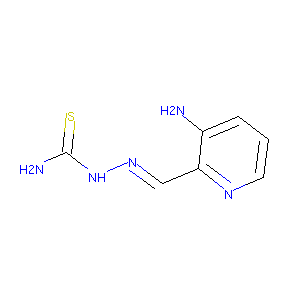
General Information of Drug Combination (ID: DCPHD7Z)

Drug Combination Name
Trifluridine Triapine
Indication
Disease Entry Status REF
Lung adenocarcinoma Investigative [1]
Component Drugs Trifluridine   DMG2YBD Triapine   DM7XZY5
Small molecular drug Small molecular drug
2D MOL 2D MOL
3D MOL 3D MOL
High-throughput Screening Result Testing Cell Line: EKVX
Zero Interaction Potency (ZIP) Score: 1.93
Bliss Independence Score: 5.05
Loewe Additivity Score: 4.68
LHighest Single Agent (HSA) Score: 1.01

Molecular Interaction Atlas of This Drug Combination

Molecular Interaction Atlas (MIA)
Indication(s) of Trifluridine
Disease Entry ICD 11 Status REF
Herpetic keratitis 1F00.10 Approved [2]
Virus infection 1A24-1D9Z Approved [3]
Colon cancer 2B90.Z Investigative [2]
Trifluridine Interacts with 1 DTT Molecule(s)
DTT Name DTT ID UniProt ID Mode of Action REF
Candida Thymidylate synthase (Candi TMP1) TTU6BFZ TYSY_CANAL Inhibitor [5]
------------------------------------------------------------------------------------
Trifluridine Interacts with 4 DTP Molecule(s)
DTP Name DTP ID UniProt ID Mode of Action REF
Organic anion transporter 1 (SLC22A6) DTQ23VB S22A6_HUMAN Substrate [6]
Concentrative nucleoside transporter 1 (SLC28A1) DT0EQPW S28A1_HUMAN Substrate [7]
Equilibrative nucleoside transporter 1 (SLC29A1) DTXD1TQ S29A1_HUMAN Substrate [7]
Equilibrative nucleoside transporter 2 (SLC29A2) DTW78DQ S29A2_HUMAN Substrate [7]
------------------------------------------------------------------------------------
Trifluridine Interacts with 1 DME Molecule(s)
DME Name DME ID UniProt ID Mode of Action REF
Thymidine phosphorylase (TYMP) DE4HCYL TYPH_HUMAN Metabolism [8]
------------------------------------------------------------------------------------
Trifluridine Interacts with 2 DOT Molecule(s)
DOT Name DOT ID UniProt ID Mode of Action REF
Nuclear receptor subfamily 1 group I member 2 (NR1I2) OTC5U0N5 NR1I2_HUMAN Increases Activity [9]
Poly polymerase 1 (PARP1) OT310QSG PARP1_HUMAN Increases Cleavage [10]
------------------------------------------------------------------------------------
Indication(s) of Triapine
Disease Entry ICD 11 Status REF
Nerve injury ND56.4 Phase 2 [4]
Triapine Interacts with 1 DTT Molecule(s)
DTT Name DTT ID UniProt ID Mode of Action REF
Ribonucleoside-diphosphate reductase M2 (RRM2) TTBWDI0 RIR2_HUMAN Modulator [4]
------------------------------------------------------------------------------------
Triapine Interacts with 2 DOT Molecule(s)
DOT Name DOT ID UniProt ID Mode of Action REF
Histone H2AX (H2AX) OT18UX57 H2AX_HUMAN Increases Expression [12]
Thioredoxin-dependent peroxide reductase, mitochondrial (PRDX3) OTLB2WEU PRDX3_HUMAN Increases Oxidation [11]
------------------------------------------------------------------------------------

Test Results of This Drug Combination in Other Disease Systems

Indication DrugCom ID Cell Line Status REF
Adult acute myeloid leukemia DC17SMO HL-60(TB) Investigative [13]
Clear cell renal cell carcinoma DCFGQVO TK-10 Investigative [13]
Clear cell renal cell carcinoma DCJ7SY2 A498 Investigative [13]
Breast adenocarcinoma DC5VSL8 MDA-MB-468 Investigative [14]
Adenocarcinoma DCJ1ZEV A549 Investigative [1]
High grade ovarian serous adenocarcinoma DCVE9FB OVCAR-8 Investigative [1]
Large cell lung carcinoma DCSSGRY NCI-H460 Investigative [1]
Non-small cell lung carcinoma DCLA67N HOP-92 Investigative [1]
Prostate carcinoma DC2ZJRH PC-3 Investigative [1]
------------------------------------------------------------------------------------
⏷ Show the Full List of 9 DrugCom(s)

References

1 CheMBL Affinity Phenotypic Cellular Interaction Assay ID: CHEMBL1125976
2 Trifluridine FDA Label
3 URL: http://www.guidetopharmacology.org Nucleic Acids Res. 2015 Oct 12. pii: gkv1037. The IUPHAR/BPS Guide to PHARMACOLOGY in 2016: towards curated quantitative interactions between 1300 protein targets and 6000 ligands. (Ligand id: 8697).
4 PAN-811 inhibits oxidative stress-induced cell death of human Alzheimer's disease-derived and age-matched olfactory neuroepithelial cells via suppression of intracellular reactive oxygen species. J Alzheimers Dis. 2009;17(3):611-9.
5 Trifluorothymidine induces cell death independently of p53. Nucleosides Nucleotides Nucleic Acids. 2008 Jun;27(6):699-703.
6 Rat multispecific organic anion transporter 1 (rOAT1) transports zidovudine, acyclovir, and other antiviral nucleoside analogs. J Pharmacol Exp Ther. 2000 Sep;294(3):844-9.
7 Lonsurf, INN-trifluridine/tipiracil.
8 Phase I clinical study of three times a day oral administration of TAS-102 in patients with solid tumors. Cancer Invest. 2008 Oct;26(8):794-9.
9 Screening of a chemical library reveals novel PXR-activating pharmacologic compounds. Toxicol Lett. 2015 Jan 5;232(1):193-202. doi: 10.1016/j.toxlet.2014.10.009. Epub 2014 Oct 16.
10 Differential activation of cell death and autophagy results in an increased cytotoxic potential for trifluorothymidine compared to 5-fluorouracil in colon cancer cells. Int J Cancer. 2010 May 15;126(10):2457-68. doi: 10.1002/ijc.24943.
11 The iron-chelating drug triapine causes pronounced mitochondrial thiol redox stress. Toxicol Lett. 2011 Mar 5;201(2):130-6. doi: 10.1016/j.toxlet.2010.12.017. Epub 2010 Dec 31.
12 Distinct mechanisms of cell-kill by triapine and its terminally dimethylated derivative Dp44mT due to a loss or gain of activity of their copper(II) complexes. Biochem Pharmacol. 2014 Oct 1;91(3):312-22. doi: 10.1016/j.bcp.2014.08.006. Epub 2014 Aug 15.
13 CheMBL Affinity Phenotypic Cellular Interaction Assay ID: CHEMBL1125966
14 CheMBL Affinity Phenotypic Cellular Interaction Assay ID: CHEMBL1126165