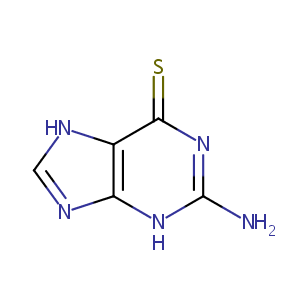
General Information of Drug Combination (ID: DCU0WIH)

Drug Combination Name
Trifluridine Thioguanine
Indication
Disease Entry Status REF
Breast adenocarcinoma Investigative [1]
Component Drugs Trifluridine   DMG2YBD Thioguanine   DM7NKEV
Small molecular drug Small molecular drug
2D MOL 2D MOL
3D MOL 3D MOL
High-throughput Screening Result Testing Cell Line: MDA-MB-468
Zero Interaction Potency (ZIP) Score: 3.95
Bliss Independence Score: 4.11
Loewe Additivity Score: 8.16
LHighest Single Agent (HSA) Score: 9.88

Molecular Interaction Atlas of This Drug Combination

Molecular Interaction Atlas (MIA)
Indication(s) of Trifluridine
Disease Entry ICD 11 Status REF
Herpetic keratitis 1F00.10 Approved [2]
Virus infection 1A24-1D9Z Approved [3]
Colon cancer 2B90.Z Investigative [2]
Trifluridine Interacts with 1 DTT Molecule(s)
DTT Name DTT ID UniProt ID Mode of Action REF
Candida Thymidylate synthase (Candi TMP1) TTU6BFZ TYSY_CANAL Inhibitor [8]
------------------------------------------------------------------------------------
Trifluridine Interacts with 4 DTP Molecule(s)
DTP Name DTP ID UniProt ID Mode of Action REF
Organic anion transporter 1 (SLC22A6) DTQ23VB S22A6_HUMAN Substrate [9]
Concentrative nucleoside transporter 1 (SLC28A1) DT0EQPW S28A1_HUMAN Substrate [10]
Equilibrative nucleoside transporter 1 (SLC29A1) DTXD1TQ S29A1_HUMAN Substrate [10]
Equilibrative nucleoside transporter 2 (SLC29A2) DTW78DQ S29A2_HUMAN Substrate [10]
------------------------------------------------------------------------------------
Trifluridine Interacts with 1 DME Molecule(s)
DME Name DME ID UniProt ID Mode of Action REF
Thymidine phosphorylase (TYMP) DE4HCYL TYPH_HUMAN Metabolism [11]
------------------------------------------------------------------------------------
Trifluridine Interacts with 2 DOT Molecule(s)
DOT Name DOT ID UniProt ID Mode of Action REF
Nuclear receptor subfamily 1 group I member 2 (NR1I2) OTC5U0N5 NR1I2_HUMAN Increases Activity [12]
Poly polymerase 1 (PARP1) OT310QSG PARP1_HUMAN Increases Cleavage [13]
------------------------------------------------------------------------------------
Indication(s) of Thioguanine
Disease Entry ICD 11 Status REF
Acute lymphocytic leukaemia 2B33.3 Approved [4]
Acute myelogenous leukaemia 2A41 Approved [5]
Acute myeloid leukaemia 2A60 Approved [6]
Middle East Respiratory Syndrome (MERS) 1D64 Preclinical [7]
Severe acute respiratory syndrome (SARS) 1D65 Preclinical [7]
Thioguanine Interacts with 3 DTT Molecule(s)
DTT Name DTT ID UniProt ID Mode of Action REF
MERS-CoV papain-like proteinase (PL-PRO) TTYJOLE R1AB_CVEMC (854-2740) Inhibitor [7]
Inosine-5'-monophosphate dehydrogenase (IMPDH) TTCAQMW NOUNIPROTAC Intercalator [14]
SARS-CoV papain-like proteinase (PL-PRO) TTRGHB2 R1AB_CVHSA (819-2740) Inhibitor [7]
------------------------------------------------------------------------------------
Thioguanine Interacts with 3 DTP Molecule(s)
DTP Name DTP ID UniProt ID Mode of Action REF
Breast cancer resistance protein (ABCG2) DTI7UX6 ABCG2_HUMAN Substrate [15]
Multidrug resistance-associated protein 4 (ABCC4) DTCSGPB MRP4_HUMAN Substrate [16]
Concentrative Na(+)-nucleoside cotransporter 3 (SLC28A3) DT4YL5R S28A3_HUMAN Substrate [17]
------------------------------------------------------------------------------------
Thioguanine Interacts with 2 DME Molecule(s)
DME Name DME ID UniProt ID Mode of Action REF
Thiopurine methyltransferase (TPMT) DEFQ8VO TPMT_HUMAN Metabolism [18]
Hypoxanthine phosphoribosyltransferase (HPRT1) DEVXTP5 HPRT_HUMAN Metabolism [19]
------------------------------------------------------------------------------------
Thioguanine Interacts with 3 DOT Molecule(s)
DOT Name DOT ID UniProt ID Mode of Action REF
Occludin (OCLN) OTSUTVWL OCLN_HUMAN Decreases Activity [20]
ATP-binding cassette sub-family C member 5 (ABCC5) OT34G4US MRP5_HUMAN Decreases Response To Substance [21]
Baculoviral IAP repeat-containing protein 2 (BIRC2) OTFXFREP BIRC2_HUMAN Decreases Response To Substance [22]
------------------------------------------------------------------------------------

Test Results of This Drug Combination in Other Disease Systems

Indication DrugCom ID Cell Line Status REF
Adult acute myeloid leukemia DCNOB48 HL-60(TB) Investigative [23]
Anaplastic large cell lymphoma DCSK2FP SR Investigative [23]
Childhood T acute lymphoblastic leukemia DCKNRZ6 CCRF-CEM Investigative [23]
------------------------------------------------------------------------------------

References

1 CheMBL Affinity Phenotypic Cellular Interaction Assay ID: CHEMBL1126165
2 Trifluridine FDA Label
3 URL: http://www.guidetopharmacology.org Nucleic Acids Res. 2015 Oct 12. pii: gkv1037. The IUPHAR/BPS Guide to PHARMACOLOGY in 2016: towards curated quantitative interactions between 1300 protein targets and 6000 ligands. (Ligand id: 8697).
4 Drugs@FDA. U.S. Food and Drug Administration. U.S. Department of Health & Human Services. 2015
5 Thioguanine FDA Label
6 URL: http://www.guidetopharmacology.org Nucleic Acids Res. 2015 Oct 12. pii: gkv1037. The IUPHAR/BPS Guide to PHARMACOLOGY in 2016: towards curated quantitative interactions between 1300 protein targets and 6000 ligands. (Ligand id: 6845).
7 Thiopurine analogs and mycophenolic acid synergistically inhibit the papain-like protease of Middle East respiratory syndrome coronavirus. Antiviral Res. 2015 Mar;115:9-16.
8 Trifluorothymidine induces cell death independently of p53. Nucleosides Nucleotides Nucleic Acids. 2008 Jun;27(6):699-703.
9 Rat multispecific organic anion transporter 1 (rOAT1) transports zidovudine, acyclovir, and other antiviral nucleoside analogs. J Pharmacol Exp Ther. 2000 Sep;294(3):844-9.
10 Lonsurf, INN-trifluridine/tipiracil.
11 Phase I clinical study of three times a day oral administration of TAS-102 in patients with solid tumors. Cancer Invest. 2008 Oct;26(8):794-9.
12 Screening of a chemical library reveals novel PXR-activating pharmacologic compounds. Toxicol Lett. 2015 Jan 5;232(1):193-202. doi: 10.1016/j.toxlet.2014.10.009. Epub 2014 Oct 16.
13 Differential activation of cell death and autophagy results in an increased cytotoxic potential for trifluorothymidine compared to 5-fluorouracil in colon cancer cells. Int J Cancer. 2010 May 15;126(10):2457-68. doi: 10.1002/ijc.24943.
14 Immune effector cells produce lethal DNA damage in cells treated with a thiopurine. Cancer Res. 2009 Mar 15;69(6):2393-9.
15 ABC transporters and their role in nucleoside and nucleotide drug resistance. Biochem Pharmacol. 2012 Apr 15;83(8):1073-83.
16 Multidrug resistance protein 4 (MRP4/ABCC4) mediates efflux of bimane-glutathione. Int J Biochem Cell Biol. 2004 Feb;36(2):247-57.
17 Involvement of the concentrative nucleoside transporter 3 and equilibrative nucleoside transporter 2 in the resistance of T-lymphoblastic cell lines to thiopurines. Biochem Biophys Res Commun. 2006 Apr 28;343(1):208-15.
18 Usefulness of thiopurine methyltransferase and thiopurine metabolite analysis in clinical practice in patients with inflammatory bowel diseases. Acta Gastroenterol Belg. 2010 Jul-Sep;73(3):331-5.
19 Qualitative and quantitative difference in mutation induction between carbon- and neon-ion beams in normal human cells. Biol Sci Space. 2003 Dec;17(4):302-6.
20 The thiopurine methyltransferase genetic polymorphism is associated with thioguanine-related veno-occlusive disease of the liver in children with acute lymphoblastic leukemia. Clin Pharmacol Ther. 2006 Oct;80(4):375-83. doi: 10.1016/j.clpt.2006.07.002.
21 The multidrug resistance protein 5 (ABCC5) confers resistance to 5-fluorouracil and transports its monophosphorylated metabolites. Mol Cancer Ther. 2005 May;4(5):855-63.
22 Expression and prognostic significance of IAP-family genes in human cancers and myeloid leukemias. Clin Cancer Res. 2000 May;6(5):1796-803.
23 CheMBL Affinity Phenotypic Cellular Interaction Assay ID: CHEMBL1125966