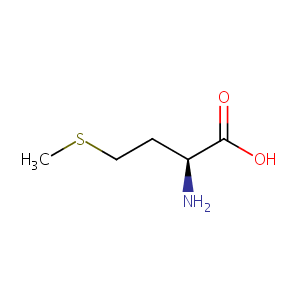
General Information of Drug (ID: DME8G1U)

Drug Name
L-methionine
Synonyms Acimethin; Cymethion
Indication
Disease Entry ICD 11 Status REF
Discovery agent N.A. Investigative [1]
Affected Organisms
Humans and other mammals
Drug Type
Small molecular drug
Structure
3D MOL is unavailable 2D MOL
#Ro5 Violations (Lipinski): 0 Molecular Weight (mw) 149.21
Logarithm of the Partition Coefficient (xlogp) -1.9
Rotatable Bond Count (rotbonds) 4
Hydrogen Bond Donor Count (hbonddonor) 2
Hydrogen Bond Acceptor Count (hbondacc) 4
ADMET Property
Absorption
The drug is absorbed from the lumen of the small intestine into the enterocytes by an active transport process []
Metabolism
The drug is metabolized via the hepatic []
Chemical Identifiers
Formula
C5H11NO2S
IUPAC Name
(2S)-2-amino-4-methylsulfanylbutanoic acid
Canonical SMILES
CSCC[C@@H](C(=O)O)N
InChI
InChI=1S/C5H11NO2S/c1-9-3-2-4(6)5(7)8/h4H,2-3,6H2,1H3,(H,7,8)/t4-/m0/s1
InChIKey
FFEARJCKVFRZRR-BYPYZUCNSA-N
Cross-matching ID
PubChem CID
6137
ChEBI ID
CHEMBL16643
CAS Number
63-68-3
UNII
AE28F7PNPL
DrugBank ID
DB00134
TTD ID
D0PO8E
INTEDE ID
DR1043
Drug-Molecule Activity Atlas (DMA)NEW Click to Jump to the Detailed DMA Information of This Drug
Drug ADMET Endpoint Profile (DAE)NEW Click to Jump to the Detailed DAE Information of This Drug

Molecular Interaction Atlas of This Drug


Drug-Metabolizing Enzyme (DME)
DME Name DME ID UniProt ID MOA REF
Methionine-tRNA ligase mitochondrial (MARS2) DEEH5Y9 SYMM_HUMAN Substrate [2]
Peptide methionine sulfoxide reductase (MSRA) DEU2ZBY MSRA_HUMAN Substrate [3]
S-adenosylmethionine synthase 2 (MAT2A) DE76G8C METK2_HUMAN Substrate [4]
Methionine adenosyltransferase II beta (MAT2B) DEKF1OH MAT2B_HUMAN Substrate [2]
S-adenosylmethionine synthase 1 (MAT1A) DEQ6NC9 METK1_HUMAN Substrate [4]
Methionine-R-sulfoxide reductase B1 (MSRB1) DEFADPU MSRB1_HUMAN Substrate [5]
Methionine-R-sulfoxide reductase B2 (MSRB2) DEMQOF7 MSRB2_HUMAN Substrate [6]
Homoserine-O-transsuccinylase (metAA) DER6EU8 METAA_THEMA Substrate [7]
Methionine-tRNA ligase cytoplasmic (MARS) DE0K52I SYMC_HUMAN Substrate [8]

Drug Off-Target (DOT)
DOT Name DOT ID UniProt ID Interaction REF
Amino acid transporter heavy chain SLC3A1 (SLC3A1) OT56V01A SLC31_HUMAN Regulation of Drug Effects [9]
Kynurenine--oxoglutarate transaminase 1 (KYAT1) OTRD3RUJ KAT1_HUMAN Biotransformations [10]
Large neutral amino acids transporter small subunit 2 (SLC7A8) OT8XXVO8 LAT2_HUMAN Regulation of Drug Effects [11]
Mitogen-activated protein kinase 8 (MAPK8) OTEREYS5 MK08_HUMAN Gene/Protein Processing [12]
von Willebrand factor OTNMMA2P VWF_HUMAN Protein Interaction/Cellular Processes [13]
Molecular Interaction Atlas (MIA) Jump to Detail Molecular Interaction Atlas of This Drug

Drug-Drug Interaction (DDI) Information of This Drug

Coadministration of a Drug Treating the Disease Different from L-methionine (Comorbidity)
DDI Drug Name DDI Drug ID Severity Mechanism Comorbidity REF
Ephedrine DMMV0KW Minor as urine pH determines the ionization state of weakly acidic or weakly alkaline drugs. L-methionine caused by Ephedrine mediated altered urine pH. Asthma [CA23] [14]
Pseudoephedrine DMIVJ0D Minor as urine pH determines the ionization state of weakly acidic or weakly alkaline drugs. L-methionine caused by Pseudoephedrine mediated altered urine pH. Breathing abnormality [MD11] [14]
Mexiletine DMCTE9R Minor as urine pH determines the ionization state of weakly acidic or weakly alkaline drugs. L-methionine caused by Mexiletine mediated altered urine pH. Ventricular tachyarrhythmia [BC71] [15]
Flecainide DMSQDLE Minor as urine pH determines the ionization state of weakly acidic or weakly alkaline drugs. L-methionine caused by Flecainide mediated altered urine pH. Ventricular tachyarrhythmia [BC71] [16]

References

1 URL: http://www.guidetopharmacology.org Nucleic Acids Res. 2015 Oct 12. pii: gkv1037. The IUPHAR/BPS Guide to PHARMACOLOGY in 2016: towards curated quantitative interactions between 1300 protein targets and 6000 ligands. (Ligand id: 4814).
2 How many drug targets are there? Nat Rev Drug Discov. 2006 Dec;5(12):993-6.
3 Characterization of the amino acids involved in substrate specificity of methionine sulfoxide reductase A. J Biol Chem. 2007 Jul 13;282(28):20484-91.
4 Role of methionine adenosyltransferase 2A and S-adenosylmethionine in mitogen-induced growth of human colon cancer cells. Gastroenterology. 2007 Jul;133(1):207-18.
5 Catalytic advantages provided by selenocysteine in methionine-S-sulfoxide reductases. Biochemistry. 2006 Nov 21;45(46):13697-704.
6 The X-ray structure of the N-terminal domain of PILB from Neisseria meningitidis reveals a thioredoxin-fold. J Mol Biol. 2006 Apr 28;358(2):443-54.
7 Regulation of the methionine feedback-sensitive enzyme in mutants of Salmonella typhimurium. J Bacteriol. 1972 Jan;109(1):8-11.
8 Mutations in methylenetetrahydrofolate reductase or cystathionine beta-synthase gene, or a high-methionine diet, increase homocysteine thiolactone levels in humans and mice. FASEB J. 2007 Jun;21(8):1707-13.
9 Characteristics of transport of selenoamino acids by epithelial amino acid transporters. Chem Biol Interact. 2009 Feb 12;177(3):234-41. doi: 10.1016/j.cbi.2008.09.008. Epub 2008 Sep 19.
10 New insights into the metabolism of organomercury compounds: mercury-containing cysteine S-conjugates are substrates of human glutamine transaminase K and potent inactivators of cystathionine gama-lyase. Arch Biochem Biophys. 2012 Jan 1;517(1):20-9.
11 Methylmercury Uptake into BeWo Cells Depends on LAT2-4F2hc, a System L Amino Acid Transporter. Int J Mol Sci. 2017 Aug 8;18(8):1730. doi: 10.3390/ijms18081730.
12 Methionine restriction induces apoptosis of prostate cancer cells via the c-Jun N-terminal kinase-mediated signaling pathway. Cancer Lett. 2002 May 8;179(1):51-8. doi: 10.1016/s0304-3835(01)00852-7.
13 von Willebrand factor multimer composition is modified following oral methionine load in women with thrombosis, but not in healthy women. Blood Coagul Fibrinolysis. 2005 Jun;16(4):267-73. doi: 10.1097/01.mbc.0000169219.93054.92.
14 Brater DC, Kaojarern S, Benet LZ, et al "Renal excretion of pseudoephedrine." Clin Pharmacol Ther 28 (1980): 690-4. [PMID: 7438686]
15 Mitchell BG, Clements JA, Pottage A, Prescott LF "Mexiletine disposition: individual variation in response to urine acidification and alkalinisation." Br J Clin Pharmacol 16 (1983): 281-4. [PMID: 6626420]
16 Hertrampf R, Gundert-Remy U, Beckmann J, et al "Elimination of flecainide as a function of urinary flow rate and pH." Eur J Clin Pharmacol 41 (1991): 61-3. [PMID: 1782979]