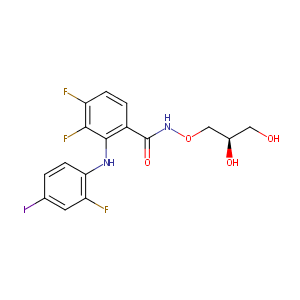
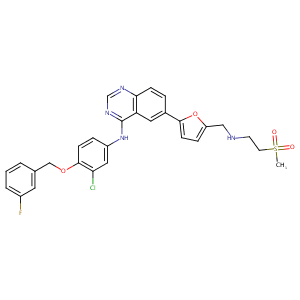
General Information of Drug Combination (ID: DC94F7Y)

Drug Combination Name
PD-0325901 Lapatinib
Indication
Disease Entry Status REF
Adenocarcinoma Investigative [1]
Component Drugs PD-0325901   DM27D4J Lapatinib   DM3BH1Y
Small molecular drug Small molecular drug
2D MOL 2D MOL
3D MOL 3D MOL
High-throughput Screening Result Testing Cell Line: COLO320DM
Zero Interaction Potency (ZIP) Score: 10.31
Bliss Independence Score: 9.69
Loewe Additivity Score: 5.62
LHighest Single Agent (HSA) Score: 11.58

Molecular Interaction Atlas of This Drug Combination

Molecular Interaction Atlas (MIA)
Indication(s) of PD-0325901
Disease Entry ICD 11 Status REF
Breast cancer 2C60-2C65 Phase 2 [2]
PD-0325901 Interacts with 1 DTT Molecule(s)
DTT Name DTT ID UniProt ID Mode of Action REF
MAPK/ERK kinase kinase (MAP3K) TTROQ37 NOUNIPROTAC Modulator [6]
------------------------------------------------------------------------------------
PD-0325901 Interacts with 62 DOT Molecule(s)
DOT Name DOT ID UniProt ID Mode of Action REF
Nuclear receptor subfamily 0 group B member 2 (NR0B2) OT7UVICX NR0B2_HUMAN Decreases Expression [7]
T-box transcription factor TBX3 (TBX3) OTM64N7K TBX3_HUMAN Decreases Expression [5]
Protein sprouty homolog 2 (SPRY2) OTH0CRCZ SPY2_HUMAN Decreases Expression [5]
Leupaxin (LPXN) OTUNV3CK LPXN_HUMAN Decreases Expression [5]
PR domain zinc finger protein 1 (PRDM1) OTQLSVBS PRDM1_HUMAN Decreases Expression [5]
Tumor necrosis factor ligand superfamily member 15 (TNFSF15) OTNGA2BW TNF15_HUMAN Decreases Expression [5]
Integrin beta-like protein 1 (ITGBL1) OTJDHE17 ITGBL_HUMAN Decreases Expression [5]
Interstitial collagenase (MMP1) OTI4I2V1 MMP1_HUMAN Decreases Expression [5]
Glycophorin-C (GYPC) OTOEDR7O GLPC_HUMAN Decreases Expression [5]
Growth-regulated alpha protein (CXCL1) OT3WCTZV GROA_HUMAN Decreases Expression [5]
Interleukin-8 (CXCL8) OTS7T5VH IL8_HUMAN Decreases Expression [5]
Mast/stem cell growth factor receptor Kit (KIT) OTHUY3VZ KIT_HUMAN Decreases Expression [5]
Protein-glutamine gamma-glutamyltransferase 2 (TGM2) OT6MFOWF TGM2_HUMAN Decreases Expression [5]
Pentraxin-related protein PTX3 (PTX3) OTPXHRKU PTX3_HUMAN Decreases Expression [5]
5-hydroxytryptamine receptor 7 (HTR7) OT44DEWB 5HT7R_HUMAN Decreases Expression [5]
17-beta-hydroxysteroid dehydrogenase type 2 (HSD17B2) OT3K7HY5 DHB2_HUMAN Decreases Expression [5]
ETS translocation variant 5 (ETV5) OTE2OBM4 ETV5_HUMAN Decreases Expression [5]
ETS translocation variant 4 (ETV4) OT8C98UZ ETV4_HUMAN Decreases Expression [5]
Transcription factor SOX-9 (SOX9) OTVDJFGN SOX9_HUMAN Decreases Expression [5]
ETS translocation variant 1 (ETV1) OT6PMJIK ETV1_HUMAN Decreases Expression [5]
Paired mesoderm homeobox protein 1 (PRRX1) OTTZK5G8 PRRX1_HUMAN Decreases Expression [5]
Epithelial membrane protein 1 (EMP1) OTSZHUHQ EMP1_HUMAN Decreases Expression [5]
Forkhead box protein G1 (FOXG1) OTAW57J4 FOXG1_HUMAN Decreases Expression [5]
ADP-ribosylation factor-like protein 4C (ARL4C) OTQ3QNNU ARL4C_HUMAN Decreases Expression [5]
Reelin (RELN) OTLKMW1O RELN_HUMAN Decreases Expression [5]
C-C motif chemokine 20 (CCL20) OTUCJY4N CCL20_HUMAN Decreases Expression [5]
A-kinase anchor protein 12 (AKAP12) OTCVRDDX AKA12_HUMAN Decreases Expression [5]
Dual specificity protein phosphatase 4 (DUSP4) OT6WAO12 DUS4_HUMAN Decreases Expression [5]
Monocyte to macrophage differentiation factor (MMD) OTB5I4OC PAQRB_HUMAN Decreases Expression [5]
Syntaxin-1A (STX1A) OTSBUZB4 STX1A_HUMAN Decreases Expression [5]
Dual specificity protein phosphatase 6 (DUSP6) OT4H6RKW DUS6_HUMAN Decreases Expression [5]
Kinesin-like protein KIF24 (KIF24) OTJTA5V3 KIF24_HUMAN Decreases Expression [5]
Anoctamin-1 (ANO1) OTSREUNI ANO1_HUMAN Decreases Expression [5]
NADH-cytochrome b5 reductase 2 (CYB5R2) OTTLM7XN NB5R2_HUMAN Decreases Expression [5]
Dynamin-binding protein (DNMBP) OTMHH14H DNMBP_HUMAN Decreases Expression [5]
Sialic acid-binding Ig-like lectin 15 (SIGLEC15) OTON4K9S SIG15_HUMAN Decreases Expression [5]
UPF0606 protein KIAA1549L (KIAA1549L) OT80HUVY K154L_HUMAN Decreases Expression [5]
Neuron navigator 3 (NAV3) OT97M1TR NAV3_HUMAN Decreases Expression [5]
Dedicator of cytokinesis protein 4 (DOCK4) OTH3XY8B DOCK4_HUMAN Decreases Expression [5]
Transmembrane protein 156 (TMEM156) OTH7YJID TM156_HUMAN Decreases Expression [5]
Tribbles homolog 2 (TRIB2) OTHSX3MX TRIB2_HUMAN Decreases Expression [5]
Hyaluronan synthase 2 (HAS2) OTTD3PAL HYAS2_HUMAN Decreases Expression [5]
Neuronal cell adhesion molecule (NRCAM) OT80HHQ2 NRCAM_HUMAN Decreases Expression [5]
Discoidin, CUB and LCCL domain-containing protein 2 (DCBLD2) OTB71I02 DCBD2_HUMAN Decreases Expression [5]
Formin-like protein 2 (FMNL2) OT9OVWCV FMNL2_HUMAN Decreases Expression [5]
Paternally-expressed gene 3 protein (PEG3) OTHQW98S PEG3_HUMAN Decreases Expression [5]
Disintegrin and metalloproteinase domain-containing protein 19 (ADAM19) OTH88TXU ADA19_HUMAN Decreases Expression [5]
Endothelial cell-specific molecule 1 (ESM1) OT331Y8V ESM1_HUMAN Decreases Expression [5]
Interleukin-1 receptor accessory protein-like 1 (IL1RAPL1) OTW3T4B2 IRPL1_HUMAN Decreases Expression [5]
Neurotrimin (NTM) OTHF0UQU NTRI_HUMAN Decreases Expression [5]
Type 2 lactosamine alpha-2,3-sialyltransferase (ST3GAL6) OTB17Q43 SIA10_HUMAN Decreases Expression [5]
Bcl-2-like protein 11 (BCL2L11) OTNQQWFJ B2L11_HUMAN Increases Expression [8]
Forkhead box protein O3 (FOXO3) OTHXQG4P FOXO3_HUMAN Increases Expression [9]
Myc proto-oncogene protein (MYC) OTPV5LUK MYC_HUMAN Decreases Expression [10]
DNA excision repair protein ERCC-1 (ERCC1) OTNPYQHI ERCC1_HUMAN Decreases Expression [11]
Poly polymerase 1 (PARP1) OT310QSG PARP1_HUMAN Increases Cleavage [12]
Mitogen-activated protein kinase 3 (MAPK3) OTCYKGKO MK03_HUMAN Decreases Phosphorylation [13]
Mitogen-activated protein kinase 1 (MAPK1) OTH85PI5 MK01_HUMAN Decreases Phosphorylation [13]
Small ribosomal subunit protein eS6 (RPS6) OTT4D1LN RS6_HUMAN Decreases Phosphorylation [14]
Heat shock factor protein 1 (HSF1) OTYNJ4KP HSF1_HUMAN Decreases Activity [15]
Bcl-2 homologous antagonist/killer (BAK1) OTDP6ILW BAK_HUMAN Increases Expression [12]
DNA repair endonuclease XPF (ERCC4) OTFIOPG1 XPF_HUMAN Increases Expression [11]
------------------------------------------------------------------------------------
⏷ Show the Full List of 62 DOT(s)
Indication(s) of Lapatinib
Disease Entry ICD 11 Status REF
Breast cancer 2C60-2C65 Approved [3]
Gastroesophageal junction adenocarcinoma 2B71 Approved [4]
Melanoma 2C30 Approved [4]
Lapatinib Interacts with 3 DTT Molecule(s)
DTT Name DTT ID UniProt ID Mode of Action REF
Erbb2 tyrosine kinase receptor (HER2) TT6EO5L ERBB2_HUMAN Inhibitor [17]
Epidermal growth factor receptor (EGFR) TTGKNB4 EGFR_HUMAN Inhibitor [17]
Eukaryotic elongation factor 2 kinase (eEF-2K) TT1QFLA EF2K_HUMAN Inhibitor [18]
------------------------------------------------------------------------------------
Lapatinib Interacts with 2 DTP Molecule(s)
DTP Name DTP ID UniProt ID Mode of Action REF
P-glycoprotein 1 (ABCB1) DTUGYRD MDR1_HUMAN Substrate [19]
Breast cancer resistance protein (ABCG2) DTI7UX6 ABCG2_HUMAN Substrate [20]
------------------------------------------------------------------------------------
Lapatinib Interacts with 4 DME Molecule(s)
DME Name DME ID UniProt ID Mode of Action REF
Cytochrome P450 3A4 (CYP3A4) DE4LYSA CP3A4_HUMAN Metabolism [21]
Cytochrome P450 3A5 (CYP3A5) DEIBDNY CP3A5_HUMAN Metabolism [22]
Cytochrome P450 2C8 (CYP2C8) DES5XRU CP2C8_HUMAN Metabolism [21]
Mephenytoin 4-hydroxylase (CYP2C19) DEGTFWK CP2CJ_HUMAN Metabolism [22]
------------------------------------------------------------------------------------
Lapatinib Interacts with 15 DOT Molecule(s)
DOT Name DOT ID UniProt ID Mode of Action REF
Bile salt export pump (ABCB11) OTRU7THO ABCBB_HUMAN Decreases Activity [23]
Superoxide dismutase , mitochondrial (SOD2) OTIWXGZ9 SODM_HUMAN Increases Expression [24]
Baculoviral IAP repeat-containing protein 5 (BIRC5) OTILXZYL BIRC5_HUMAN Decreases Expression [25]
Poly polymerase 1 (PARP1) OT310QSG PARP1_HUMAN Increases Cleavage [26]
Histone H2AX (H2AX) OT18UX57 H2AX_HUMAN Increases Expression [27]
Phosphatidylcholine translocator ABCB4 (ABCB4) OTE6PY83 MDR3_HUMAN Decreases Activity [28]
Receptor tyrosine-protein kinase erbB-3 (ERBB3) OTRSST0A ERBB3_HUMAN Decreases Activity [29]
Mitogen-activated protein kinase 3 (MAPK3) OTCYKGKO MK03_HUMAN Decreases Activity [26]
Mitogen-activated protein kinase 1 (MAPK1) OTH85PI5 MK01_HUMAN Decreases Activity [26]
Cyclin-dependent kinase inhibitor 1B (CDKN1B) OTNY5LLZ CDN1B_HUMAN Increases Expression [30]
HLA class II histocompatibility antigen, DQ alpha 1 chain (HLA-DQA1) OTC6GISG DQA1_HUMAN Increases ADR [31]
Zinc finger protein SNAI1 (SNAI1) OTDPYAMC SNAI1_HUMAN Decreases Response To Substance [32]
Transforming growth factor beta-1 proprotein (TGFB1) OTV5XHVH TGFB1_HUMAN Decreases Response To Substance [32]
Tenascin-X (TNXB) OTVBWAV5 TENX_HUMAN Increases ADR [31]
HLA class II histocompatibility antigen, DQ beta 1 chain (HLA-DQB1) OTVVI3UI DQB1_HUMAN Increases ADR [31]
------------------------------------------------------------------------------------
⏷ Show the Full List of 15 DOT(s)

Test Results of This Drug Combination in Other Disease Systems

Indication DrugCom ID Cell Line Status REF
Ewing sarcoma-peripheral primitive neuroectodermal tumour DCERNQ6 ES2 Investigative [33]
Breast carcinoma DCKKNGJ KPL1 Investigative [34]
Breast carcinoma DC2J4BT OCUBM Investigative [34]
Carcinoma DCR6XGK EFM192B Investigative [34]
Carcinoma DC6PCU2 MDAMB436 Investigative [34]
Colon adenocarcinoma DCUI661 LOVO Investigative [34]
Colon carcinoma DCJRTDJ RKO Investigative [34]
Invasive ductal carcinoma DCCB57U T-47D Investigative [34]
Rectal adenocarcinoma DCUY2HO SW837 Investigative [34]
Adenocarcinoma DCXSDN6 CAOV3 Investigative [1]
Adenocarcinoma DCXJO0W A427 Investigative [1]
Adenocarcinoma DCR78NF NCIH1650 Investigative [1]
Adenocarcinoma DCVT3VI NCIH2122 Investigative [1]
Adenocarcinoma DCOJZFW NCIH23 Investigative [1]
Adenocarcinoma DC0HN10 NCIH520 Investigative [1]
Adenocarcinoma DCQQMQK DLD1 Investigative [1]
Amelanotic melanoma DCLP8DL A2058 Investigative [1]
Germ cell tumour DCMASXK PA1 Investigative [1]
Malignant melanoma DCXY24W HT144 Investigative [1]
Malignant melanoma DCQH2CL RPMI7951 Investigative [1]
Malignant melanoma DC6XLIR SKMEL30 Investigative [1]
Malignant melanoma DCHTPI1 UACC62 Investigative [1]
Mesothelioma DCN7XNQ MSTO Investigative [1]
Non small cell carcinoma DC7BUTH SKMES1 Investigative [1]
Ovarian endometrioid adenocarcinoma DCEJZX3 A2780 Investigative [1]
Ovarian serous cystadenocarcinoma DC1XLUB SK-OV-3 Investigative [1]
Prostate carcinoma DC51RDB VCAP Investigative [1]
------------------------------------------------------------------------------------
⏷ Show the Full List of 27 DrugCom(s)

References

1 CheMBL Affinity Phenotypic Cellular Interaction Assay ID: CHEMBL1125976
2 URL: http://www.guidetopharmacology.org Nucleic Acids Res. 2015 Oct 12. pii: gkv1037. The IUPHAR/BPS Guide to PHARMACOLOGY in 2016: towards curated quantitative interactions between 1300 protein targets and 6000 ligands. (Ligand id: 7935).
3 URL: http://www.guidetopharmacology.org Nucleic Acids Res. 2015 Oct 12. pii: gkv1037. The IUPHAR/BPS Guide to PHARMACOLOGY in 2016: towards curated quantitative interactions between 1300 protein targets and 6000 ligands. (Ligand id: 5692).
4 Lapatinib FDA Label
5 PRC2 loss amplifies Ras-driven transcription and confers sensitivity to BRD4-based therapies. Nature. 2014 Oct 9;514(7521):247-51.
6 MEK and the inhibitors: from bench to bedside. J Hematol Oncol. 2013; 6: 27.
7 U0126, a mitogen-activated protein kinase kinase 1 and 2 (MEK1 and 2) inhibitor, selectively up-regulates main isoforms of CYP3A subfamily via a pregnane X receptor (PXR) in HepG2 cells. Arch Toxicol. 2014 Dec;88(12):2243-59.
8 Combination PI3K/MEK inhibition promotes tumor apoptosis and regression in PIK3CA wild-type, KRAS mutant colorectal cancer. Cancer Lett. 2014 Jun 1;347(2):204-11. doi: 10.1016/j.canlet.2014.02.018. Epub 2014 Feb 24.
9 Antitumor activity of luteolin in human colon cancer SW620 cells is mediated by the ERK/FOXO3a signaling pathway. Toxicol In Vitro. 2020 Aug;66:104852. doi: 10.1016/j.tiv.2020.104852. Epub 2020 Apr 5.
10 Perturbation biology nominates upstream-downstream drug combinations in RAF inhibitor resistant melanoma cells. Elife. 2015 Aug 18;4:e04640. doi: 10.7554/eLife.04640.
11 Cisplatin regulates the MAPK kinase pathway to induce increased expression of DNA repair gene ERCC1 and increase melanoma chemoresistance. Oncogene. 2012 May 10;31(19):2412-22. doi: 10.1038/onc.2011.426. Epub 2011 Sep 26.
12 Blocking downstream signaling pathways in the context of HDAC inhibition promotes apoptosis preferentially in cells harboring mutant Ras. Oncotarget. 2016 Oct 25;7(43):69804-69815. doi: 10.18632/oncotarget.12001.
13 The synergistic interaction of MEK and PI3K inhibitors is modulated by mTOR inhibition. Br J Cancer. 2012 Apr 10;106(8):1386-94. doi: 10.1038/bjc.2012.70. Epub 2012 Mar 13.
14 Synergistic inhibition of ovarian cancer cell growth by combining selective PI3K/mTOR and RAS/ERK pathway inhibitors. Eur J Cancer. 2013 Dec;49(18):3936-44. doi: 10.1016/j.ejca.2013.08.007. Epub 2013 Sep 3.
15 A Gene Expression Biomarker Predicts Heat Shock Factor 1 Activation in a Gene Expression Compendium. Chem Res Toxicol. 2021 Jul 19;34(7):1721-1737. doi: 10.1021/acs.chemrestox.0c00510. Epub 2021 Jun 25.
16 UGT-dependent regioselective glucuronidation of ursodeoxycholic acid and obeticholic acid and selective transport of the consequent acyl glucuronides by OATP1B1 and 1B3. Chem Biol Interact. 2019 Sep 1;310:108745. doi: 10.1016/j.cbi.2019.108745. Epub 2019 Jul 9.
17 Triple negative breast cancer--current status and prospective targeted treatment based on HER1 (EGFR), TOP2A and C-MYC gene assessment. Biomed Pap Med Fac Univ Palacky Olomouc Czech Repub. 2009 Mar;153(1):13-7.
18 Inhibition of eEF-2 kinase sensitizes human nasopharyngeal carcinoma cells to lapatinib-induced apoptosis through the Src and Erk pathways.BMC Cancer. 2016 Oct 19;16(1):813.
19 Tarascon Pocket Pharmacopoeia 2018 Classic Shirt-Pocket Edition.
20 The role of efflux and uptake transporters in [N-{3-chloro-4-[(3-fluorobenzyl)oxy]phenyl}-6-[5-({[2-(methylsulfonyl)ethyl]amino}methyl)-2-furyl]-4-quinazolinamine (GW572016, lapatinib) disposition and drug interactions. Drug Metab Dispos. 2008 Apr;36(4):695-701.
21 Mechanism-based inactivation of cytochrome P450 3A4 by lapatinib. Mol Pharmacol. 2010 Oct;78(4):693-703.
22 Clinical pharmacokinetics of tyrosine kinase inhibitors. Cancer Treat Rev. 2009 Dec;35(8):692-706.
23 Interference with bile salt export pump function is a susceptibility factor for human liver injury in drug development. Toxicol Sci. 2010 Dec; 118(2):485-500.
24 P450 3A-catalyzed O-dealkylation of lapatinib induces mitochondrial stress and activates Nrf2. Chem Res Toxicol. 2016 May 16;29(5):784-96.
25 Combining lapatinib (GW572016), a small molecule inhibitor of ErbB1 and ErbB2 tyrosine kinases, with therapeutic anti-ErbB2 antibodies enhances apoptosis of ErbB2-overexpressing breast cancer cells. Oncogene. 2005 Sep 15;24(41):6213-21. doi: 10.1038/sj.onc.1208774.
26 CDK4/6 inhibition provides a potent adjunct to Her2-targeted therapies in preclinical breast cancer models. Genes Cancer. 2014 Jul;5(7-8):261-72. doi: 10.18632/genesandcancer.24.
27 The involvement of hepatic cytochrome P450s in the cytotoxicity of lapatinib. Toxicol Sci. 2023 Dec 21;197(1):69-78. doi: 10.1093/toxsci/kfad099.
28 Evaluating the Role of Multidrug Resistance Protein 3 (MDR3) Inhibition in Predicting Drug-Induced Liver Injury Using 125 Pharmaceuticals. Chem Res Toxicol. 2017 May 15;30(5):1219-1229. doi: 10.1021/acs.chemrestox.7b00048. Epub 2017 May 4.
29 Suppression of HER2/HER3-mediated growth of breast cancer cells with combinations of GDC-0941 PI3K inhibitor, trastuzumab, and pertuzumab. Clin Cancer Res. 2009 Jun 15;15(12):4147-56. doi: 10.1158/1078-0432.CCR-08-2814. Epub 2009 Jun 9.
30 The dual ErbB1/ErbB2 inhibitor, lapatinib (GW572016), cooperates with tamoxifen to inhibit both cell proliferation- and estrogen-dependent gene expression in antiestrogen-resistant breast cancer. Cancer Res. 2005 Jan 1;65(1):18-25.
31 HLA-DQA1*02:01 is a major risk factor for lapatinib-induced hepatotoxicity in women with advanced breast cancer. J Clin Oncol. 2011 Feb 20;29(6):667-73. doi: 10.1200/JCO.2010.31.3197. Epub 2011 Jan 18.
32 Niclosamide inhibits epithelial-mesenchymal transition and tumor growth in lapatinib-resistant human epidermal growth factor receptor 2-positive breast cancer. Int J Biochem Cell Biol. 2016 Feb;71:12-23. doi: 10.1016/j.biocel.2015.11.014. Epub 2015 Nov 28.
33 CheMBL Affinity Phenotypic Cellular Interaction Assay ID: CHEMBL1125966
34 CheMBL Affinity Phenotypic Cellular Interaction Assay ID: CHEMBL1126165