General Information of Drug Combination (ID: DCJSGYE)

Drug Combination Name
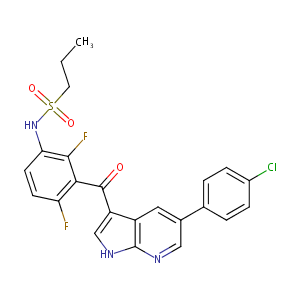
Vandetanib Vemurafenib
Indication
Disease Entry Status REF
Colon carcinoma Investigative [1]
Component Drugs Vandetanib   DMRICNP Vemurafenib   DM62UG5
Small molecular drug Small molecular drug
2D MOL 2D MOL
3D MOL 3D MOL
High-throughput Screening Result Testing Cell Line: KM12
Zero Interaction Potency (ZIP) Score: 2.83
Bliss Independence Score: 5.43
Loewe Additivity Score: 4.86
LHighest Single Agent (HSA) Score: 0.83

Molecular Interaction Atlas of This Drug Combination

Molecular Interaction Atlas (MIA)
Indication(s) of Vandetanib
Disease Entry ICD 11 Status REF
Solid tumour/cancer 2A00-2F9Z Approved [2]
Vandetanib Interacts with 3 DTT Molecule(s)
DTT Name DTT ID UniProt ID Mode of Action REF
Epidermal growth factor receptor (EGFR) TTGKNB4 EGFR_HUMAN Inhibitor [4]
Proto-oncogene c-Ret (RET) TT4DXQT RET_HUMAN Inhibitor [4]
Vascular endothelial growth factor receptor 2 (KDR) TTUTJGQ VGFR2_HUMAN Inhibitor [4]
------------------------------------------------------------------------------------
Vandetanib Interacts with 3 DTP Molecule(s)
DTP Name DTP ID UniProt ID Mode of Action REF
Breast cancer resistance protein (ABCG2) DTI7UX6 ABCG2_HUMAN Substrate [5]
Organic anion transporting polypeptide 1B1 (SLCO1B1) DT3D8F0 SO1B1_HUMAN Substrate [6]
Organic anion transporting polypeptide 1B3 (SLCO1B3) DT9C1TS SO1B3_HUMAN Substrate [6]
------------------------------------------------------------------------------------
Vandetanib Interacts with 1 DME Molecule(s)
DME Name DME ID UniProt ID Mode of Action REF
Cytochrome P450 3A4 (CYP3A4) DE4LYSA CP3A4_HUMAN Metabolism [7]
------------------------------------------------------------------------------------
Vandetanib Interacts with 22 DOT Molecule(s)
DOT Name DOT ID UniProt ID Mode of Action REF
Procollagen-lysine,2-oxoglutarate 5-dioxygenase 2 (PLOD2) OTKOZRZP PLOD2_HUMAN Increases Expression [8]
Stearoyl-CoA desaturase (SCD) OTB1073G SCD_HUMAN Increases Expression [8]
Insulin-induced gene 1 protein (INSIG1) OTZF5X1D INSI1_HUMAN Increases Expression [8]
BCL2/adenovirus E1B 19 kDa protein-interacting protein 3-like (BNIP3L) OTJKOMXE BNI3L_HUMAN Increases Expression [8]
Protein FAM13A (FAM13A) OTZ6GN0Q FA13A_HUMAN Increases Expression [8]
Phosphoglycerate kinase 1 (PGK1) OT6V1ICH PGK1_HUMAN Increases Expression [8]
Calbindin (CALB1) OTM7IXDG CALB1_HUMAN Increases Expression [8]
Prothymosin alpha (PTMA) OT2W4T1M PTMA_HUMAN Decreases Expression [8]
Trypsin-2 (PRSS2) OTOMVUWL TRY2_HUMAN Increases Expression [8]
Gamma-enolase (ENO2) OTRODL0T ENOG_HUMAN Increases Expression [8]
Solute carrier family 2, facilitated glucose transporter member 3 (SLC2A3) OT2HZK5M GTR3_HUMAN Increases Expression [8]
Histone H1.2 (H1-2) OT0AVI4M H12_HUMAN Increases Expression [8]
DNA mismatch repair protein Msh3 (MSH3) OTD3YPVL MSH3_HUMAN Decreases Expression [8]
Pro-adrenomedullin (ADM) OT7T0TA4 ADML_HUMAN Increases Expression [8]
Small ribosomal subunit protein eS6 (RPS6) OTT4D1LN RS6_HUMAN Decreases Phosphorylation [9]
Collagen alpha-3(IV) chain (COL4A3) OT6SB8X5 CO4A3_HUMAN Increases Expression [8]
Solute carrier family 2, facilitated glucose transporter member 14 (SLC2A14) OTBFIOVY GTR14_HUMAN Increases Expression [8]
Protein NDRG1 (NDRG1) OTVO66BO NDRG1_HUMAN Increases Expression [8]
TSC22 domain family protein 3 (TSC22D3) OT03UM03 T22D3_HUMAN Increases Expression [8]
Transcription factor SOX-17 (SOX17) OT9H4WWE SOX17_HUMAN Decreases Localization [10]
Hypoxia-inducible lipid droplet-associated protein (HILPDA) OTEID3ZM HLPDA_HUMAN Increases Expression [8]
Insulin-induced gene 2 protein (INSIG2) OTX4VY51 INSI2_HUMAN Increases Expression [8]
------------------------------------------------------------------------------------
⏷ Show the Full List of 22 DOT(s)
Indication(s) of Vemurafenib
Disease Entry ICD 11 Status REF
Melanoma 2C30 Approved [3]
Vemurafenib Interacts with 1 DTT Molecule(s)
DTT Name DTT ID UniProt ID Mode of Action REF
Serine/threonine-protein kinase B-raf (BRAF) TTWCGQT BRAF_HUMAN Modulator [13]
------------------------------------------------------------------------------------
Vemurafenib Interacts with 3 DTP Molecule(s)
DTP Name DTP ID UniProt ID Mode of Action REF
P-glycoprotein 1 (ABCB1) DTUGYRD MDR1_HUMAN Substrate [14]
Organic anion transporting polypeptide 1B1 (SLCO1B1) DT3D8F0 SO1B1_HUMAN Substrate [6]
Organic anion transporting polypeptide 1B3 (SLCO1B3) DT9C1TS SO1B3_HUMAN Substrate [6]
------------------------------------------------------------------------------------
Vemurafenib Interacts with 1 DME Molecule(s)
DME Name DME ID UniProt ID Mode of Action REF
Cytochrome P450 3A4 (CYP3A4) DE4LYSA CP3A4_HUMAN Metabolism [15]
------------------------------------------------------------------------------------
Vemurafenib Interacts with 8 DOT Molecule(s)
DOT Name DOT ID UniProt ID Mode of Action REF
Microphthalmia-associated transcription factor (MITF) OT6XJCZH MITF_HUMAN Affects Expression [11]
Myc proto-oncogene protein (MYC) OTPV5LUK MYC_HUMAN Decreases Expression [16]
C-C motif chemokine 2 (CCL2) OTAD2HEL CCL2_HUMAN Increases Expression [17]
Mitogen-activated protein kinase 3 (MAPK3) OTCYKGKO MK03_HUMAN Decreases Phosphorylation [12]
Mitogen-activated protein kinase 1 (MAPK1) OTH85PI5 MK01_HUMAN Decreases Phosphorylation [12]
CD70 antigen (CD70) OTHB2AL1 CD70_HUMAN Decreases Expression [18]
Melanocyte protein PMEL (PMEL) OTCDDHHM PMEL_HUMAN Increases Expression [11]
Melanoma antigen recognized by T-cells 1 (MLANA) OT1N2S2K MAR1_HUMAN Increases Expression [11]
------------------------------------------------------------------------------------
⏷ Show the Full List of 8 DOT(s)

Test Results of This Drug Combination in Other Disease Systems

Indication DrugCom ID Cell Line Status REF
Invasive ductal carcinoma DC8F3HR BT-549 Investigative [1]
Adult T acute lymphoblastic leukemia DC2UZ7X MOLT-4 Investigative [19]
Melanoma DCQ119I SK-MEL-2 Investigative [19]
------------------------------------------------------------------------------------

References

1 CheMBL Affinity Phenotypic Cellular Interaction Assay ID: CHEMBL1126165
2 URL: http://www.guidetopharmacology.org Nucleic Acids Res. 2015 Oct 12. pii: gkv1037. The IUPHAR/BPS Guide to PHARMACOLOGY in 2016: towards curated quantitative interactions between 1300 protein targets and 6000 ligands. (Ligand id: 5717).
3 URL: http://www.guidetopharmacology.org Nucleic Acids Res. 2015 Oct 12. pii: gkv1037. The IUPHAR/BPS Guide to PHARMACOLOGY in 2016: towards curated quantitative interactions between 1300 protein targets and 6000 ligands. (Ligand id: 5893).
4 A comparison of physicochemical property profiles of marketed oral drugs and orally bioavailable anti-cancer protein kinase inhibitors in clinical development. Curr Top Med Chem. 2007;7(14):1408-22.
5 Tyrosine kinase inhibitors and multidrug resistance proteins: interactions and biological consequences. Cancer Chemother Pharmacol. 2010 Jan;65(2):335-46.
6 Contribution of OATP1B1 and OATP1B3 to the disposition of sorafenib and sorafenib-glucuronide. Clin Cancer Res. 2013 Mar 15;19(6):1458-66.
7 FDA label of Vandetanib. The 2020 official website of the U.S. Food and Drug Administration.
8 ZD6474 inhibits tumor growth and intraperitoneal dissemination in a highly metastatic orthotopic gastric cancer model. Int J Cancer. 2006 Jan 15;118(2):483-9. doi: 10.1002/ijc.21340.
9 Autophagy inhibition induces enhanced proapoptotic effects of ZD6474 in glioblastoma. Br J Cancer. 2013 Jul 9;109(1):164-71. doi: 10.1038/bjc.2013.306. Epub 2013 Jun 25.
10 A high-throughput screen for teratogens using human pluripotent stem cells. Toxicol Sci. 2014 Jan;137(1):76-90. doi: 10.1093/toxsci/kft239. Epub 2013 Oct 23.
11 PLX4032 Mediated Melanoma Associated Antigen Potentiation in Patient Derived Primary Melanoma Cells. J Cancer. 2015 Oct 29;6(12):1320-30. doi: 10.7150/jca.11126. eCollection 2015.
12 Actin remodeling confers BRAF inhibitor resistance to melanoma cells through YAP/TAZ activation. EMBO J. 2016 Mar 1;35(5):462-78. doi: 10.15252/embj.201592081. Epub 2015 Dec 14.
13 Drugs@FDA. U.S. Food and Drug Administration. U.S. Department of Health & Human Services. 2015
14 Differential effects of the oncogenic BRAF inhibitor PLX4032 (vemurafenib) and its progenitor PLX4720 on ABCB1 function. J Pharm Pharm Sci. 2014;17(1):154-68.
15 Vemurafenib for the treatment of melanoma. Expert Opin Pharmacother. 2012 Dec;13(17):2533-43.
16 Perturbation biology nominates upstream-downstream drug combinations in RAF inhibitor resistant melanoma cells. Elife. 2015 Aug 18;4:e04640. doi: 10.7554/eLife.04640.
17 Overcoming melanoma resistance to vemurafenib by targeting CCL2-induced miR-34a, miR-100 and miR-125b. Oncotarget. 2016 Jan 26;7(4):4428-41. doi: 10.18632/oncotarget.6599.
18 Melanoma Expressed-CD70 Is Regulated by RhoA and MAPK Pathways without Affecting Vemurafenib Treatment Activity. PLoS One. 2016 Feb 1;11(2):e0148095. doi: 10.1371/journal.pone.0148095. eCollection 2016.
19 CheMBL Affinity Phenotypic Cellular Interaction Assay ID: CHEMBL1125976