General Information of Drug Combination (ID: DC4NSKF)

Drug Combination Name
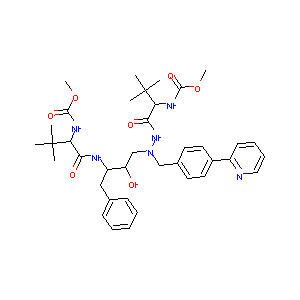
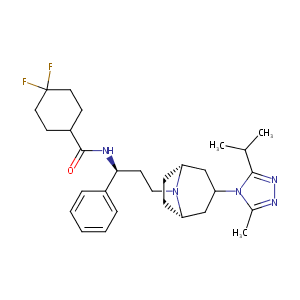
Atazanavir Maraviroc
Indication
Disease Entry Status REF
HIV Infections Phase 1 [1]
Component Drugs Atazanavir   DMSYRBX Maraviroc   DMTL94F
Small molecular drug Small molecular drug
2D MOL 2D MOL
3D MOL 3D MOL

Molecular Interaction Atlas of This Drug Combination

Molecular Interaction Atlas (MIA)
Indication(s) of Atazanavir
Disease Entry ICD 11 Status REF
Human immunodeficiency virus infection 1C62 Approved [2]
Atazanavir Interacts with 1 DTT Molecule(s)
DTT Name DTT ID UniProt ID Mode of Action REF
Human immunodeficiency virus Protease (HIV PR) TT5FNQT POL_HV1B1 Modulator [6]
------------------------------------------------------------------------------------
Atazanavir Interacts with 5 DME Molecule(s)
DME Name DME ID UniProt ID Mode of Action REF
Cytochrome P450 3A4 (CYP3A4) DE4LYSA CP3A4_HUMAN Metabolism [7]
UDP-glucuronosyltransferase 1A1 (UGT1A1) DEYGVN4 UD11_HUMAN Metabolism [8]
Cytochrome P450 3A5 (CYP3A5) DEIBDNY CP3A5_HUMAN Metabolism [7]
Cytochrome P450 3A7 (CYP3A7) DERD86B CP3A7_HUMAN Metabolism [7]
Cytochrome P450 2C9 (CYP2C9) DE5IED8 CP2C9_HUMAN Metabolism [9]
------------------------------------------------------------------------------------
Atazanavir Interacts with 30 DOT Molecule(s)
DOT Name DOT ID UniProt ID Mode of Action REF
Bile salt export pump (ABCB11) OTRU7THO ABCBB_HUMAN Decreases Activity [10]
ATP-binding cassette sub-family C member 3 (ABCC3) OTC3IJV4 MRP3_HUMAN Decreases Expression [5]
Nuclear receptor subfamily 1 group I member 2 (NR1I2) OTC5U0N5 NR1I2_HUMAN Decreases Expression [5]
Phosphatidylinositol 3-kinase C2 domain-containing subunit gamma (PIK3C2G) OTW3LY1C P3C2G_HUMAN Decreases Expression [5]
Aflatoxin B1 aldehyde reductase member 3 (AKR7A3) OTW3GO4Y ARK73_HUMAN Decreases Expression [5]
Ubiquitin-like modifier-activating enzyme ATG7 (ATG7) OTVT4YA1 ATG7_HUMAN Increases Expression [5]
Albumin (ALB) OTVMM513 ALBU_HUMAN Affects Binding [11]
Superoxide dismutase , mitochondrial (SOD2) OTIWXGZ9 SODM_HUMAN Increases Expression [5]
Plasminogen activator inhibitor 1 (SERPINE1) OTT0MPQ3 PAI1_HUMAN Increases Expression [5]
C-C motif chemokine 3 (CCL3) OTW2H3ND CCL3_HUMAN Increases Expression [12]
C-C motif chemokine 2 (CCL2) OTAD2HEL CCL2_HUMAN Increases Expression [12]
Glutathione peroxidase 2 (GPX2) OTXI2NTI GPX2_HUMAN Decreases Expression [5]
Cyclic AMP-dependent transcription factor ATF-4 (ATF4) OTRFV19J ATF4_HUMAN Increases Expression [5]
Cyclic AMP-dependent transcription factor ATF-6 alpha (ATF6) OTAFHAVI ATF6A_HUMAN Increases Expression [5]
Phosphatidylinositol 3-kinase regulatory subunit alpha (PIK3R1) OT5BZ1J9 P85A_HUMAN Decreases Expression [5]
DNA damage-inducible transcript 3 protein (DDIT3) OTI8YKKE DDIT3_HUMAN Increases Expression [5]
Dual specificity mitogen-activated protein kinase kinase 6 (MAP2K6) OTK13JKC MP2K6_HUMAN Decreases Expression [5]
Flavin-containing monooxygenase 1 (FMO1) OTTHSQKP FMO1_HUMAN Decreases Expression [5]
Peptidyl-prolyl cis-trans isomerase FKBP5 (FKBP5) OT404F9K FKBP5_HUMAN Decreases Expression [5]
Nuclear receptor subfamily 1 group I member 3 (NR1I3) OTS3SGH7 NR1I3_HUMAN Decreases Expression [5]
DnaJ homolog subfamily C member 10 (DNAJC10) OTD2EG0R DJC10_HUMAN Increases Expression [5]
Mixed lineage kinase domain-like protein (MLKL) OTDSLC81 MLKL_HUMAN Increases Expression [5]
DnaJ homolog subfamily C member 9 (DNAJC9) OTDBQBNZ DNJC9_HUMAN Increases Expression [5]
Bile acid receptor (NR1H4) OTWZLPTB NR1H4_HUMAN Decreases Expression [5]
Microtubule-associated proteins 1A/1B light chain 3B (MAP1LC3B) OTUYHB84 MLP3B_HUMAN Increases Expression [5]
Ubiquitin carboxyl-terminal hydrolase CYLD (CYLD) OT37FKH0 CYLD_HUMAN Increases Expression [5]
Transcription factor MafF (MAFF) OT9B7MX0 MAFF_HUMAN Increases Expression [5]
Endophilin-B1 (SH3GLB1) OTAZ5OP8 SHLB1_HUMAN Increases Expression [5]
Solute carrier organic anion transporter family member 1B1 (SLCO1B1) OTNEN8QK SO1B1_HUMAN Decreases Expression [5]
ATP-dependent translocase ABCB1 (ABCB1) OTEJROBO MDR1_HUMAN Increases Transport [13]
------------------------------------------------------------------------------------
⏷ Show the Full List of 30 DOT(s)
Indication(s) of Maraviroc
Disease Entry ICD 11 Status REF
Human immunodeficiency virus infection 1C62 Approved [3]
Chronic obstructive pulmonary disease CA22 Phase 3 [3]
Maraviroc Interacts with 2 DTT Molecule(s)
DTT Name DTT ID UniProt ID Mode of Action REF
C-C chemokine receptor type 5 (CCR5) TT2CEJG CCR5_HUMAN Antagonist [14]
CCR5 messenger RNA (CCR5 mRNA) TTJIH8Q CCR5_HUMAN Antagonist [15]
------------------------------------------------------------------------------------
Maraviroc Interacts with 1 DTP Molecule(s)
DTP Name DTP ID UniProt ID Mode of Action REF
P-glycoprotein 1 (ABCB1) DTUGYRD MDR1_HUMAN Substrate [16]
------------------------------------------------------------------------------------

References

1 ClinicalTrials.gov (NCT00977756) IMPAACT P1058A: Pharmacokinetic Effects of New Antiretroviral Drugs on Children, Adolescents and Young Adults
2 Natural products as sources of new drugs over the last 25 years. J Nat Prod. 2007 Mar;70(3):461-77.
3 URL: http://www.guidetopharmacology.org Nucleic Acids Res. 2015 Oct 12. pii: gkv1037. The IUPHAR/BPS Guide to PHARMACOLOGY in 2016: towards curated quantitative interactions between 1300 protein targets and 6000 ligands. (Ligand id: 806).
4 Clinical Pharmacogenetics Implementation Consortium (CPIC) Guideline for UGT1A1 and Atazanavir Prescribing. Clin Pharmacol Ther. 2016 Apr;99(4):363-9. doi: 10.1002/cpt.269. Epub 2015 Nov 9.
5 Robustness testing and optimization of an adverse outcome pathway on cholestatic liver injury. Arch Toxicol. 2020 Apr;94(4):1151-1172. doi: 10.1007/s00204-020-02691-9. Epub 2020 Mar 10.
6 Hollow-fiber unit evaluation of a new human immunodeficiency virus type 1 protease inhibitor, BMS-232632, for determination of the linked pharmacod... J Infect Dis. 2001 Apr 1;183(7):1126-9.
7 Atazanavir: effects on P-glycoprotein transport and CYP3A metabolism in vitro. Drug Metab Dispos. 2005 Jun;33(6):764-70.
8 In vitro inhibition of UDP glucuronosyltransferases by atazanavir and other HIV protease inhibitors and the relationship of this property to in vivo bilirubin glucuronidation. Drug Metab Dispos. 2005 Nov;33(11):1729-39.
9 Atazanavir for the treatment of human immunodeficiency virus infection. Pharmacotherapy. 2004 Dec;24(12):1732-47.
10 Early identification of clinically relevant drug interactions with the human bile salt export pump (BSEP/ABCB11). Toxicol Sci. 2013 Dec;136(2):328-43.
11 Binding of anti-HIV drugs to human serum albumin. IUBMB Life. 2004 Oct;56(10):609-14. doi: 10.1080/15216540400016286.
12 Some HIV antiretrovirals increase oxidative stress and alter chemokine, cytokine or adiponectin production in human adipocytes and macrophages. Antivir Ther. 2007;12(4):489-500.
13 Interactions of protease inhibitors atazanavir and ritonavir with ABCB1, ABCG2, and ABCC2 transporters: Effect on transplacental disposition in rats. Reprod Toxicol. 2018 Aug;79:57-65. doi: 10.1016/j.reprotox.2018.05.008. Epub 2018 May 30.
14 Rapamycin enhances aplaviroc anti-HIV activity: implications for the clinical development of novel CCR5 antagonists. Antiviral Res. 2009 Jul;83(1):86-9.
15 Molecular cloning and radioligand binding characterization of the chemokine receptor CCR5 from rhesus macaque and human. Biochem Pharmacol. 2005 Dec 19;71(1-2):163-72.
16 Tarascon Pocket Pharmacopoeia 2018 Classic Shirt-Pocket Edition.