General Information of Drug Combination (ID: DCG8MX3)

Drug Combination Name
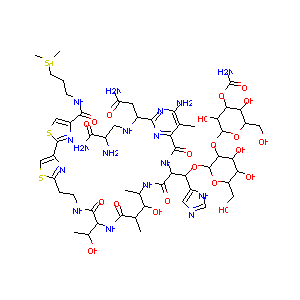
Bleomycin Busulfan
Indication
Disease Entry Status REF
Adult acute myeloid leukemia Investigative [1]
Component Drugs Bleomycin   DMNER5S Busulfan   DMXYJ9C
Small molecular drug Small molecular drug
2D MOL 2D MOL
3D MOL 3D MOL
High-throughput Screening Result Testing Cell Line: HL-60(TB)
Zero Interaction Potency (ZIP) Score: 9.72
Bliss Independence Score: 8.77
Loewe Additivity Score: 4.16
LHighest Single Agent (HSA) Score: 10.12

Molecular Interaction Atlas of This Drug Combination

Molecular Interaction Atlas (MIA)
Indication(s) of Bleomycin
Disease Entry ICD 11 Status REF
Cervical cancer 2C77.0 Approved [2]
Head and neck cancer 2D42 Approved [2]
Hodgkin lymphoma 2B30 Approved [3]
Penile cancer N.A. Approved [2]
Testicular germ cell tumor N.A. Approved [2]
Classic Hodgkin lymphoma N.A. Investigative [2]
Follicular lymphoma 2A80 Investigative [2]
Bleomycin Interacts with 1 DTT Molecule(s)
DTT Name DTT ID UniProt ID Mode of Action REF
Human Deoxyribonucleic acid (hDNA) TTUTN1I NOUNIPROTAC Breaker [10]
------------------------------------------------------------------------------------
Bleomycin Interacts with 1 DME Molecule(s)
DME Name DME ID UniProt ID Mode of Action REF
Bleomycin hydrolase (BLMH) DECH1VP BLMH_HUMAN Metabolism [11]
------------------------------------------------------------------------------------
Bleomycin Interacts with 23 DOT Molecule(s)
DOT Name DOT ID UniProt ID Mode of Action REF
Superoxide dismutase , mitochondrial (SOD2) OTIWXGZ9 SODM_HUMAN Increases Expression [12]
Interstitial collagenase (MMP1) OTI4I2V1 MMP1_HUMAN Increases Expression [13]
Interleukin-8 (CXCL8) OTS7T5VH IL8_HUMAN Increases Expression [13]
Mucin-5AC (MUC5AC) OTJV8O04 MUC5A_HUMAN Increases Expression [13]
Transmembrane protein 250 (TMEM250) OTLJ4G5G TM250_HUMAN Increases Expression [6]
Serine/threonine-protein kinase Chk2 (CHEK2) OT8ZPCNS CHK2_HUMAN Increases Phosphorylation [14]
Transforming growth factor beta-1 proprotein (TGFB1) OTV5XHVH TGFB1_HUMAN Increases Expression [7]
Histone H2AX (H2AX) OT18UX57 H2AX_HUMAN Increases Expression [15]
Max-interacting protein 1 (MXI1) OTUQ9E0D MXI1_HUMAN Decreases Expression [6]
Actin, aortic smooth muscle (ACTA2) OTEDLG8E ACTA_HUMAN Increases Expression [7]
Unconventional myosin-Ie (MYO1E) OTM9YSIZ MYO1E_HUMAN Decreases Expression [6]
Serine-protein kinase ATM (ATM) OTQVOHLT ATM_HUMAN Increases Phosphorylation [14]
Structural maintenance of chromosomes protein 1A (SMC1A) OT9ZMRK9 SMC1A_HUMAN Increases Phosphorylation [14]
7SK snRNA methylphosphate capping enzyme (MEPCE) OTRBQEYP MEPCE_HUMAN Increases Expression [6]
Transmembrane protein 87A (TMEM87A) OT8ATDVX TM87A_HUMAN Increases Expression [6]
Lipase member H (LIPH) OTRGYLKL LIPH_HUMAN Decreases Expression [6]
Abasic site processing protein HMCES (HMCES) OTVRDL6U HMCES_HUMAN Decreases Expression [6]
Small integral membrane protein 14 (SMIM14) OT47IF19 SIM14_HUMAN Decreases Expression [6]
Kelch-like protein 42 (KLHL42) OTK6WARI KLH42_HUMAN Increases Expression [6]
Inactive cell surface hyaluronidase CEMIP2 (CEMIP2) OT9I1XUO CEIP2_HUMAN Decreases Expression [6]
ERBB receptor feedback inhibitor 1 (ERRFI1) OT7VZ2IZ ERRFI_HUMAN Decreases Expression [6]
Transmembrane and coiled-coil domain protein 3 (TMCC3) OTAIQ6V6 TMCC3_HUMAN Decreases Expression [6]
Baculoviral IAP repeat-containing protein 2 (BIRC2) OTFXFREP BIRC2_HUMAN Decreases Response To Substance [16]
------------------------------------------------------------------------------------
⏷ Show the Full List of 23 DOT(s)
Indication(s) of Busulfan
Disease Entry ICD 11 Status REF
Chronic myelogenous leukaemia 2A20.0 Approved [4]
Hematologic disease 3C0Z Approved [4]
Immunodeficiency 4A00-4A85 Approved [4]
Leukemia N.A. Approved [4]
Myeloproliferative syndrome 2A22 Approved [5]
Systemic lupus erythematosus 4A40.0 Approved [4]
Systemic sclerosis 4A42 Approved [4]
Neuroblastoma 2D11.2 Investigative [4]
Retinoblastoma 2D02.2 Investigative [4]
Busulfan Interacts with 1 DTT Molecule(s)
DTT Name DTT ID UniProt ID Mode of Action REF
Human Deoxyribonucleic acid (hDNA) TTUTN1I NOUNIPROTAC Modulator [18]
------------------------------------------------------------------------------------
Busulfan Interacts with 6 DME Molecule(s)
DME Name DME ID UniProt ID Mode of Action REF
Cytochrome P450 3A4 (CYP3A4) DE4LYSA CP3A4_HUMAN Metabolism [19]
Glutathione S-transferase alpha-1 (GSTA1) DE4ZHS1 GSTA1_HUMAN Metabolism [20]
Glutathione S-transferase alpha-2 (GSTA2) DEH49YS GSTA2_HUMAN Metabolism [21]
Glutathione S-transferase pi (GSTP1) DEK6079 GSTP1_HUMAN Metabolism [22]
Microsomal glutathione S-transferase 2 (MGST2) DE31KMQ MGST2_HUMAN Metabolism [23]
Glutathione S-transferase mu-1 (GSTM1) DEYZEJA GSTM1_HUMAN Metabolism [22]
------------------------------------------------------------------------------------
⏷ Show the Full List of 6 DME(s)
Busulfan Interacts with 15 DOT Molecule(s)
DOT Name DOT ID UniProt ID Mode of Action REF
Serotransferrin (TF) OT41PEMS TRFE_HUMAN Increases Expression [24]
Antithrombin-III (SERPINC1) OTDFATG0 ANT3_HUMAN Affects Expression [25]
Transforming growth factor beta-1 proprotein (TGFB1) OTV5XHVH TGFB1_HUMAN Increases Expression [26]
Plasminogen activator inhibitor 1 (SERPINE1) OTT0MPQ3 PAI1_HUMAN Increases Expression [26]
Poly polymerase 1 (PARP1) OT310QSG PARP1_HUMAN Increases Cleavage [27]
Histone H2AX (H2AX) OT18UX57 H2AX_HUMAN Increases Phosphorylation [27]
Cyclic AMP-dependent transcription factor ATF-4 (ATF4) OTRFV19J ATF4_HUMAN Increases Expression [17]
Nuclear factor NF-kappa-B p105 subunit (NFKB1) OTNRRD8I NFKB1_HUMAN Increases Expression [17]
Mitogen-activated protein kinase 3 (MAPK3) OTCYKGKO MK03_HUMAN Increases Activity [28]
Mitogen-activated protein kinase 1 (MAPK1) OTH85PI5 MK01_HUMAN Increases Activity [28]
Cyclin-dependent kinase inhibitor 1 (CDKN1A) OTQWHCZE CDN1A_HUMAN Increases Expression [28]
Signal transducer and activator of transcription 2 (STAT2) OTO9G2RZ STAT2_HUMAN Decreases Expression [17]
Pseudouridylate synthase 7 homolog (PUS7) OTE5AQHJ PUS7_HUMAN Increases Expression [29]
DNA repair nuclease/redox regulator APEX1 (APEX1) OT53OI14 APEX1_HUMAN Increases Response To Substance [30]
Rho GDP-dissociation inhibitor 1 (ARHGDIA) OTEXWJDO GDIR1_HUMAN Affects Response To Substance [31]
------------------------------------------------------------------------------------
⏷ Show the Full List of 15 DOT(s)

Test Results of This Drug Combination in Other Disease Systems

Indication DrugCom ID Cell Line Status REF
Adult T acute lymphoblastic leukemia DCNV7MJ MOLT-4 Investigative [1]
Anaplastic large cell lymphoma DCB8ZXY SR Investigative [1]
Chronic myelogenous leukemia DCF0SNB K-562 Investigative [1]
Glioma DCML76U SF-539 Investigative [1]
Plasma cell myeloma DCRIJ1K RPMI-8226 Investigative [1]
Colon adenocarcinoma DCKJNFK COLO 205 Investigative [32]
High grade ovarian serous adenocarcinoma DC6MYBF OVCAR-4 Investigative [33]
------------------------------------------------------------------------------------
⏷ Show the Full List of 7 DrugCom(s)

References

1 CheMBL Affinity Phenotypic Cellular Interaction Assay ID: CHEMBL1125966
2 Bleomycin FDA Label
3 Natural products as sources of new drugs over the last 25 years. J Nat Prod. 2007 Mar;70(3):461-77.
4 Busulfan FDA Label
5 URL: http://www.guidetopharmacology.org Nucleic Acids Res. 2015 Oct 12. pii: gkv1037. The IUPHAR/BPS Guide to PHARMACOLOGY in 2016: towards curated quantitative interactions between 1300 protein targets and 6000 ligands. (Ligand id: 7136).
6 Development and validation of the TGx-HDACi transcriptomic biomarker to detect histone deacetylase inhibitors in human TK6 cells. Arch Toxicol. 2021 May;95(5):1631-1645. doi: 10.1007/s00204-021-03014-2. Epub 2021 Mar 26.
7 Pulmonary fibrosis model using micro-CT analyzable human PSC-derived alveolar organoids containing alveolar macrophage-like cells. Cell Biol Toxicol. 2022 Aug;38(4):557-575. doi: 10.1007/s10565-022-09698-1. Epub 2022 Mar 10.
8 An antisense oligonucleotide targeted to human Ku86 messenger RNA sensitizes M059K malignant glioma cells to ionizing radiation, bleomycin, and etoposide but not DNA cross-linking agents. Cancer Res. 2002 Oct 15;62(20):5888-96.
9 XRCC1 deficiency sensitizes human lung epithelial cells to genotoxicity by crocidolite asbestos and Libby amphibole. Environ Health Perspect. 2010 Dec;118(12):1707-13. doi: 10.1289/ehp.1002312. Epub 2010 Aug 11.
10 Bleomycin and talisomycin sequence-specific strand scission of DNA: a mechanism of double-strand cleavage. Cancer Res. 1982 Jul;42(7):2779-85.
11 The C-terminus of human bleomycin hydrolase is required for protection against bleomycin-induced chromosomal damage. Mutat Res. 1998 Oct 12;421(1):1-7.
12 Age-dependent basal level and induction capacity of copper-zinc and manganese superoxide dismutase and other scavenging enzyme activities in leukocytes from young and elderly adults. Am J Pathol. 1993 Jul;143(1):312-20.
13 Agents associated with lung inflammation induce similar responses in NCI-H292 lung epithelial cells. Toxicol In Vitro. 2008 Oct;22(7):1782-8.
14 Direct activation of ATM by resveratrol under oxidizing conditions. PLoS One. 2014 Jun 16;9(6):e97969. doi: 10.1371/journal.pone.0097969. eCollection 2014.
15 Distinct mechanisms of cell-kill by triapine and its terminally dimethylated derivative Dp44mT due to a loss or gain of activity of their copper(II) complexes. Biochem Pharmacol. 2014 Oct 1;91(3):312-22. doi: 10.1016/j.bcp.2014.08.006. Epub 2014 Aug 15.
16 Expression and prognostic significance of IAP-family genes in human cancers and myeloid leukemias. Clin Cancer Res. 2000 May;6(5):1796-803.
17 Direct transcriptomic comparison of xenobiotic metabolism and toxicity pathway induction of airway epithelium models at an air-liquid interface generated from induced pluripotent stem cells and primary bronchial epithelial cells. Cell Biol Toxicol. 2023 Feb;39(1):1-18. doi: 10.1007/s10565-022-09726-0. Epub 2022 May 31.
18 DNA intrastrand cross-link at the 5'-GA-3' sequence formed by busulfan and its role in the cytotoxic effect. Cancer Sci. 2004 May;95(5):454-8.
19 Update: clinically significant cytochrome P-450 drug interactions. Pharmacotherapy. 1998 Jan-Feb;18(1):84-112.
20 Glutathione S-transferase M1 polymorphism: a risk factor for hepatic venoocclusive disease in bone marrow transplantation. Blood. 2004 Sep 1;104(5):1574-7.
21 Endothelial cells do not express GSTA1: potential relevance to busulfan-mediated endothelial damage during haematopoietic stem cell transplantation. Eur J Haematol. 2008 Apr;80(4):299-302.
22 Busulfan conjugation by glutathione S-transferases alpha, mu, and pi. Drug Metab Dispos. 1996 Sep;24(9):1015-9.
23 Overexpression of glutathione-S-transferase, MGSTII, confers resistance to busulfan and melphalan. Cancer Invest. 2005;23(1):19-25.
24 Busulfan induces activin A expression in vitro and in vivo: a possible link to venous occlusive disease. Clin Pharmacol Ther. 2003 Sep;74(3):264-74.
25 Decreased incidence of hepatic veno-occlusive disease and fewer hemostatic derangements associated with intravenous busulfan vs oral busulfan in adults conditioned with busulfan + cyclophosphamide for allogeneic bone marrow transplantation. Ann Hematol. 2005 May;84(5):321-30. doi: 10.1007/s00277-004-0982-4. Epub 2004 Dec 4.
26 Antineoplastic agent busulfan regulates a network of genes related to coagulation and fibrinolysis. Eur J Clin Pharmacol. 2012 Jun;68(6):923-35. doi: 10.1007/s00228-011-1209-y.
27 Altered gene expression in busulfan-resistant human myeloid leukemia. Leuk Res. 2008 Nov;32(11):1684-97. doi: 10.1016/j.leukres.2008.01.016. Epub 2008 Mar 12.
28 Busulfan selectively induces cellular senescence but not apoptosis in WI38 fibroblasts via a p53-independent but extracellular signal-regulated kinase-p38 mitogen-activated protein kinase-dependent mechanism. J Pharmacol Exp Ther. 2006 Nov;319(2):551-60. doi: 10.1124/jpet.106.107771. Epub 2006 Aug 1.
29 CD34+ derived macrophage and dendritic cells display differential responses to paraquat. Toxicol In Vitro. 2021 Sep;75:105198. doi: 10.1016/j.tiv.2021.105198. Epub 2021 Jun 9.
30 Impairment of APE1 function enhances cellular sensitivity to clinically relevant alkylators and antimetabolites. Mol Cancer Res. 2009 Jun;7(6):897-906. doi: 10.1158/1541-7786.MCR-08-0519. Epub 2009 May 26.
31 Reduced expression of Rho guanine nucleotide dissociation inhibitor-alpha modulates the cytotoxic effect of busulfan in HEK293 cells. Anticancer Drugs. 2007 Mar;18(3):333-40. doi: 10.1097/CAD.0b013e328011fd7f.
32 CheMBL Affinity Phenotypic Cellular Interaction Assay ID: CHEMBL1126165
33 CheMBL Affinity Phenotypic Cellular Interaction Assay ID: CHEMBL1125976