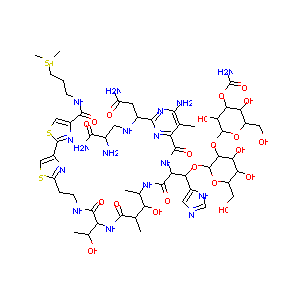
General Information of Drug Combination (ID: DCOQR2P)

Drug Combination Name
Bleomycin Picoplatin
Indication
Disease Entry Status REF
Mixed endometrioid and clear cell carcinoma Investigative [1]
Component Drugs Bleomycin   DMNER5S Picoplatin   DM0PIY6
Small molecular drug Small molecular drug
2D MOL 2D MOL
3D MOL 3D MOL
High-throughput Screening Result Testing Cell Line: IGROV1
Zero Interaction Potency (ZIP) Score: 6.92
Bliss Independence Score: 6.87
Loewe Additivity Score: 5.92
LHighest Single Agent (HSA) Score: 7.82

Molecular Interaction Atlas of This Drug Combination

Molecular Interaction Atlas (MIA)
Indication(s) of Bleomycin
Disease Entry ICD 11 Status REF
Cervical cancer 2C77.0 Approved [2]
Head and neck cancer 2D42 Approved [2]
Hodgkin lymphoma 2B30 Approved [3]
Penile cancer N.A. Approved [2]
Testicular germ cell tumor N.A. Approved [2]
Classic Hodgkin lymphoma N.A. Investigative [2]
Follicular lymphoma 2A80 Investigative [2]
Bleomycin Interacts with 1 DTT Molecule(s)
DTT Name DTT ID UniProt ID Mode of Action REF
Human Deoxyribonucleic acid (hDNA) TTUTN1I NOUNIPROTAC Breaker [9]
------------------------------------------------------------------------------------
Bleomycin Interacts with 1 DME Molecule(s)
DME Name DME ID UniProt ID Mode of Action REF
Bleomycin hydrolase (BLMH) DECH1VP BLMH_HUMAN Metabolism [10]
------------------------------------------------------------------------------------
Bleomycin Interacts with 23 DOT Molecule(s)
DOT Name DOT ID UniProt ID Mode of Action REF
Superoxide dismutase , mitochondrial (SOD2) OTIWXGZ9 SODM_HUMAN Increases Expression [11]
Interstitial collagenase (MMP1) OTI4I2V1 MMP1_HUMAN Increases Expression [12]
Interleukin-8 (CXCL8) OTS7T5VH IL8_HUMAN Increases Expression [12]
Mucin-5AC (MUC5AC) OTJV8O04 MUC5A_HUMAN Increases Expression [12]
Transmembrane protein 250 (TMEM250) OTLJ4G5G TM250_HUMAN Increases Expression [5]
Serine/threonine-protein kinase Chk2 (CHEK2) OT8ZPCNS CHK2_HUMAN Increases Phosphorylation [13]
Transforming growth factor beta-1 proprotein (TGFB1) OTV5XHVH TGFB1_HUMAN Increases Expression [6]
Histone H2AX (H2AX) OT18UX57 H2AX_HUMAN Increases Expression [14]
Max-interacting protein 1 (MXI1) OTUQ9E0D MXI1_HUMAN Decreases Expression [5]
Actin, aortic smooth muscle (ACTA2) OTEDLG8E ACTA_HUMAN Increases Expression [6]
Unconventional myosin-Ie (MYO1E) OTM9YSIZ MYO1E_HUMAN Decreases Expression [5]
Serine-protein kinase ATM (ATM) OTQVOHLT ATM_HUMAN Increases Phosphorylation [13]
Structural maintenance of chromosomes protein 1A (SMC1A) OT9ZMRK9 SMC1A_HUMAN Increases Phosphorylation [13]
7SK snRNA methylphosphate capping enzyme (MEPCE) OTRBQEYP MEPCE_HUMAN Increases Expression [5]
Transmembrane protein 87A (TMEM87A) OT8ATDVX TM87A_HUMAN Increases Expression [5]
Lipase member H (LIPH) OTRGYLKL LIPH_HUMAN Decreases Expression [5]
Abasic site processing protein HMCES (HMCES) OTVRDL6U HMCES_HUMAN Decreases Expression [5]
Small integral membrane protein 14 (SMIM14) OT47IF19 SIM14_HUMAN Decreases Expression [5]
Kelch-like protein 42 (KLHL42) OTK6WARI KLH42_HUMAN Increases Expression [5]
Inactive cell surface hyaluronidase CEMIP2 (CEMIP2) OT9I1XUO CEIP2_HUMAN Decreases Expression [5]
ERBB receptor feedback inhibitor 1 (ERRFI1) OT7VZ2IZ ERRFI_HUMAN Decreases Expression [5]
Transmembrane and coiled-coil domain protein 3 (TMCC3) OTAIQ6V6 TMCC3_HUMAN Decreases Expression [5]
Baculoviral IAP repeat-containing protein 2 (BIRC2) OTFXFREP BIRC2_HUMAN Decreases Response To Substance [15]
------------------------------------------------------------------------------------
⏷ Show the Full List of 23 DOT(s)
Indication(s) of Picoplatin
Disease Entry ICD 11 Status REF
Colorectal cancer 2B91.Z Phase 3 [4]
Ovarian cancer 2C73 Phase 3 [4]
Prostate cancer 2C82.0 Phase 3 [4]
Small-cell lung cancer 2C25.Y Phase 3 [4]

References

1 CheMBL Affinity Phenotypic Cellular Interaction Assay ID: CHEMBL1125976
2 Bleomycin FDA Label
3 Natural products as sources of new drugs over the last 25 years. J Nat Prod. 2007 Mar;70(3):461-77.
4 ClinicalTrials.gov (NCT00465491) Study of Picoplatin Efficacy After Relapse. U.S. National Institutes of Health.
5 Development and validation of the TGx-HDACi transcriptomic biomarker to detect histone deacetylase inhibitors in human TK6 cells. Arch Toxicol. 2021 May;95(5):1631-1645. doi: 10.1007/s00204-021-03014-2. Epub 2021 Mar 26.
6 Pulmonary fibrosis model using micro-CT analyzable human PSC-derived alveolar organoids containing alveolar macrophage-like cells. Cell Biol Toxicol. 2022 Aug;38(4):557-575. doi: 10.1007/s10565-022-09698-1. Epub 2022 Mar 10.
7 An antisense oligonucleotide targeted to human Ku86 messenger RNA sensitizes M059K malignant glioma cells to ionizing radiation, bleomycin, and etoposide but not DNA cross-linking agents. Cancer Res. 2002 Oct 15;62(20):5888-96.
8 XRCC1 deficiency sensitizes human lung epithelial cells to genotoxicity by crocidolite asbestos and Libby amphibole. Environ Health Perspect. 2010 Dec;118(12):1707-13. doi: 10.1289/ehp.1002312. Epub 2010 Aug 11.
9 Bleomycin and talisomycin sequence-specific strand scission of DNA: a mechanism of double-strand cleavage. Cancer Res. 1982 Jul;42(7):2779-85.
10 The C-terminus of human bleomycin hydrolase is required for protection against bleomycin-induced chromosomal damage. Mutat Res. 1998 Oct 12;421(1):1-7.
11 Age-dependent basal level and induction capacity of copper-zinc and manganese superoxide dismutase and other scavenging enzyme activities in leukocytes from young and elderly adults. Am J Pathol. 1993 Jul;143(1):312-20.
12 Agents associated with lung inflammation induce similar responses in NCI-H292 lung epithelial cells. Toxicol In Vitro. 2008 Oct;22(7):1782-8.
13 Direct activation of ATM by resveratrol under oxidizing conditions. PLoS One. 2014 Jun 16;9(6):e97969. doi: 10.1371/journal.pone.0097969. eCollection 2014.
14 Distinct mechanisms of cell-kill by triapine and its terminally dimethylated derivative Dp44mT due to a loss or gain of activity of their copper(II) complexes. Biochem Pharmacol. 2014 Oct 1;91(3):312-22. doi: 10.1016/j.bcp.2014.08.006. Epub 2014 Aug 15.
15 Expression and prognostic significance of IAP-family genes in human cancers and myeloid leukemias. Clin Cancer Res. 2000 May;6(5):1796-803.