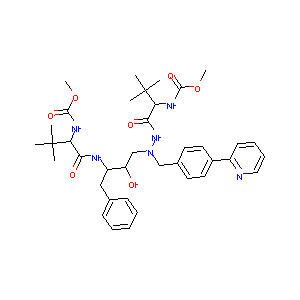
General Information of Drug Combination (ID: DCUIOGY)

Drug Combination Name
Atazanavir Ritonavir
Indication
Disease Entry Status REF
Human Immunodeficiency Virus Type 1 (HIV-1) Phase 1 [1]
Component Drugs Atazanavir   DMSYRBX Ritonavir   DMU764S
Small molecular drug Small molecular drug
2D MOL 2D MOL
3D MOL 3D MOL

Molecular Interaction Atlas of This Drug Combination

Molecular Interaction Atlas (MIA)
Indication(s) of Atazanavir
Disease Entry ICD 11 Status REF
Human immunodeficiency virus infection 1C62 Approved [2]
Atazanavir Interacts with 1 DTT Molecule(s)
DTT Name DTT ID UniProt ID Mode of Action REF
Human immunodeficiency virus Protease (HIV PR) TT5FNQT POL_HV1B1 Modulator [5]
------------------------------------------------------------------------------------
Atazanavir Interacts with 5 DME Molecule(s)
DME Name DME ID UniProt ID Mode of Action REF
Cytochrome P450 3A4 (CYP3A4) DE4LYSA CP3A4_HUMAN Metabolism [6]
UDP-glucuronosyltransferase 1A1 (UGT1A1) DEYGVN4 UD11_HUMAN Metabolism [7]
Cytochrome P450 3A5 (CYP3A5) DEIBDNY CP3A5_HUMAN Metabolism [6]
Cytochrome P450 3A7 (CYP3A7) DERD86B CP3A7_HUMAN Metabolism [6]
Cytochrome P450 2C9 (CYP2C9) DE5IED8 CP2C9_HUMAN Metabolism [8]
------------------------------------------------------------------------------------
Atazanavir Interacts with 30 DOT Molecule(s)
DOT Name DOT ID UniProt ID Mode of Action REF
Bile salt export pump (ABCB11) OTRU7THO ABCBB_HUMAN Decreases Activity [9]
ATP-binding cassette sub-family C member 3 (ABCC3) OTC3IJV4 MRP3_HUMAN Decreases Expression [4]
Nuclear receptor subfamily 1 group I member 2 (NR1I2) OTC5U0N5 NR1I2_HUMAN Decreases Expression [4]
Phosphatidylinositol 3-kinase C2 domain-containing subunit gamma (PIK3C2G) OTW3LY1C P3C2G_HUMAN Decreases Expression [4]
Aflatoxin B1 aldehyde reductase member 3 (AKR7A3) OTW3GO4Y ARK73_HUMAN Decreases Expression [4]
Ubiquitin-like modifier-activating enzyme ATG7 (ATG7) OTVT4YA1 ATG7_HUMAN Increases Expression [4]
Albumin (ALB) OTVMM513 ALBU_HUMAN Affects Binding [10]
Superoxide dismutase , mitochondrial (SOD2) OTIWXGZ9 SODM_HUMAN Increases Expression [4]
Plasminogen activator inhibitor 1 (SERPINE1) OTT0MPQ3 PAI1_HUMAN Increases Expression [4]
C-C motif chemokine 3 (CCL3) OTW2H3ND CCL3_HUMAN Increases Expression [11]
C-C motif chemokine 2 (CCL2) OTAD2HEL CCL2_HUMAN Increases Expression [11]
Glutathione peroxidase 2 (GPX2) OTXI2NTI GPX2_HUMAN Decreases Expression [4]
Cyclic AMP-dependent transcription factor ATF-4 (ATF4) OTRFV19J ATF4_HUMAN Increases Expression [4]
Cyclic AMP-dependent transcription factor ATF-6 alpha (ATF6) OTAFHAVI ATF6A_HUMAN Increases Expression [4]
Phosphatidylinositol 3-kinase regulatory subunit alpha (PIK3R1) OT5BZ1J9 P85A_HUMAN Decreases Expression [4]
DNA damage-inducible transcript 3 protein (DDIT3) OTI8YKKE DDIT3_HUMAN Increases Expression [4]
Dual specificity mitogen-activated protein kinase kinase 6 (MAP2K6) OTK13JKC MP2K6_HUMAN Decreases Expression [4]
Flavin-containing monooxygenase 1 (FMO1) OTTHSQKP FMO1_HUMAN Decreases Expression [4]
Peptidyl-prolyl cis-trans isomerase FKBP5 (FKBP5) OT404F9K FKBP5_HUMAN Decreases Expression [4]
Nuclear receptor subfamily 1 group I member 3 (NR1I3) OTS3SGH7 NR1I3_HUMAN Decreases Expression [4]
DnaJ homolog subfamily C member 10 (DNAJC10) OTD2EG0R DJC10_HUMAN Increases Expression [4]
Mixed lineage kinase domain-like protein (MLKL) OTDSLC81 MLKL_HUMAN Increases Expression [4]
DnaJ homolog subfamily C member 9 (DNAJC9) OTDBQBNZ DNJC9_HUMAN Increases Expression [4]
Bile acid receptor (NR1H4) OTWZLPTB NR1H4_HUMAN Decreases Expression [4]
Microtubule-associated proteins 1A/1B light chain 3B (MAP1LC3B) OTUYHB84 MLP3B_HUMAN Increases Expression [4]
Ubiquitin carboxyl-terminal hydrolase CYLD (CYLD) OT37FKH0 CYLD_HUMAN Increases Expression [4]
Transcription factor MafF (MAFF) OT9B7MX0 MAFF_HUMAN Increases Expression [4]
Endophilin-B1 (SH3GLB1) OTAZ5OP8 SHLB1_HUMAN Increases Expression [4]
Solute carrier organic anion transporter family member 1B1 (SLCO1B1) OTNEN8QK SO1B1_HUMAN Decreases Expression [4]
ATP-dependent translocase ABCB1 (ABCB1) OTEJROBO MDR1_HUMAN Increases Transport [12]
------------------------------------------------------------------------------------
⏷ Show the Full List of 30 DOT(s)
Indication(s) of Ritonavir
Disease Entry ICD 11 Status REF
Human immunodeficiency virus infection 1C62 Approved [2]
Ritonavir Interacts with 1 DTT Molecule(s)
DTT Name DTT ID UniProt ID Mode of Action REF
Human immunodeficiency virus Protease (HIV PR) TT5FNQT POL_HV1B1 Inhibitor [15]
------------------------------------------------------------------------------------
Ritonavir Interacts with 3 DTP Molecule(s)
DTP Name DTP ID UniProt ID Mode of Action REF
Multidrug resistance-associated protein 2 (ABCC2) DTFI42L MRP2_HUMAN Substrate [16]
P-glycoprotein 1 (ABCB1) DTUGYRD MDR1_HUMAN Substrate [17]
Organic anion transporting polypeptide 2B1 (SLCO2B1) DTPFTEQ SO2B1_HUMAN Substrate [18]
------------------------------------------------------------------------------------
Ritonavir Interacts with 5 DME Molecule(s)
DME Name DME ID UniProt ID Mode of Action REF
Cytochrome P450 3A4 (CYP3A4) DE4LYSA CP3A4_HUMAN Metabolism [19]
Cytochrome P450 2D6 (CYP2D6) DECB0K3 CP2D6_HUMAN Metabolism [20]
Cytochrome P450 3A5 (CYP3A5) DEIBDNY CP3A5_HUMAN Metabolism [21]
Cytochrome P450 3A7 (CYP3A7) DERD86B CP3A7_HUMAN Metabolism [19]
Cytochrome P450 2B6 (CYP2B6) DEPKLMQ CP2B6_HUMAN Metabolism [22]
------------------------------------------------------------------------------------
Ritonavir Interacts with 42 DOT Molecule(s)
DOT Name DOT ID UniProt ID Mode of Action REF
Sterol regulatory element-binding protein 2 (SREBF2) OTBXUNPL SRBP2_HUMAN Increases ADR [23]
Cytochrome P450 2C19 (CYP2C19) OTFMJYYE CP2CJ_HUMAN Increases Expression [24]
Bile salt export pump (ABCB11) OTRU7THO ABCBB_HUMAN Decreases Activity [25]
Growth-regulated alpha protein (CXCL1) OT3WCTZV GROA_HUMAN Decreases Expression [26]
C-C motif chemokine 4 (CCL4) OT6B8P25 CCL4_HUMAN Decreases Expression [26]
Sterol carrier protein 2 (SCP2) OTPAFCPQ SCP2_HUMAN Decreases Expression [26]
MHC class II transactivator (CIITA) OTRJNZFO C2TA_HUMAN Increases Expression [26]
C-X-C motif chemokine 5 (CXCL5) OTZOUPCA CXCL5_HUMAN Decreases Expression [26]
C-C motif chemokine 20 (CCL20) OTUCJY4N CCL20_HUMAN Decreases Expression [26]
C-X-C motif chemokine 6 (CXCL6) OTFTCQ4O CXCL6_HUMAN Decreases Expression [26]
Organic solute transporter subunit alpha (SLC51A) OTDJRZ0P OSTA_HUMAN Decreases Expression [26]
Protein NLRC5 (NLRC5) OTY8X6MC NLRC5_HUMAN Decreases Expression [26]
Heat shock protein 105 kDa (HSPH1) OTVRR73T HS105_HUMAN Increases Expression [26]
Bile acid receptor (NR1H4) OTWZLPTB NR1H4_HUMAN Increases Expression [26]
7-alpha-hydroxycholest-4-en-3-one 12-alpha-hydroxylase (CYP8B1) OTRI4UR1 CP8B1_HUMAN Decreases Expression [26]
Transcription factor E2F3 (E2F3) OT5VQMWY E2F3_HUMAN Decreases Expression [27]
Baculoviral IAP repeat-containing protein 5 (BIRC5) OTILXZYL BIRC5_HUMAN Decreases Expression [28]
Protein c-Fos (FOS) OTJBUVWS FOS_HUMAN Increases Expression [29]
Myc proto-oncogene protein (MYC) OTPV5LUK MYC_HUMAN Decreases Expression [28]
Prelamin-A/C (LMNA) OT3SG7ZR LMNA_HUMAN Increases Expression [30]
Albumin (ALB) OTVMM513 ALBU_HUMAN Affects Binding [10]
Transcription factor Jun (JUN) OTCYBO6X JUN_HUMAN Increases Expression [29]
Retinoblastoma-associated protein (RB1) OTQJUJMZ RB_HUMAN Increases Expression [27]
Poly polymerase 1 (PARP1) OT310QSG PARP1_HUMAN Increases Cleavage [27]
Interleukin-8 (CXCL8) OTS7T5VH IL8_HUMAN Increases Secretion [30]
C-C motif chemokine 3 (CCL3) OTW2H3ND CCL3_HUMAN Increases Expression [11]
Proto-oncogene tyrosine-protein kinase Src (SRC) OTETYX40 SRC_HUMAN Decreases Phosphorylation [31]
C-C motif chemokine 2 (CCL2) OTAD2HEL CCL2_HUMAN Increases Expression [11]
Nuclear factor NF-kappa-B p105 subunit (NFKB1) OTNRRD8I NFKB1_HUMAN Decreases Activity [28]
Phosphatidylcholine translocator ABCB4 (ABCB4) OTE6PY83 MDR3_HUMAN Decreases Activity [32]
Retinoblastoma-like protein 1 (RBL1) OTDEBFYC RBL1_HUMAN Increases Expression [27]
G1/S-specific cyclin-D2 (CCND2) OTDULQF9 CCND2_HUMAN Decreases Expression [28]
Cyclin-dependent kinase inhibitor 1 (CDKN1A) OTQWHCZE CDN1A_HUMAN Increases Expression [27]
Cyclin-dependent kinase 4 inhibitor B (CDKN2B) OTAG24N1 CDN2B_HUMAN Increases Expression [27]
Cyclin-dependent kinase inhibitor 1B (CDKN1B) OTNY5LLZ CDN1B_HUMAN Increases Expression [27]
Tumor necrosis factor ligand superfamily member 6 (FASLG) OTZARCHH TNFL6_HUMAN Decreases Expression [33]
Transcription factor E2F1 (E2F1) OTLKYBBC E2F1_HUMAN Decreases Expression [27]
Transcription factor p65 (RELA) OTUJP9CN TF65_HUMAN Decreases Activity [28]
Bcl-2-like protein 1 (BCL2L1) OTRC5K9O B2CL1_HUMAN Decreases Expression [28]
Retinoblastoma-like protein 2 (RBL2) OTBQSOE6 RBL2_HUMAN Decreases Expression [27]
Bcl-2 homologous antagonist/killer (BAK1) OTDP6ILW BAK_HUMAN Increases Expression [27]
AP-2 complex subunit alpha-2 (AP2A2) OTD1UGUN AP2A2_HUMAN Increases ADR [23]
------------------------------------------------------------------------------------
⏷ Show the Full List of 42 DOT(s)

Test Results of This Drug Combination in Other Disease Systems

Indication DrugCom ID Cell Line Status REF
HIV, Combination Therapy DCRZS8N N. A. Phase 4 [34]
HIV Infections DCKM8IJ N. A. Phase 1 [35]
HIV DCBXVIY N. A. Phase 1 [36]
------------------------------------------------------------------------------------

References

1 ClinicalTrials.gov (NCT00833482) Drug Interactions Between Voriconazole and Atazanavir Coadministered as Atazanavir/Ritonavir in Healthy Participants
2 Natural products as sources of new drugs over the last 25 years. J Nat Prod. 2007 Mar;70(3):461-77.
3 Clinical Pharmacogenetics Implementation Consortium (CPIC) Guideline for UGT1A1 and Atazanavir Prescribing. Clin Pharmacol Ther. 2016 Apr;99(4):363-9. doi: 10.1002/cpt.269. Epub 2015 Nov 9.
4 Robustness testing and optimization of an adverse outcome pathway on cholestatic liver injury. Arch Toxicol. 2020 Apr;94(4):1151-1172. doi: 10.1007/s00204-020-02691-9. Epub 2020 Mar 10.
5 Hollow-fiber unit evaluation of a new human immunodeficiency virus type 1 protease inhibitor, BMS-232632, for determination of the linked pharmacod... J Infect Dis. 2001 Apr 1;183(7):1126-9.
6 Atazanavir: effects on P-glycoprotein transport and CYP3A metabolism in vitro. Drug Metab Dispos. 2005 Jun;33(6):764-70.
7 In vitro inhibition of UDP glucuronosyltransferases by atazanavir and other HIV protease inhibitors and the relationship of this property to in vivo bilirubin glucuronidation. Drug Metab Dispos. 2005 Nov;33(11):1729-39.
8 Atazanavir for the treatment of human immunodeficiency virus infection. Pharmacotherapy. 2004 Dec;24(12):1732-47.
9 Early identification of clinically relevant drug interactions with the human bile salt export pump (BSEP/ABCB11). Toxicol Sci. 2013 Dec;136(2):328-43.
10 Binding of anti-HIV drugs to human serum albumin. IUBMB Life. 2004 Oct;56(10):609-14. doi: 10.1080/15216540400016286.
11 Some HIV antiretrovirals increase oxidative stress and alter chemokine, cytokine or adiponectin production in human adipocytes and macrophages. Antivir Ther. 2007;12(4):489-500.
12 Interactions of protease inhibitors atazanavir and ritonavir with ABCB1, ABCG2, and ABCC2 transporters: Effect on transplacental disposition in rats. Reprod Toxicol. 2018 Aug;79:57-65. doi: 10.1016/j.reprotox.2018.05.008. Epub 2018 May 30.
13 A potent HIV protease inhibitor, darunavir, does not inhibit ZMPSTE24 or lead to an accumulation of farnesyl-prelamin A in cells. J Biol Chem. 2008 Apr 11;283(15):9797-804. doi: 10.1074/jbc.M709629200. Epub 2008 Jan 28.
14 Modulation of UDP-glucuronosyltransferase 1A1 in primary human hepatocytes by prototypical inducers. J Biochem Mol Toxicol. 2005;19(2):96-108. doi: 10.1002/jbt.20058.
15 Anti-HIV drugs: 25 compounds approved within 25 years after the discovery of HIV. Int J Antimicrob Agents. 2009 Apr;33(4):307-20.
16 Interaction of eight HIV protease inhibitors with the canalicular efflux transporter ABCC2 (MRP2) in sandwich-cultured rat and human hepatocytes. Biopharm Drug Dispos. 2010 Mar;31(2-3):178-88.
17 MDR1 G1199A polymorphism alters permeability of HIV protease inhibitors across P-glycoprotein-expressing epithelial cells. AIDS. 2005 Oct 14;19(15):1617-25.
18 pH dependence of organic anion-transporting polypeptide 2B1 in Caco-2 cells: potential role in antiretroviral drug oral bioavailability and drug-drug interactions. J Pharmacol Exp Ther. 2010 Sep 1;334(3):1009-22.
19 Effect of extended exposure to grapefruit juice on cytochrome P450 3A activity in humans: comparison with ritonavir. Clin Pharmacol Ther. 2006 Mar;79(3):243-54.
20 Reversible coma caused by risperidone-ritonavir interaction. Clin Neuropharmacol. 2002 Sep-Oct;25(5):251-3.
21 Drug Interactions Flockhart Table
22 Evaluation of CYP2B6 induction and prediction of clinical drug-drug interactions: considerations from the IQ consortium induction working group-an industry perspective. Drug Metab Dispos. 2016 Oct;44(10):1720-30.
23 ADReCS-Target: target profiles for aiding drug safety research and application. Nucleic Acids Res. 2018 Jan 4;46(D1):D911-D917. doi: 10.1093/nar/gkx899.
24 Severe interaction between ritonavir and acenocoumarol. Ann Pharmacother. 2002 Apr;36(4):621-3.
25 Interference with bile salt export pump function is a susceptibility factor for human liver injury in drug development. Toxicol Sci. 2010 Dec; 118(2):485-500.
26 Transcriptional profiling suggests that Nevirapine and Ritonavir cause drug induced liver injury through distinct mechanisms in primary human hepatocytes. Chem Biol Interact. 2016 Aug 5;255:31-44.
27 Ritonavir blocks AKT signaling, activates apoptosis and inhibits migration and invasion in ovarian cancer cells. Mol Cancer. 2009 Apr 22;8:26. doi: 10.1186/1476-4598-8-26.
28 Efficient intervention of growth and infiltration of primary adult T-cell leukemia cells by an HIV protease inhibitor, ritonavir. Blood. 2006 Jan 15;107(2):716-24. doi: 10.1182/blood-2005-02-0735. Epub 2005 Sep 20.
29 The HIV protease inhibitor ritonavir synergizes with butyrate for induction of apoptotic cell death and mediates expression of heme oxygenase-1 in DLD-1 colon carcinoma cells. Br J Pharmacol. 2004 Dec;143(7):890-8. doi: 10.1038/sj.bjp.0706023. Epub 2004 Oct 25.
30 Premature senescence of vascular cells is induced by HIV protease inhibitors: implication of prelamin A and reversion by statin. Arterioscler Thromb Vasc Biol. 2010 Dec;30(12):2611-20. doi: 10.1161/ATVBAHA.110.213603. Epub 2010 Sep 30.
31 The human immunodeficiency virus protease inhibitor ritonavir inhibits lung cancer cells, in part, by inhibition of survivin. J Thorac Oncol. 2011 Apr;6(4):661-70. doi: 10.1097/JTO.0b013e31820c9e3c.
32 Evaluating the Role of Multidrug Resistance Protein 3 (MDR3) Inhibition in Predicting Drug-Induced Liver Injury Using 125 Pharmaceuticals. Chem Res Toxicol. 2017 May 15;30(5):1219-1229. doi: 10.1021/acs.chemrestox.7b00048. Epub 2017 May 4.
33 HIV-1 protease inhibitor ritonavir modulates susceptibility to apoptosis of uninfected T cells. J Hum Virol. 1999 Sep-Oct;2(5):261-9.
34 ClinicalTrials.gov (NCT01332227) Atazanavir/Ritonavir, Once Daily + Raltegravir, Twice Daily, Switch Study in HIV-1-Infected Patients
35 ClinicalTrials.gov (NCT00977756) IMPAACT P1058A: Pharmacokinetic Effects of New Antiretroviral Drugs on Children, Adolescents and Young Adults
36 ClinicalTrials.gov (NCT01335698) Phase IIIB Study Evaluating the Effects of Atazanavir Powder With Ritonavir in HIV-infected Pediatric Patients