General Information of Drug Combination (ID: DCWRKWX)

Drug Combination Name
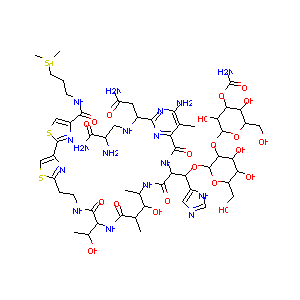
Bleomycin Mercaptopurine
Indication
Disease Entry Status REF
Large cell lung carcinoma Investigative [1]
Component Drugs Bleomycin   DMNER5S Mercaptopurine   DMTM2IK
Small molecular drug Small molecular drug
2D MOL 2D MOL
3D MOL 3D MOL
High-throughput Screening Result Testing Cell Line: NCI-H460
Zero Interaction Potency (ZIP) Score: 1.4
Bliss Independence Score: 2.13
Loewe Additivity Score: 0.9
LHighest Single Agent (HSA) Score: 2.98

Molecular Interaction Atlas of This Drug Combination

Molecular Interaction Atlas (MIA)
Indication(s) of Bleomycin
Disease Entry ICD 11 Status REF
Cervical cancer 2C77.0 Approved [2]
Head and neck cancer 2D42 Approved [2]
Hodgkin lymphoma 2B30 Approved [3]
Penile cancer N.A. Approved [2]
Testicular germ cell tumor N.A. Approved [2]
Classic Hodgkin lymphoma N.A. Investigative [2]
Follicular lymphoma 2A80 Investigative [2]
Bleomycin Interacts with 1 DTT Molecule(s)
DTT Name DTT ID UniProt ID Mode of Action REF
Human Deoxyribonucleic acid (hDNA) TTUTN1I NOUNIPROTAC Breaker [12]
------------------------------------------------------------------------------------
Bleomycin Interacts with 1 DME Molecule(s)
DME Name DME ID UniProt ID Mode of Action REF
Bleomycin hydrolase (BLMH) DECH1VP BLMH_HUMAN Metabolism [13]
------------------------------------------------------------------------------------
Bleomycin Interacts with 23 DOT Molecule(s)
DOT Name DOT ID UniProt ID Mode of Action REF
Superoxide dismutase , mitochondrial (SOD2) OTIWXGZ9 SODM_HUMAN Increases Expression [14]
Interstitial collagenase (MMP1) OTI4I2V1 MMP1_HUMAN Increases Expression [15]
Interleukin-8 (CXCL8) OTS7T5VH IL8_HUMAN Increases Expression [15]
Mucin-5AC (MUC5AC) OTJV8O04 MUC5A_HUMAN Increases Expression [15]
Transmembrane protein 250 (TMEM250) OTLJ4G5G TM250_HUMAN Increases Expression [8]
Serine/threonine-protein kinase Chk2 (CHEK2) OT8ZPCNS CHK2_HUMAN Increases Phosphorylation [16]
Transforming growth factor beta-1 proprotein (TGFB1) OTV5XHVH TGFB1_HUMAN Increases Expression [9]
Histone H2AX (H2AX) OT18UX57 H2AX_HUMAN Increases Expression [17]
Max-interacting protein 1 (MXI1) OTUQ9E0D MXI1_HUMAN Decreases Expression [8]
Actin, aortic smooth muscle (ACTA2) OTEDLG8E ACTA_HUMAN Increases Expression [9]
Unconventional myosin-Ie (MYO1E) OTM9YSIZ MYO1E_HUMAN Decreases Expression [8]
Serine-protein kinase ATM (ATM) OTQVOHLT ATM_HUMAN Increases Phosphorylation [16]
Structural maintenance of chromosomes protein 1A (SMC1A) OT9ZMRK9 SMC1A_HUMAN Increases Phosphorylation [16]
7SK snRNA methylphosphate capping enzyme (MEPCE) OTRBQEYP MEPCE_HUMAN Increases Expression [8]
Transmembrane protein 87A (TMEM87A) OT8ATDVX TM87A_HUMAN Increases Expression [8]
Lipase member H (LIPH) OTRGYLKL LIPH_HUMAN Decreases Expression [8]
Abasic site processing protein HMCES (HMCES) OTVRDL6U HMCES_HUMAN Decreases Expression [8]
Small integral membrane protein 14 (SMIM14) OT47IF19 SIM14_HUMAN Decreases Expression [8]
Kelch-like protein 42 (KLHL42) OTK6WARI KLH42_HUMAN Increases Expression [8]
Inactive cell surface hyaluronidase CEMIP2 (CEMIP2) OT9I1XUO CEIP2_HUMAN Decreases Expression [8]
ERBB receptor feedback inhibitor 1 (ERRFI1) OT7VZ2IZ ERRFI_HUMAN Decreases Expression [8]
Transmembrane and coiled-coil domain protein 3 (TMCC3) OTAIQ6V6 TMCC3_HUMAN Decreases Expression [8]
Baculoviral IAP repeat-containing protein 2 (BIRC2) OTFXFREP BIRC2_HUMAN Decreases Response To Substance [18]
------------------------------------------------------------------------------------
⏷ Show the Full List of 23 DOT(s)
Indication(s) of Mercaptopurine
Disease Entry ICD 11 Status REF
Acute lymphoblastic leukaemia 2A85 Approved [4]
Acute lymphocytic leukaemia 2B33.3 Approved [5]
Crohn disease DD70 Phase 4 [6]
Middle East Respiratory Syndrome (MERS) 1D64 Preclinical [7]
Severe acute respiratory syndrome (SARS) 1D65 Preclinical [7]
Mercaptopurine Interacts with 4 DTT Molecule(s)
DTT Name DTT ID UniProt ID Mode of Action REF
MERS-CoV papain-like proteinase (PL-PRO) TTYJOLE R1AB_CVEMC (854-2740) Inhibitor [7]
Inosine-5'-monophosphate dehydrogenase 1 (IMPDH1) TTL7C8Q IMDH1_HUMAN Inhibitor [21]
SARS-CoV papain-like proteinase (PL-PRO) TTRGHB2 R1AB_CVHSA (819-2740) Inhibitor [7]
Amidophosphoribosyltransferase (PPAT) TTZFTY4 PUR1_HUMAN Breaker [22]
------------------------------------------------------------------------------------
Mercaptopurine Interacts with 9 DTP Molecule(s)
DTP Name DTP ID UniProt ID Mode of Action REF
Breast cancer resistance protein (ABCG2) DTI7UX6 ABCG2_HUMAN Substrate [23]
Multidrug resistance-associated protein 4 (ABCC4) DTCSGPB MRP4_HUMAN Substrate [24]
Multidrug resistance-associated protein 5 (ABCC5) DTYVM24 MRP5_HUMAN Substrate [25]
Organic anion transporter 3 (SLC22A8) DTVP67E S22A8_HUMAN Substrate [26]
Concentrative nucleoside transporter 2 (SLC28A2) DT82KPY S28A2_HUMAN Substrate [27]
Concentrative Na(+)-nucleoside cotransporter 3 (SLC28A3) DT4YL5R S28A3_HUMAN Substrate [28]
Equilibrative nucleoside transporter 1 (SLC29A1) DTXD1TQ S29A1_HUMAN Substrate [27]
Equilibrative nucleoside transporter 2 (SLC29A2) DTW78DQ S29A2_HUMAN Substrate [27]
Equilibrative nucleobase transporter 1 (SLC43A3) DTGBPR5 S43A3_HUMAN Substrate [29]
------------------------------------------------------------------------------------
⏷ Show the Full List of 9 DTP(s)
Mercaptopurine Interacts with 3 DME Molecule(s)
DME Name DME ID UniProt ID Mode of Action REF
UDP-glucuronosyltransferase 1A1 (UGT1A1) DEYGVN4 UD11_HUMAN Metabolism [30]
Cytochrome P450 1A1 (CYP1A1) DE6OQ3W CP1A1_HUMAN Metabolism [30]
Thiopurine methyltransferase (TPMT) DEFQ8VO TPMT_HUMAN Metabolism [31]
------------------------------------------------------------------------------------
Mercaptopurine Interacts with 10 DOT Molecule(s)
DOT Name DOT ID UniProt ID Mode of Action REF
Nuclear receptor subfamily 4 group A member 3 (NR4A3) OTPBE9R1 NR4A3_HUMAN Increases ADR [32]
Superoxide dismutase , mitochondrial (SOD2) OTIWXGZ9 SODM_HUMAN Increases Expression [33]
Glutathione peroxidase 2 (GPX2) OTXI2NTI GPX2_HUMAN Increases Expression [33]
Glutathione peroxidase 3 (GPX3) OT6PK94R GPX3_HUMAN Increases Expression [33]
Transcription factor p65 (RELA) OTUJP9CN TF65_HUMAN Affects Localization [19]
Bcl-2-like protein 1 (BCL2L1) OTRC5K9O B2CL1_HUMAN Decreases Expression [19]
Molybdenum cofactor sulfurase (MOCOS) OT0TL3Q5 MOCOS_HUMAN Decreases Oxidation [34]
HLA class II histocompatibility antigen, DQ alpha 1 chain (HLA-DQA1) OTC6GISG DQA1_HUMAN Affects Response To Substance [35]
Major vault protein (MVP) OTJGHJRB MVP_HUMAN Decreases Response To Substance [36]
Nucleotide triphosphate diphosphatase NUDT15 (NUDT15) OTX8SZOT NUD15_HUMAN Increases Response To Substance [37]
------------------------------------------------------------------------------------
⏷ Show the Full List of 10 DOT(s)

Test Results of This Drug Combination in Other Disease Systems

Indication DrugCom ID Cell Line Status REF
Adult acute myeloid leukemia DCWYO7E HL-60(TB) Investigative [38]
High grade ovarian serous adenocarcinoma DCK8GEJ NCI\\/ADR-RES Investigative [1]
------------------------------------------------------------------------------------

References

1 CheMBL Affinity Phenotypic Cellular Interaction Assay ID: CHEMBL1125976
2 Bleomycin FDA Label
3 Natural products as sources of new drugs over the last 25 years. J Nat Prod. 2007 Mar;70(3):461-77.
4 URL: http://www.guidetopharmacology.org Nucleic Acids Res. 2015 Oct 12. pii: gkv1037. The IUPHAR/BPS Guide to PHARMACOLOGY in 2016: towards curated quantitative interactions between 1300 protein targets and 6000 ligands. (Ligand id: 7226).
5 Drugs@FDA. U.S. Food and Drug Administration. U.S. Department of Health & Human Services. 2015
6 ClinicalTrials.gov (NCT00846703) The GD-2008 ALL Protocol for Childhood Acute Lymphoblastic Leukemia. U.S. National Institutes of Health.
7 Thiopurine analogs and mycophenolic acid synergistically inhibit the papain-like protease of Middle East respiratory syndrome coronavirus. Antiviral Res. 2015 Mar;115:9-16.
8 Development and validation of the TGx-HDACi transcriptomic biomarker to detect histone deacetylase inhibitors in human TK6 cells. Arch Toxicol. 2021 May;95(5):1631-1645. doi: 10.1007/s00204-021-03014-2. Epub 2021 Mar 26.
9 Pulmonary fibrosis model using micro-CT analyzable human PSC-derived alveolar organoids containing alveolar macrophage-like cells. Cell Biol Toxicol. 2022 Aug;38(4):557-575. doi: 10.1007/s10565-022-09698-1. Epub 2022 Mar 10.
10 An antisense oligonucleotide targeted to human Ku86 messenger RNA sensitizes M059K malignant glioma cells to ionizing radiation, bleomycin, and etoposide but not DNA cross-linking agents. Cancer Res. 2002 Oct 15;62(20):5888-96.
11 XRCC1 deficiency sensitizes human lung epithelial cells to genotoxicity by crocidolite asbestos and Libby amphibole. Environ Health Perspect. 2010 Dec;118(12):1707-13. doi: 10.1289/ehp.1002312. Epub 2010 Aug 11.
12 Bleomycin and talisomycin sequence-specific strand scission of DNA: a mechanism of double-strand cleavage. Cancer Res. 1982 Jul;42(7):2779-85.
13 The C-terminus of human bleomycin hydrolase is required for protection against bleomycin-induced chromosomal damage. Mutat Res. 1998 Oct 12;421(1):1-7.
14 Age-dependent basal level and induction capacity of copper-zinc and manganese superoxide dismutase and other scavenging enzyme activities in leukocytes from young and elderly adults. Am J Pathol. 1993 Jul;143(1):312-20.
15 Agents associated with lung inflammation induce similar responses in NCI-H292 lung epithelial cells. Toxicol In Vitro. 2008 Oct;22(7):1782-8.
16 Direct activation of ATM by resveratrol under oxidizing conditions. PLoS One. 2014 Jun 16;9(6):e97969. doi: 10.1371/journal.pone.0097969. eCollection 2014.
17 Distinct mechanisms of cell-kill by triapine and its terminally dimethylated derivative Dp44mT due to a loss or gain of activity of their copper(II) complexes. Biochem Pharmacol. 2014 Oct 1;91(3):312-22. doi: 10.1016/j.bcp.2014.08.006. Epub 2014 Aug 15.
18 Expression and prognostic significance of IAP-family genes in human cancers and myeloid leukemias. Clin Cancer Res. 2000 May;6(5):1796-803.
19 CD28-dependent Rac1 activation is the molecular target of azathioprine in primary human CD4+ T lymphocytes. J Clin Invest. 2003 Apr;111(8):1133-45. doi: 10.1172/JCI16432.
20 Pharmacogenetics of outcome in children with acute lymphoblastic leukemia. Blood. 2005 Jun 15;105(12):4752-8. doi: 10.1182/blood-2004-11-4544. Epub 2005 Feb 15.
21 Clinical pharmacology and pharmacogenetics of thiopurines. Eur J Clin Pharmacol. 2008 Aug;64(8):753-67.
22 6-mercaptopurine (6-MP) induces p53-mediated apoptosis of neural progenitor cells in the developing fetal rodent brain. Neurotoxicol Teratol. 2009 Jul-Aug;31(4):198-202.
23 ABC transporters and their role in nucleoside and nucleotide drug resistance. Biochem Pharmacol. 2012 Apr 15;83(8):1073-83.
24 Polymorphisms in multidrug resistance-associated protein gene 4 is associated with outcome in childhood acute lymphoblastic leukemia. Blood. 2009 Aug 13;114(7):1383-6.
25 Overexpression of MRP4 (ABCC4) and MRP5 (ABCC5) confer resistance to the nucleoside analogs cytarabine and troxacitabine, but not gemcitabine. Springerplus. 2014 Dec 13;3:732.
26 Organic anion transporter 3 is involved in the brain-to-blood efflux transport of thiopurine nucleobase analogs. J Neurochem. 2004 Aug;90(4):931-41.
27 PharmGKB: A worldwide resource for pharmacogenomic information. Wiley Interdiscip Rev Syst Biol Med. 2018 Jul;10(4):e1417. (ID: PA2040)
28 Involvement of the concentrative nucleoside transporter 3 and equilibrative nucleoside transporter 2 in the resistance of T-lymphoblastic cell lines to thiopurines. Biochem Biophys Res Commun. 2006 Apr 28;343(1):208-15.
29 Characterization of 6-Mercaptopurine Transport by the SLC43A3-Encoded Nucleobase Transporter. Mol Pharmacol. 2019 Jun;95(6):584-596.
30 Pharmacogenomics in drug-metabolizing enzymes catalyzing anticancer drugs for personalized cancer chemotherapy. Curr Drug Metab. 2007 Aug;8(6):554-62.
31 The degree of myelosuppression during maintenance therapy of adolescents with B-lineage intermediate risk acute lymphoblastic leukemia predicts risk of relapse. Leukemia. 2010 Apr;24(4):715-20.
32 ADReCS-Target: target profiles for aiding drug safety research and application. Nucleic Acids Res. 2018 Jan 4;46(D1):D911-D917. doi: 10.1093/nar/gkx899.
33 Petit E, Langouet S, Akhdar H, Nicolas-Nicolaz C, Guillouzo A, Morel F. Differential toxic effects of azathioprine, 6-mercaptopurine and 6-thioguanine on human hepatocytes. Toxicol In Vitro. 2008;22(3):632-642. [PMID: 18222062]
34 Thiopurine-induced toxicity is associated with dysfunction variant of the human molybdenum cofactor sulfurase gene (xanthinuria type II). Toxicol Appl Pharmacol. 2018 Aug 15;353:102-108. doi: 10.1016/j.taap.2018.06.015. Epub 2018 Jun 20.
35 HLA-DQA1-HLA-DRB1 variants confer susceptibility to pancreatitis induced by thiopurine immunosuppressants. Nat Genet. 2014 Oct;46(10):1131-4. doi: 10.1038/ng.3093. Epub 2014 Sep 14.
36 Sensitization of ABCG2-overexpressing cells to conventional chemotherapeutic agent by sunitinib was associated with inhibiting the function of ABCG2. Cancer Lett. 2009 Jun 28;279(1):74-83. doi: 10.1016/j.canlet.2009.01.027. Epub 2009 Feb 18.
37 A common missense variant in NUDT15 confers susceptibility to thiopurine-induced leukopenia. Nat Genet. 2014 Sep;46(9):1017-20. doi: 10.1038/ng.3060. Epub 2014 Aug 10.
38 CheMBL Affinity Phenotypic Cellular Interaction Assay ID: CHEMBL1125966