General Information of Drug Combination (ID: DCX0KT7)

Drug Combination Name
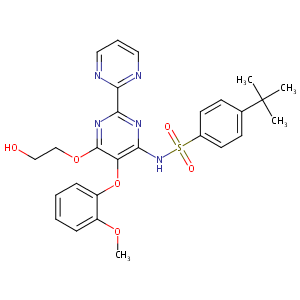
Bosentan Pazopanib
Indication
Disease Entry Status REF
Chronic myelogenous leukemia Investigative [1]
Component Drugs Bosentan   DMIOGBU Pazopanib   DMF57DM
Small molecular drug N.A.
2D MOL 2D MOL
3D MOL 3D MOL
High-throughput Screening Result Testing Cell Line: KBM-7
Zero Interaction Potency (ZIP) Score: 12.34
Bliss Independence Score: 12.34
Loewe Additivity Score: 26.77
LHighest Single Agent (HSA) Score: 26.77

Molecular Interaction Atlas of This Drug Combination

Molecular Interaction Atlas (MIA)
Indication(s) of Bosentan
Disease Entry ICD 11 Status REF
Pulmonary arterial hypertension BB01.0 Approved [2]
Pulmonary hypertension BB01 Approved [3]
Scleroderma 4A42 Investigative [3]
Bosentan Interacts with 2 DTT Molecule(s)
DTT Name DTT ID UniProt ID Mode of Action REF
Endothelin A receptor (EDNRA) TTKRD0G EDNRA_HUMAN Modulator [5]
Endothelin B receptor (EDNRB) TT3ZTGU EDNRB_HUMAN Modulator [5]
------------------------------------------------------------------------------------
Bosentan Interacts with 3 DTP Molecule(s)
DTP Name DTP ID UniProt ID Mode of Action REF
Organic anion transporting polypeptide 1B1 (SLCO1B1) DT3D8F0 SO1B1_HUMAN Substrate [6]
Organic anion transporting polypeptide 1B3 (SLCO1B3) DT9C1TS SO1B3_HUMAN Substrate [6]
Organic anion transporting polypeptide 2B1 (SLCO2B1) DTPFTEQ SO2B1_HUMAN Substrate [6]
------------------------------------------------------------------------------------
Bosentan Interacts with 2 DME Molecule(s)
DME Name DME ID UniProt ID Mode of Action REF
Cytochrome P450 3A4 (CYP3A4) DE4LYSA CP3A4_HUMAN Metabolism [7]
Cytochrome P450 2C9 (CYP2C9) DE5IED8 CP2C9_HUMAN Metabolism [8]
------------------------------------------------------------------------------------
Bosentan Interacts with 40 DOT Molecule(s)
DOT Name DOT ID UniProt ID Mode of Action REF
Solute carrier organic anion transporter family member 1B1 (SLCO1B1) OTNEN8QK SO1B1_HUMAN Decreases Expression [4]
Bile salt export pump (ABCB11) OTRU7THO ABCBB_HUMAN Decreases Expression [4]
Serine/threonine-protein kinase DCLK1 (DCLK1) OTVSPS98 DCLK1_HUMAN Affects Expression [4]
Kynurenine 3-monooxygenase (KMO) OT3MRMM9 KMO_HUMAN Affects Expression [4]
Carbonic anhydrase 12 (CA12) OT6WNFU8 CAH12_HUMAN Affects Expression [4]
All-trans-retinol dehydrogenase ADH1B (ADH1B) OTV3TB81 ADH1B_HUMAN Decreases Expression [4]
Alcohol dehydrogenase 1C (ADH1C) OTO1DV7F ADH1G_HUMAN Decreases Expression [4]
Complement component C9 (C9) OT7I5FDX CO9_HUMAN Affects Expression [4]
Superoxide dismutase , mitochondrial (SOD2) OTIWXGZ9 SODM_HUMAN Increases Expression [4]
Fructose-bisphosphate aldolase B (ALDOB) OT7FR69A ALDOB_HUMAN Decreases Expression [4]
Amino acid transporter heavy chain SLC3A2 (SLC3A2) OTBR33M9 4F2_HUMAN Increases Expression [4]
All-trans-retinol dehydrogenase ADH4 (ADH4) OTKDKKNG ADH4_HUMAN Decreases Expression [4]
Glutathione S-transferase theta-2 (GSTT2) OTANW3TJ GST2_HUMAN Decreases Expression [4]
Interleukin-8 (CXCL8) OTS7T5VH IL8_HUMAN Increases Expression [4]
3 beta-hydroxysteroid dehydrogenase/Delta 5-->4-isomerase type 1 (HSD3B1) OTNAZVKB 3BHS1_HUMAN Affects Expression [4]
Tyrosine aminotransferase (TAT) OT2CJ91O ATTY_HUMAN Affects Expression [4]
Phosphatidylcholine translocator ABCB4 (ABCB4) OTE6PY83 MDR3_HUMAN Decreases Expression [4]
Macrophage mannose receptor 1 (MRC1) OTTVCOPT MRC1_HUMAN Affects Expression [4]
G0/G1 switch protein 2 (G0S2) OT8FL49L G0S2_HUMAN Affects Expression [4]
Carbamoyl-phosphate synthase , mitochondrial (CPS1) OTXV8NSR CPSM_HUMAN Decreases Expression [4]
Glucose-6-phosphatase catalytic subunit 1 (G6PC1) OTJ6FM9F G6PC1_HUMAN Affects Expression [4]
Achaete-scute homolog 1 (ASCL1) OTI4X44G ASCL1_HUMAN Affects Expression [4]
Microsomal triglyceride transfer protein large subunit (MTTP) OTNUVSDT MTP_HUMAN Decreases Expression [4]
Inhibin beta E chain (INHBE) OTOI2NYG INHBE_HUMAN Affects Expression [4]
Metallothionein-1X (MT1X) OT9AKFVS MT1X_HUMAN Increases Expression [4]
Complement factor H-related protein 3 (CFHR3) OTYL8SDO FHR3_HUMAN Affects Expression [4]
Nuclear factor 1 X-type (NFIX) OT1DPZAE NFIX_HUMAN Decreases Expression [4]
Phosphoenolpyruvate carboxykinase , mitochondrial (PCK2) OTJ8LX4N PCKGM_HUMAN Decreases Expression [4]
Organic solute transporter subunit alpha (SLC51A) OTDJRZ0P OSTA_HUMAN Increases Expression [4]
Organic solute transporter subunit beta (SLC51B) OT4WYPSR OSTB_HUMAN Increases Expression [4]
Liver-expressed antimicrobial peptide 2 (LEAP2) OTUOPIS5 LEAP2_HUMAN Affects Expression [4]
N-acetylmuramoyl-L-alanine amidase (PGLYRP2) OTF8319A PGRP2_HUMAN Affects Expression [4]
Bile acid receptor (NR1H4) OTWZLPTB NR1H4_HUMAN Decreases Expression [4]
Normal mucosa of esophagus-specific gene 1 protein (C15ORF48) OT85J32K NMES1_HUMAN Affects Expression [4]
ATP-binding cassette sub-family G member 5 (ABCG5) OT1OMY93 ABCG5_HUMAN Affects Expression [4]
Peroxisome proliferator-activated receptor gamma coactivator 1-alpha (PPARGC1A) OTHCDQ22 PRGC1_HUMAN Decreases Expression [4]
Solute carrier family 22 member 7 (SLC22A7) OTKTNH1W S22A7_HUMAN Affects Expression [4]
ATP-binding cassette sub-family C member 3 (ABCC3) OTC3IJV4 MRP3_HUMAN Decreases Expression [9]
ATP-dependent translocase ABCB1 (ABCB1) OTEJROBO MDR1_HUMAN Decreases Expression [9]
Coxsackievirus and adenovirus receptor (CXADR) OT9ZP02A CXAR_HUMAN Decreases Expression [10]
------------------------------------------------------------------------------------
⏷ Show the Full List of 40 DOT(s)
Pazopanib Interacts with 4 DME Molecule(s)
DME Name DME ID UniProt ID Mode of Action REF
Cytochrome P450 3A4 (CYP3A4) DE4LYSA CP3A4_HUMAN Metabolism [12]
Cytochrome P450 1A2 (CYP1A2) DEJGDUW CP1A2_HUMAN Metabolism [12]
Cytochrome P450 2D6 (CYP2D6) DECB0K3 CP2D6_HUMAN Metabolism [13]
Cytochrome P450 2C8 (CYP2C8) DES5XRU CP2C8_HUMAN Metabolism [12]
------------------------------------------------------------------------------------
Pazopanib Interacts with 6 DOT Molecule(s)
DOT Name DOT ID UniProt ID Mode of Action REF
Bile salt export pump (ABCB11) OTRU7THO ABCBB_HUMAN Decreases Activity [14]
Phosphatidylcholine translocator ABCB4 (ABCB4) OTE6PY83 MDR3_HUMAN Decreases Activity [15]
Myeloblastin (PRTN3) OT72MHP7 PRTN3_HUMAN Increases Expression [16]
Mitogen-activated protein kinase 3 (MAPK3) OTCYKGKO MK03_HUMAN Decreases Phosphorylation [17]
Mitogen-activated protein kinase 1 (MAPK1) OTH85PI5 MK01_HUMAN Decreases Phosphorylation [17]
HLA class I histocompatibility antigen protein P5 (HCP5) OTV0YRI8 HCP5_HUMAN Increases ADR [18]
------------------------------------------------------------------------------------
⏷ Show the Full List of 6 DOT(s)

References

1 CheMBL Affinity Phenotypic Cellular Interaction Assay ID: CHEMBL1125966
2 URL: http://www.guidetopharmacology.org Nucleic Acids Res. 2015 Oct 12. pii: gkv1037. The IUPHAR/BPS Guide to PHARMACOLOGY in 2016: towards curated quantitative interactions between 1300 protein targets and 6000 ligands. (Ligand id: 3494).
3 Bosentan FDA Label
4 Omics-based responses induced by bosentan in human hepatoma HepaRG cell cultures. Arch Toxicol. 2018 Jun;92(6):1939-1952.
5 Drugs@FDA. U.S. Food and Drug Administration. U.S. Department of Health & Human Services.
6 Bosentan is a substrate of human OATP1B1 and OATP1B3: inhibition of hepatic uptake as the common mechanism of its interactions with cyclosporin A, rifampicin, and sildenafil. Drug Metab Dispos. 2007 Aug;35(8):1400-7.
7 Bosentan is a substrate of human OATP1B1 and OATP1B3: inhibition of hepatic uptake as the common mechanism of its interactions with cyclosporin A, rifampicin, and sildenafil. Drug Metab Dispos. 2007 Aug;35(8):1400-7.
8 Investigation of the mutual pharmacokinetic interactions between bosentan, a dual endothelin receptor antagonist, and simvastatin. Clin Pharmacokinet. 2003;42(3):293-301.
9 From the Cover: MechanisticInsights in Cytotoxic and Cholestatic Potential of the Endothelial Receptor Antagonists Using HepaRG Cells. Toxicol Sci. 2017 Jun 1;157(2):451-464. doi: 10.1093/toxsci/kfx062.
10 Antiviral effect of Bosentan and Valsartan during coxsackievirus B3 infection of human endothelial cells. J Gen Virol. 2010 Aug;91(Pt 8):1959-1970. doi: 10.1099/vir.0.020065-0. Epub 2010 Apr 14.
11 Pazopanib-induced hyperbilirubinemia is associated with Gilbert's syndrome UGT1A1 polymorphism. Br J Cancer. 2010 Apr 27;102(9):1371-7. doi: 10.1038/sj.bjc.6605653. Epub 2010 Apr 13.
12 Pazopanib, a new therapy for metastatic soft tissue sarcoma. Expert Opin Pharmacother. 2013 May;14(7):929-35.
13 Pazopanib: the newest tyrosine kinase inhibitor for the treatment of advanced or metastatic renal cell carcinoma. Drugs. 2011 Mar 5;71(4):443-54.
14 Interference with bile salt export pump function is a susceptibility factor for human liver injury in drug development. Toxicol Sci. 2010 Dec; 118(2):485-500.
15 Evaluating the Role of Multidrug Resistance Protein 3 (MDR3) Inhibition in Predicting Drug-Induced Liver Injury Using 125 Pharmaceuticals. Chem Res Toxicol. 2017 May 15;30(5):1219-1229. doi: 10.1021/acs.chemrestox.7b00048. Epub 2017 May 4.
16 Activation of inflammasomes by tyrosine kinase inhibitors of vascular endothelial growth factor receptor: Implications for VEGFR TKIs-induced immune related adverse events. Toxicol In Vitro. 2021 Mar;71:105063. doi: 10.1016/j.tiv.2020.105063. Epub 2020 Dec 1.
17 MEK inhibition abrogates sunitinib resistance in a renal cell carcinoma patient-derived xenograft model. Br J Cancer. 2016 Oct 11;115(8):920-928. doi: 10.1038/bjc.2016.263. Epub 2016 Aug 25.
18 HLA-B*57:01 Confers Susceptibility to Pazopanib-Associated Liver Injury in Patients with Cancer. Clin Cancer Res. 2016 Mar 15;22(6):1371-7. doi: 10.1158/1078-0432.CCR-15-2044. Epub 2015 Nov 6.